
Clinician Grief After Client Death
At some point in my second year of working with adolescents, I started following the local news. Not because I was told to. Not because it was in any protocol or supervision checklist. Because I learned — quickly — that if something happened to one of my clients, I was going to find out from a news app before I found out from anyone at work.
Every week or two, I’d scan the headlines. An arrest. A missing person report. Sometimes something worse. It became routine in the way that a lot of things in this field become routine — not because they should be, but because you adapt or you fall apart.
I was working with a 16-year-old at an alternative school. Funny kid. Likeable. He was on my caseload because he’d been caught high at school more than once, and we were working on it — motivational interviewing, building his change talk, trying to help him find a reason that was bigger than the next party. He was the kind of kid you root for.
One Friday — I think I saw him that afternoon, or maybe it was the day before — he went to a party. He got drunk. At some point he wandered off alone, and he drowned in a small body of water. He was 16 years old.
I found out before anyone told me. I’d already seen it in the news.
📚 This is Blog #25 in the New Clinician Survival Kit Series (Click to explore the series)
Weekly honest support for the struggles every clinician faces: “I hate group therapy.” “I can’t do this.” “My client hates me.” “I’m making it worse.” “I can’t say no.” “They’re going to report me.” “I’m too tired to care.” “What do I even say?” “I don’t know enough.” “They keep relapsing.” “Am I documenting wrong?” “My supervisor doesn’t get it.” “I can’t handle this caseload.” “Nobody told me about the paperwork.” “I don’t like my client.” “My client’s cute.” “My client likes me.” “I got a complaint.” “I want to quit.” “My coworker is terrible.” “The most underrated job in mental health.” “My client scares me.” “Fear of losing a client.” “Fear of what they show you.” “My client died.”
These aren’t signs you’re failing. They’re signs you’re human.
How It Happens
When I came in that following week and was told what happened, I already knew. I had already sat with it over the weekend. I had already seen the coverage — and there was a lot of it. He didn’t have much of a criminal background, so the media treated him the way the media treats kids who look like they didn’t deserve it. Favorable. Sympathetic. Comments from strangers who had never met him, never sat across from him, never watched him laugh at something stupid and then immediately try to play it cool.
The Wake
I went to his wake.
I want to be honest about what that was like, because I think clinicians who have done this know exactly what I mean. It was crowded. He was well-loved, which was the right thing, and there were people everywhere. I stayed in the background. I didn’t introduce myself to the family. I didn’t get close to the casket. I just paid my respects, quietly, from a distance, and left.
There’s a gray area that nobody prepares you for. When a client dies, you don’t automatically have a role. I hadn’t had consent to communicate with his family while he was alive — he had a substance use disorder and he was old enough to hold that right. And now he was gone, and I was standing in a funeral home full of people who loved him, and I was essentially a stranger to all of them. I was someone who had known something real about him that almost no one in that room knew. And I had nowhere to put that.
If you’ve worked with high-risk clients and felt that specific dread — the one that lives in your chest every time a client walks out the door and you’re not sure what they’re walking into — you already know what I’m talking about. I wrote about that fear in depth in My Client Scares Me, because that fear and this grief are related. One is the before. This is the after.
I just drove home.
What The System Gives You
When you lose an active client, there is a process. I want to be clear about that — there is a process, and it exists for a reason, and it is not nothing.
My supervisor walked me through it. I filed an incident report. I documented what needed to be documented. She was present, she was professional, and in that moment the system did what systems do — it gave me a procedure to follow, which honestly was something to hold onto when everything else felt unsteady.
And then it was over.
No one above my supervisor ever reached out to me. No one acknowledged the report. No follow-up, no check-in, no “how are you doing with this.” The incident report went wherever incident reports go, and the next week looked a lot like the week before, except that one of my clients was dead.
I remember trying to find someone to talk to about it. I asked a couple of colleagues if they had ever lost a client on their active caseload. I got uncertain glances. A few quiet no’s. Nobody had. And I understood — if you’re working in a setting where your population isn’t carrying the level of risk that substance use brings, you may go your entire career without this happening. I’m genuinely glad for that. I don’t wish this on anyone.
But what that meant for me, in that moment, was that I was largely alone with it. The system had processed the paperwork. My colleagues hadn’t been there. My supervisor had a mental health background — her clients didn’t die at the same rate mine did, and she knew that, and I knew that. I talked to my closest colleague, who had lost clients after they left her caseload — to incarceration, to relapse, to the slow fade of losing track — and she understood the grief even if the circumstances were different. That conversation helped.

But the institution? It had moved on. The report was filed. Case closed.
The First Time
Before that teenager, there was another one.
I was still completing his intake paperwork when he died. He had never been formally opened on my caseload — no case number, no treatment plan, nothing signed. Which meant there was no incident report to file. No protocol to follow. No supervisor to loop in.
So I didn’t tell anyone. What would I have said? This happens. This is the population. I didn’t even have the language for what I was feeling because the system didn’t have a category for it.
What I had instead was an existential crisis, quiet and private, that forced me to sit with something I hadn’t fully faced yet: no matter how good I am at this job, I am one hour a week in someone’s life. One day a week. And sometimes that is not enough, and there is nothing I can do about that, and people are going to die anyway.
Professor’s Advice
I was in grad school at the time — already working as a drug counselor for several years, pursuing my license — and I wrote about it in a self-reflection paper. The death had happened a year or two before I wrote it. That’s important context, because I wasn’t writing about something fresh. I was writing about something I had been carrying quietly for years, blaming myself in ways I hadn’t fully named, cycling through grief that never quite resolved. My professor caught it. Their response was something along the lines of a warning: if you keep being this hard on yourself when this happens, you will burn out fast.
They weren’t wrong. And I remember thinking — yeah, probably. But this isn’t something I’m going to actively fix. This is something that’s going to fade as I keep working. As I get more experience. As I get tougher.
It’s normal to grieve. It’s normal to go through the stages — denial, anger, bargaining, all of it. What isn’t talked about enough is how long that process can stretch when you have no real outlet for it, when the loss isn’t legitimized by the people around you, when you’re doing this work alone. For me it was years before I started to genuinely relieve myself of the self-blame. Years of wondering what I missed, what I could have said, what one different moment might have changed.
This kind of loss — losing clients you’ve worked with, watched struggle, watched make progress — doesn’t only happen through death. I’ve written about the cumulative grief that builds when clients cycle in and out of your life, relapse, disappear, or come back changed. If that resonates, They Keep Relapsing gets into that specific kind of grief in more depth. But death is its own category. And the self-blame that comes with it is its own beast.
And I wasn’t entirely wrong that it would fade. It did.
That’s the part I wish someone had warned me about.
Getting Tougher vs. Getting Gone
Because there’s a version of getting tougher that is actually healthy — building resilience, finding perspective, learning to hold grief without being consumed by it. And then there’s another version that looks almost identical from the outside, where you’re not getting tougher so much as you’re getting more removed. More dissociated. Where each loss lands a little quieter not because you’ve healed but because something has gradually turned down the volume.
By the time that teenager drowned, I had already been through it once. I was already, without fully realizing it, a little further away from my own feelings than I had been at the start. The system didn’t cause that. Nobody caused that. It was just what happened when the grief kept coming and there was nowhere to put it.
The Rumination
The grief doesn’t come alone. It brings a companion, and that companion is every session you’ve ever had with that person, playing back on a loop.
I went back through everything. Did I cover this? Did I say the right things? We had talked about substances and risk — I was sure of that. But had I specifically talked about the dangers of being drunk in the cold, wandering around alone, without anyone watching out for you? Had I said that out loud in a way that landed?
I was pretty sure I had. But pretty sure isn’t the same as certain, and grief has a way of making you audit yourself at a level that is neither fair nor useful.
Here’s what I had to keep coming back to: he was 16. He knew the risks the way most 16-year-olds know risks — intellectually, distantly, in a way that doesn’t quite connect to a Friday night at a party with his friends. That is not a clinical failure. That is adolescence. That is the part of this work where you do everything right and the outcome is still wrong, because you are one hour a week in a life that has twenty-three other hours in every single day.
There was no one to blame. That was the hardest thing to accept, because blame at least gives you somewhere to put the feeling.
The moment that cracked something open for me was when I started thinking about reaching out to his family. He was gone — consent wasn’t an issue anymore. I thought maybe I should say something. Maybe they deserved to know who he was in our sessions, what he was working on, that someone had been in his corner.
My supervisor stopped me. She asked, simply: what would that be for? How would that benefit them?
And I sat with that question and I recognized what I was actually looking for. Absolution. Not for anything I had done wrong — there was nothing to absolve — but for the helpless, awful feeling of having been close to someone and not being able to stop what happened. I wanted someone to tell me it wasn’t my fault. I was looking for that from a grieving family who had no idea I existed and were in the middle of the worst days of their lives.
I didn’t reach out. That was the right call. But I needed someone to help me see it clearly, because grief doesn’t make you think clearly. It makes you reach for whatever might make the feeling stop.
As one clinical psychologist who has worked with grief for nearly 40 years notes, the self-questioning spiral after a client’s death — the perceived responsibility, the “did I miss something” — is one of the most common and most painful experiences clinicians carry. It doesn’t mean you failed. It means you were paying attention.
The Grief That Doesn’t Count
I tried to talk about it. I really did. But there’s something about bringing up a client’s death in a staff room or a hallway that makes the air change. It’s a heavy topic. A dreary one. People don’t know what to say, and when people don’t know what to say they get quiet and uncomfortable and suddenly very interested in whatever is on their desk.
So after a while, I stopped bringing it up.
And I think that’s where the real damage happens — not in the loss itself, but in the message you absorb when the world around you doesn’t have space for it. The message that says this grief isn’t quite legitimate. That clients aren’t the same as people you knew outside of work. That the relationship existed inside a fifty-minute hour and maybe that’s all it was.
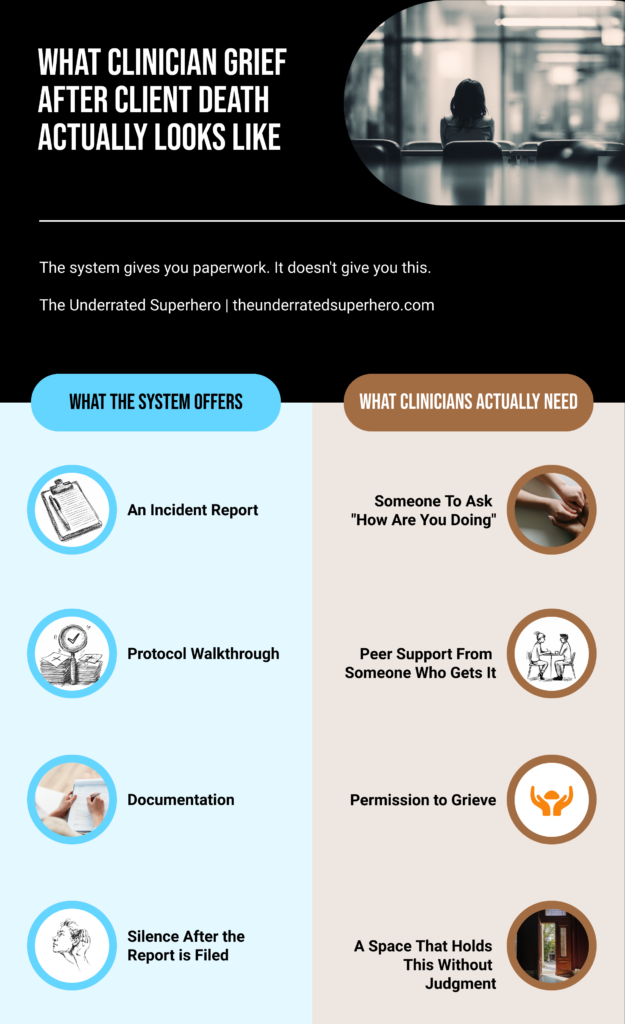
There’s a name for this. It’s called disenfranchised grief — a term coined by Dr. Kenneth Doka in 1989 to describe grief that isn’t publicly acknowledged or socially validated. The griever isn’t recognized as a griever. The loss isn’t seen as worthy of mourning. And so the grief goes underground, unspoken, and often turns inward. For clinicians who lose clients, this is almost always what happens. We grieve in private because there is no ceremony, no bereavement leave, no ritual that says: this person mattered to you, and you are allowed to show it.
A recent peer-reviewed study published in Death Studies looked specifically at therapists who lost clients suddenly during active treatment. The finding that stuck with me: therapists often become the sole “keeper of knowledge” of their client’s inner world. The intimacy of the therapeutic relationship is real — and because of confidentiality, that intimacy has nowhere to go after the client dies. The grief becomes concealed. Silenced by the same ethical obligations that made the relationship meaningful in the first place.
I want to push back on that directly.
Think about what this work actually looks like. You are seeing someone weekly, sometimes twice a week. You are sitting with them through the ugliest, most shameful, most frightening parts of their life. You are watching them grow. You are tracking their setbacks and their progress and the small moments that nobody else notices — the session where something finally clicked, the week they came in and something in their face was different. You are genuinely invested in whether they make it.
That is not a casual relationship. That does not disappear because it happened in a clinical context.
And then there’s this — something I don’t hear talked about enough. Sometimes you find out from another client.
Sometimes You Find Out From Another Client
They come in and they tell you. Maybe they knew him. Maybe they ran in the same circles. Maybe they’re processing their own grief about it and they need to talk it through with you. And you have to sit there and hold your face. You cannot make the shocked face, the devastated face, the face that says I knew him too and this is hitting me harder than you realize. You cannot name what you’re feeling because it’s their session, not yours. Your grief is not relevant in that room. So you stay present, you track their experience, you do your job — and you carry yours home alone at the end of the day.
And then you go home.
And someone asks how your day was.
What do you say to that? You can’t talk about your clients — confidentiality doesn’t stop at the door just because someone died. So you either put on a face and say fine, it was fine, or you say nothing and hope they don’t notice. Sometimes they notice anyway. They can tell something is wrong and they want to help and you can’t let them because you can’t explain it. So you’re sitting at the dinner table carrying something heavy and completely alone with it, surrounded by people who love you.
That’s the full picture of what this isolation actually looks like.
Almost A Dozen

I have lost almost a dozen clients at this point. All male, as far as I know. Overdose. Drowning. Gang violence. I have been to several wakes now and the experience is always some version of the same thing — me, in the back of the room, unknown to most of the people there. Not introducing myself. Not explaining who I am or what I meant to him or what he was working toward when I last saw him. Just standing there, paying my respects, and leaving quietly.
And then I open my news app the following week, and the week after that, because that’s the job now. Scanning for names. Feeling my stomach drop when I see one I recognize. Reading the comments from strangers who didn’t know him — who are making assumptions, projecting, reducing him to whatever narrative fits the story — and sitting alone with the knowledge of who he actually was.
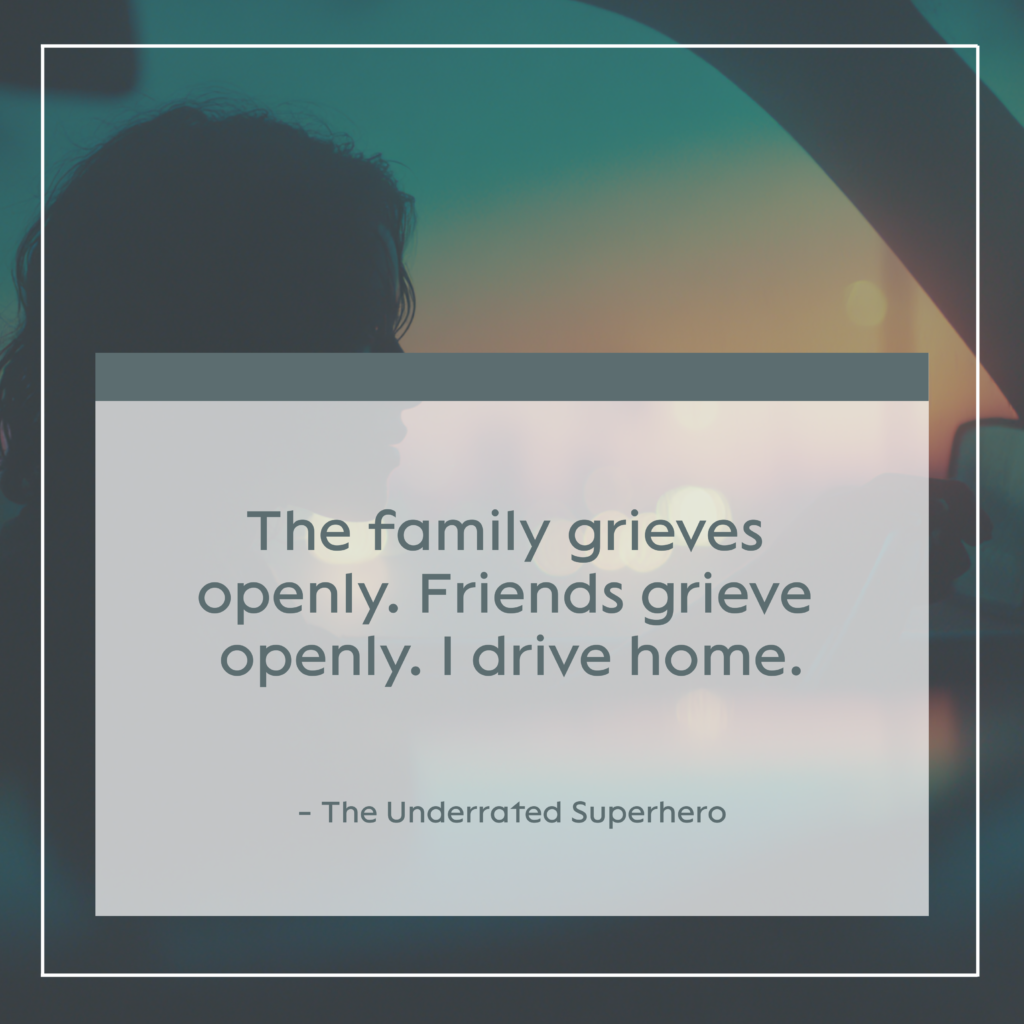
That grief is real. It counts. And the fact that our field doesn’t have a great structure for holding it doesn’t mean you’re wrong to feel it.
What I Want You To Know
Before I left that job, after losing several clients within the same twelve month period, I started looking for something. A space. A community. Somewhere that understood what it means to do this work with this population and carry these losses without a real place to put them. I looked around and I couldn’t find it. Not something that felt like it was actually for us — addiction counselors, people working with high risk populations, people who check the local news because they have to.
So I built it. That’s part of why this community exists.
After I left that job, I kept checking the news.
I told myself it was habit. And it was, partly. But it was also something else — a way of still being connected to kids I had moved on from, kids I could no longer reach. The person who took my place would do the job their own way, and that’s okay, that’s how it should be. But to me they felt alone now in a way they hadn’t before. And checking the news was the only thread I had left.
Eventually I had to stop. Not because it got easier but because it was making things worse. I wasn’t their counselor anymore. I couldn’t do anything with what I found. All checking the news gave me was helplessness, and I already had plenty of that. Letting go of that ritual was its own kind of grief — closing a door I hadn’t fully admitted was still open.
I’m telling you all of this not to make this about me but because I want you to understand that the absence of that space is real and it has consequences. When clinicians have nowhere to process this, they dissociate. They get quieter about it. They absorb loss after loss and call it experience and keep moving because what else is there to do. And some of them burn out, and some of them leave the field, and some of them stay but they’re not really all there anymore — not the way they were at the beginning, before the losses started accumulating.
You deserve better than that. Your clients deserve a version of you that has somewhere to put this.
What I’d Tell You Now
So here is what I want you to know, as directly as I can say it:
You are allowed to grieve them. Not in the margins. Not quietly, by yourself, after everyone else has moved on. Fully, legitimately, as someone who lost a person they cared about and worked hard for and will not stop thinking about for a long time.
The relationship was real. The loss is real.
If you haven’t lost anyone yet — you may. And here’s the thing: you might already know that. If you’re working in addiction, with high risk populations, a good training program probably told you this was possible. Mine did. I went into this work with my eyes open about the reality of the population I was choosing.
It doesn’t matter. Knowing it’s coming and being prepared for it are not the same thing. You can understand intellectually that this is part of the work and still be completely undone when it actually happens. Don’t let anyone — including yourself — use your prior knowledge as a reason to minimize what you’re feeling. You knew the risks is not the same as you should have been ready.
Follow your local news. I know that sounds grim. Do it anyway. Finding out from a headline is hard. Finding out from a headline after everyone at work already knew is harder.
Let your supervisor walk you through protocol, and then ask for more than protocol. The incident report is not the same as support. If your supervisor can’t provide that, find a colleague who gets it, or a therapist of your own, or a peer who works in a similarly high risk setting and understands what this population carries. As one therapist and clinical psychologist puts it, your influence only goes as far as the time you offer in session — there are too many variables outside that room that you cannot control, and you were never meant to carry all of them.
Watch the rumination. Go back through your sessions once, maybe twice, and then make yourself stop. You will not find the thing you’re looking for because in most cases there is no thing. There is a person who made a choice, or a disease that progressed, or a moment of bad luck on a Friday night. You were one hour a week. You were not the whole story.
And watch what happens to you over time. Not just after the first loss but after the third and the fifth and the eighth. Notice if you’re building resilience or if you’re building distance. They can look identical from the outside. They are not the same thing. One of them will keep you in this work with your whole self intact. The other one will hollow you out slowly and you won’t notice until you’re already gone.
You got into this work because you wanted to help people. Some of those people are not going to make it. That truth lives alongside everything else that makes this work meaningful — it doesn’t cancel it out, it doesn’t mean you’re in the wrong field, and it doesn’t mean the ones you lost didn’t matter.
They mattered. You knew them in a way almost no one else did. That counts for something, even when the system acts like it doesn’t
This blog asks a lot of you. Before you move on, take a moment with what it brought up.
The Underrated Superhero | theunderratedsuperhero.com
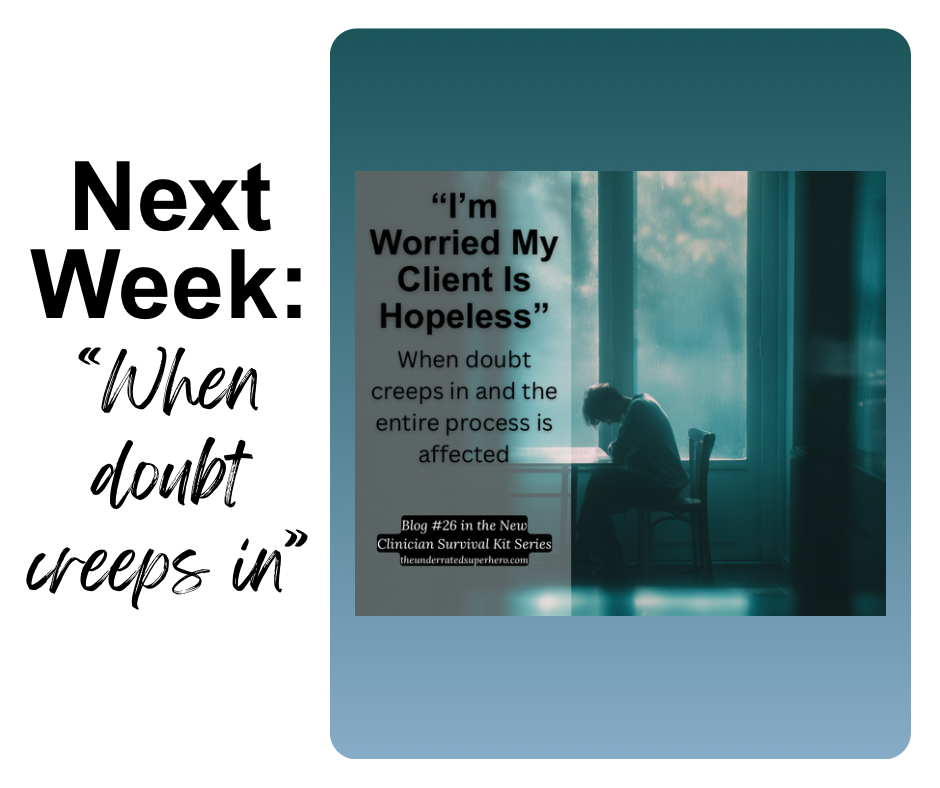
Next in the Series: "I'm Worried My Client Is Hopeless" Some clients come in week after week and nothing seems to shift. The same patterns. The same excuses. The same starting line. And at some point a thought creeps in that you're not supposed to have — what if this person just isn't going to get better? Next month we're going there. The guilt of losing hope for a client, what it actually means clinically, and how to keep showing up when you're not sure it matters anymore.
This is Blog #25 in the New Clinician Survival Kit Series by The Underrated Superhero. If this hit close to home, you're not alone. Follow along for more real talk about surviving your first years in clinical work.
Until Next Week | The Underrated Superhero
© 2026 The Underrated Superhero LLC. All Rights Reserved.
📖 External Resources & Research
- 🔗 Sole Keepers of Their Secrets: Disenfranchised Grief Among Therapists After Client Death — Death Studies — Peer-reviewed research on how therapists develop continuing bonds with deceased clients that remain hidden due to confidentiality and lack of social recognition for their grief
- 🔗 Disenfranchised Grief — Wikipedia — Overview of Dr. Kenneth Doka's foundational concept describing grief that isn't publicly acknowledged or socially validated, and why it goes underground
- 🔗 Lessons Learned: Forty Years of Clinical Work With Suicide Loss Survivors — Frontiers in Psychology — Clinical reflection on the self-questioning spiral clinicians experience after client death, including perceived responsibility and the limits of what one clinician can control
- 🔗 Managing Grief for Therapists, When a Client Dies — LinkedIn — A clinical psychologist's reflection on the disenfranchised grief that arises when a client dies, and the importance of treating yourself as a human first
📌 From This Series
- 🔗 Blog #22: "My Client Scares Me, Part 1" — The body fear, the shame, the fears you're not supposed to admit
- 🔗 Blog #23: "My Client Scares Me, Part 2" — The high stakes client and the fear of getting it wrong
- 🔗 Blog #24: "My Client Scares Me, Part 3" — When the clinical fear takes over and you're not sure you're enough for this client
- 🔗 Blog #[X]: "They Keep Relapsing" — The cumulative grief of losing clients to the cycle — not to death, but to the disease
