
Fear of Losing a Client
There’s a name on your schedule that changes the weight of your whole day.
Not because you’re afraid of them in the way we talked about in Part 1 — not the body fear, not the physical scan-the-room kind. This is something slower. Something that starts the night before and doesn’t lift until the session is over. Sometimes not even then.
This is the fear that comes with a client when the stakes are real. Where you understand, maybe more clearly than they do, exactly what’s on the line.
The client presenting with persistent suicidal ideation. The one with IV use and a drug supply you can’t trust. The justice involved client whose documentation directly affects whether they go home to their kids. The one who’s been to treatment six times, and this might be the last shot before something permanent happens.
Nobody really prepares you for what it feels like to sit across from someone you’re genuinely afraid of losing.
📚 This is Blog #23 in the New Clinician Survival Kit Series (Click to explore the series)
Weekly honest support for the struggles every clinician faces: “I hate group therapy.” “I can’t do this.” “My client hates me.” “I’m making it worse.” “I can’t say no.” “They’re going to report me.” “I’m too tired to care.” “What do I even say?” “I don’t know enough.” “They keep relapsing.” “Am I documenting wrong?” “My supervisor doesn’t get it.” “I can’t handle this caseload.” “Nobody told me about the paperwork.” “I don’t like my client.” “My client’s cute.” “My client likes me.” “I got a complaint.” “I want to quit.” “My coworker is terrible.” “The most underrated job in mental health.” “My client scares me.” “Fear of losing a client.”
These aren’t signs you’re failing. They’re signs you’re human.
The Client You’re Afraid to Lose

I had a client I’d been working with since he was 17. Funny, genuinely smart, likeable in a way that made you root for him immediately. Chronically in trouble. Rarely in class. The school had run out of patience long before I met him.
I knew early on his situation was serious. Not in a vague clinical way — but specific. This-could-go-very-wrong specific. He was abusing substances. The substances were dangerous. He’d already been diagnosed with pancreatitis at 19 and was still drinking daily. The circumstances around him weren’t making anything easier.
I recommended residential treatment multiple times. Once I actually got him to agree. His mom said no.
They were Latino, Spanish-speaking, and I understood — even if it wasn’t said directly — that sending her son somewhere on record felt like a risk the family wasn’t willing to take. That’s not denial. That’s a family navigating institution that haven’t always been safe for people who look like them. I couldn’t argue with that. I just had to keep showing up.
The Call You Make Anyway
I visited him at his house after he got expelled. One day his mom called — he was drunk, threatening the family with a knife. I went. I talked with him. Made the decision to call 911.
Later, I was told he ran out of the hospital in his gown and barefoot.

After that it was hard to reach him. I carried the what-ifs. The second-guessing. He trusted me, treated me well, and I still made a call he hated because there was no other option. That’s the thing about high stakes clients — sometimes the only call available is still a hard one.
A few years later I was sitting with another client. They pulled out their phone and showed me a photo, casually, the way people do. It was my prior client. He had died.
I said “that’s unfortunate” and looked away.
I couldn’t concentrate for the rest of the session.
This is what the high stakes client does. The fear doesn’t live only in the room. It follows you out. And research on addiction counselors experiencing client death confirms what most of us figure out alone: we are never fully prepared for it, and the field rarely gives us a road map for what comes after.
The Urgency You Have to Manage
Here’s something nobody tells you about sitting with a high stakes client: you have to actively manage your own urgency in real time.
Often, I catch myself talking too much. It gets exhausting — I can feel it happening and I’ll actually say it out loud. “I feel like I’m preaching. I’m sorry.” Then I stop, apologize to the client, and reorient.
That moment of catching yourself is the whole job sometimes. Because when you know the prognosis is serious — when you’ve seen what pancreatitis does to an 18-year-old who keeps drinking, when you know this client has already used up most of their second chances — everything in you wants to say it louder. More directly. One more time.
That’s not what they need. But you’re human and you can feel the pressure.
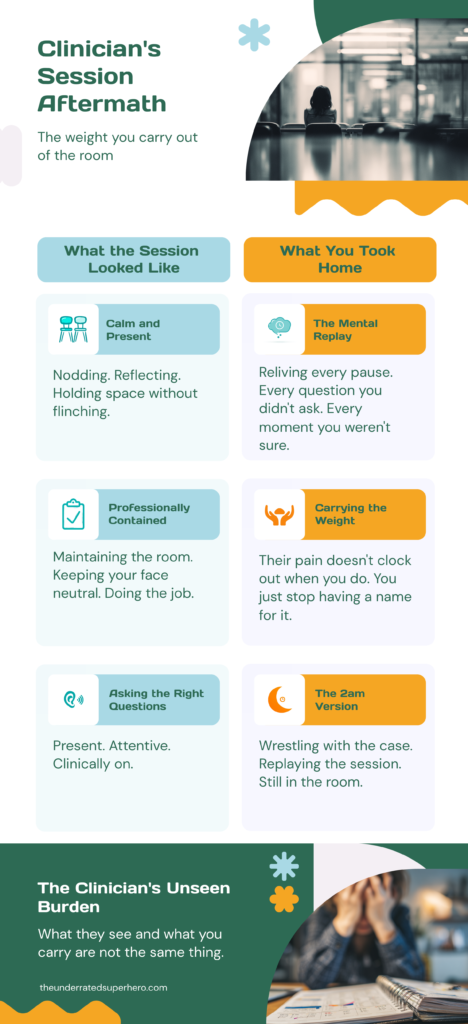
Urgency isn’t a clinical intervention. It’s a feeling. When you deliver it to a client, you’re not helping them — you’re relieving yourself. This is where motivational interviewing earns its keep. Not as a technique you perform, but as a discipline that keeps your fear from landing on the client. Holding the weight of what’s at stake while not letting it collapse onto them — that’s the advanced skill. Nobody hands it to you in a training.
The Support Gap Nobody Talks About
When I was carrying clients like this — and later, when I lost some of them — I looked for support and mostly didn’t find it.
My supervisor at the time specialized in mental health. She was good at what she did. But mental health and addiction are different fields with different relationships to mortality. Clients don’t pass away at the same rate. The stakes don’t feel the same way. I could feel the gap when I tried to bring it into supervision.
I tried talking to colleagues in private practice. Most of them had never even lost a client. They couldn’t understand — not because they didn’t care, but because they genuinely hadn’t been there.
When a client died while I was actively seeing them, the system gave me an incident report to fill out. I sat there knowing what to write, knowing it was my client, knowing only a handful of counselors ever had to fill out that form. That’s a specific kind of alone.
That gap is part of why I built this site. I looked for something that understood this specific experience, and it didn’t exist. The New Clinician Survival Kit hub is what I wished had existed when I needed it.
This isolation isn’t unique to my experience. Research on clinician grief in the addictions field consistently finds that counselors can’t process with family because of confidentiality, and supervisors in other specialties don’t fully understand addiction-related loss. The field built the gap. We just live in it.
And if you’re noticing that the cumulative weight of too many high stakes clients is wearing you down — that’s not caring too much about one client. That’s what happens when you take on too many and the load compounds. If that sounds familiar, this is worth reading.
Leave No Regrets
The thing I learned — the hard way, the only way — is this:
When you leave a session with a high stakes client, make sure that if something happened, you would have no regrets about that session.
Not perfectly. Not with the right technique. Just — did you show up? Did you say what needed to be said? Did you treat this person like the next session wasn’t guaranteed?
Because for some of them, it isn’t.

That’s not morbid. That’s the reality of addiction work nobody wants to say out loud. Standardized mortality rates among opioid-dependent individuals are nearly 15 times those of the general population. And overdose is only part of it — people with substance use disorders face significantly elevated risk of death from external causes, including homicide and unintentional injury, not just overdose. You are going to work with people whose lives are genuinely at risk from multiple directions. Some of them are going to die. You don’t get to know which session was the last one.
Talk to each client as if the next day isn’t certain. Not from panic — from intention. Say the thing. Reflect what you see. Let them know they matter. Do the work that needs doing in that room, that day, because that room is what you have.
The Weight Is the Point

If you feel the weight of a high stakes client — if their name on your schedule sits differently, if you leave their sessions carrying something you can’t quite put down — that’s not a sign you’re not ready.
It’s a sign you fully understand what’s in front of you.
The clinicians who don’t feel it aren’t tougher. They’re not more experienced. They’re either burned out past the point of feeling, or they haven’t yet reckoned with what this work actually is.
You’re not supposed to be comfortable with high stakes. You’re supposed to be present for them. Those are different things.
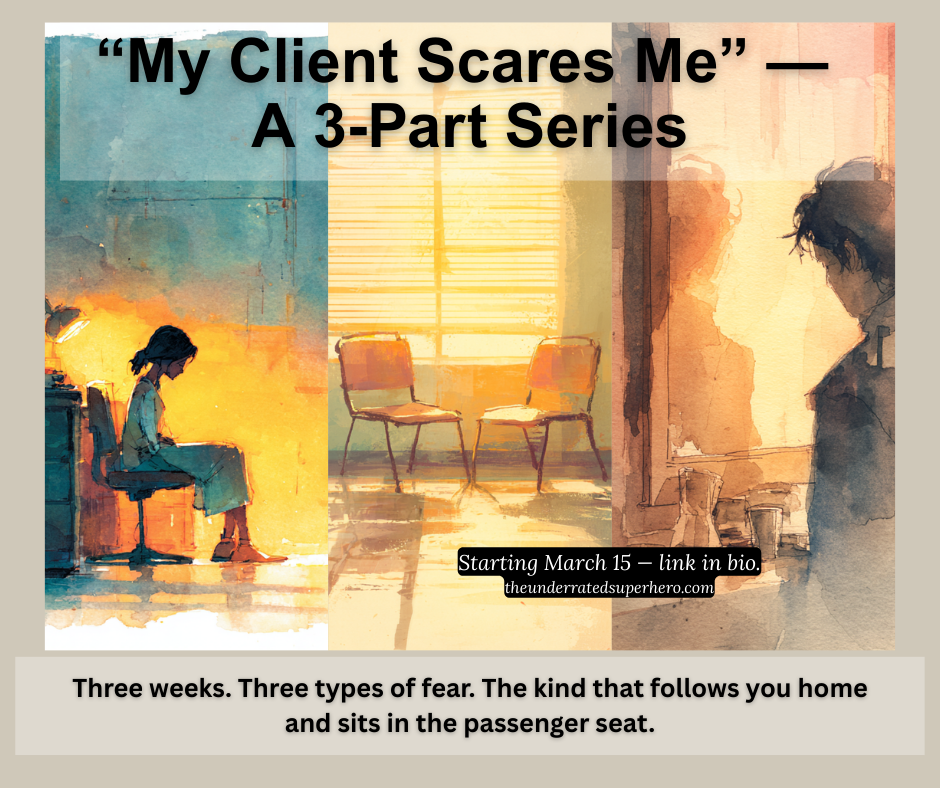
Next in the Series: “My Client Scares Me, Part 3: Fear of What They Show You” — because some clients don’t scare you because of what might happen to them. They scare you because of what they reflect back. The client who reminds you of yourself. The one whose story sits too close to home. The fear that has nothing to do with danger and everything to do with what you weren’t ready to see.
This is Blog #23 in the New Clinician Survival Kit Series by The Underrated Superhero. If this hit close to home, you’re not alone. Follow along for more real talk about surviving your first years in clinical work.
Until Next Week | The Underrated Superhero
© 2026 The Underrated Superhero LLC. All Rights Reserved.
📖 External Resources & Research
- 🔗 Never Ready: Addiction Counselors Dealing With Client Death — Research on how addiction counselors experience client death, the isolation that follows, and what the field still isn’t doing to support them
- 🔗 Grief and Addiction — Hazelden Betty Ford — Research overview including mortality data showing standardized death rates among opioid-dependent individuals are nearly 15 times those of the general population
- 🔗 Excess Mortality Among People Who Report Lifetime Drug Use — PubMed — CDC-linked 20-year follow-up study finding significantly elevated risk of death from homicide, unintentional injury, and other external causes among people with heroin or cocaine use history
- 🔗 Vicarious Trauma Interventions for Service Providers — PMC — Scoping review of vicarious trauma interventions for clinicians working with traumatized populations, including gaps in organizational-level support
📌 From This Series
- 🔗 Blog #22: “My Client Scares Me, Part 1” — The body fear, the shame, the fears you’re not supposed to admit
- 🔗 Blog #2: “I Can’t Do This” — On imposter syndrome and the fear that you’re not cut out for this work
- 🔗 Blog #8: “What Do I Even Say?” — When you freeze in session and your training doesn’t show up
- 🔗 Blog #7: “I’m Too Tired to Care” — When exhaustion stops being a bad week and starts being your baseline
- 🔗 Blog #19: “I Want to Quit” — When burnout becomes a career question
- 🔗 Blog #13: “I Can’t Handle This Caseload” — Drowning in clients and running out of air
