
Part of the Justice-Involved Treatment Mastery Series
There’s a specific feeling you get when you’re sitting in a room full of professionals — a PO, a school administrator, maybe a judge’s representative — and you realize you’re the only one seeing between the lines.
Everyone else is looking at a kid who tested positive again, who got caught with something, who blew up in the hallway, who missed his last three appointments. They’re seeing a pattern of noncompliance. A problem that needs a consequence.
You’re seeing a trauma response.
And if you say that out loud, someone in that room is going to visibly check out. Not because they disagree exactly — but because the word has been used so many times in so many trainings and mission statements and grant applications that it has started to lose meaning. Trauma-informed has become wallpaper. Say it enough times and people stop hearing it. Say it in a staffing when someone is frustrated with a client and you’ll watch the eyes glaze over before you finish the sentence.
That’s the problem this article is actually about. It’s not that these systems haven’t heard of trauma-informed care. It’s that they’ve heard it so many times it stopped meaning anything — and somewhere in that process the practice got left behind while the language moved on without it.
If you’re new to this series, start with the Justice-Involved Treatment Mastery Series landing page for context on the full framework we’ve been building across these articles.
What Trauma-Informed Actually Means vs. What Systems Do With It
Let’s be clear about what trauma-informed care actually is, because the definition has gotten blurry.
It’s not a feeling. It’s not being nice to clients or giving them extra chances or going easy on them. It’s not a training you attend once and then put a certificate on the wall. SAMHSA’s six guiding principles of trauma-informed care describe it as a framework built on safety, trustworthiness, peer support, collaboration, empowerment, and cultural sensitivity — and critically, one that requires actively resisting retraumatization at every level of a system. Not just in the therapy room. In the policies. The procedures. The way a waiting room is set up. The tone of a violation letter.
The keyword is every.
Because a system can claim to be trauma-informed and still send a kid to detention for an outburst that was a startle response. It can claim to be trauma-informed and still require a client to sit in a hard plastic chair in a fluorescent-lit waiting room for two hours before their court date. It can use all the right language in its mission statement and still respond to a positive drug test with a violation instead of a conversation.
That’s not trauma-informed. That’s trauma-informed on paper.
The justice-involved population carries a disproportionate burden of trauma — and that is not a controversial statement. A systematic review published in PMC found consistent evidence across multiple studies that higher ACE scores are strongly associated with juvenile justice system contact, and that roughly 25 to 30 percent of incarcerated youth meet criteria for PTSD. The research has been clear on this for decades. What is less talked about is how the system itself compounds that trauma at almost every contact point. The arrest. The processing. The courtroom. The conditions of supervision. The threat of incarceration hanging over every appointment, every drug test, every misstep.
These aren’t neutral experiences. They activate the same threat responses that trauma already put on a hair trigger. And then the system turns around and wonders why the client isn’t making progress.
The System Sees the Behavior. You See What’s Underneath

I worked with adolescents in alternative school settings for years. Kids who had been caught using, who were on probation, who were showing up to see me because a judge said they had to. And I watched over and over again as the adults around them — well-meaning adults, many of them — responded to trauma responses with punitive measures and then expressed frustration when nothing changed.
An outburst in the hallway is not defiance. It might be a kid who doesn’t feel safe and has never been taught another way to communicate that. Getting caught with substances is not a moral failure. It is a chronic condition doing what chronic conditions do — progressing, cycling, resisting easy fixes. A missed appointment is not disrespect. It might be a family in crisis, a transportation barrier, a kid who is terrified of what happens if he shows up and has nothing good to report.
The system sees the behavior. The trauma-informed clinician sees what’s underneath it.
Building that kind of therapeutic relationship — the one that lets you see underneath — takes time and intentional effort. I covered the specific work of therapeutic alliance with this population in Article 3: Building Therapeutic Alliance in Justice-Involved Treatment.
The Patience Problem
After the first appointment, people are already expecting change.
I want to sit with that for a second because I think clinicians who are new to this population need to hear it stated plainly: the expectation is not that you will begin building a therapeutic relationship, conduct a thorough assessment, establish rapport, identify treatment goals, and then slowly and carefully work toward sustainable change over a realistic timeline. The expectation, in many cases, is that you will fix it. Quickly. Demonstrably. In a way that shows up on a compliance report.
That is not how this works. That is not how any of this works.
Here’s what the timeline actually looks like for a lot of the clients I’ve seen. By the time they get to me they’ve already been in the system for a while — because the system moves slow. There’s a referral process, a waiting list, maybe a few failed attempts at other providers. The court has been watching this client cycle through violations and interventions for months, sometimes longer. By the time I open the file and schedule the first appointment, everyone involved is already frustrated. Already fed up. Already at the end of their patience.
And then I am expected to produce results immediately.
I’ve had to explain to courts, to probation officers, to school administrators — more times than I can count — that this is a chronic condition. That a kid who has been using substances and making high-risk choices for two years is not going to walk out of our first session transformed. That real change takes time and consistency and a relationship built on trust, and that none of those things happen overnight. That I am not a miracle worker and I was never going to be.

I Wrote the Letter Anyway
I remember writing a letter once for an adult client in intensive outpatient who was at risk of losing his work release. He asked me to advocate for him and I did — I wrote about how removing that structure could negatively impact his treatment outcomes, how stability in employment was part of his recovery foundation, how disrupting it at that moment would likely set things back rather than move them forward. It was a clinical argument based on what I knew about that client and what the research supports.
Someone rolled their eyes. And then, from what I heard, started teasing the client about it — something along the lines of oh, you had to ask your counselor to help you.
I want to name what that is. That is a person in a position of authority over a justice-involved client mocking him for having an advocate. For using the system the way it’s supposed to be used. For asking the clinician assigned to his case to do her job.
That is not trauma-informed. That is the opposite of trauma-informed. And it happens — not always that openly, but it happens — and clinicians need to know it happens so they aren’t surprised when their advocacy is met with something other than professional respect.
I wrote the letter anyway. My job is not to make the system comfortable with my clinical decisions. My job is to advocate for my client based on what I actually know — which is more than what shows up in a violation report. If that makes someone uncomfortable, that’s information about them, not about whether I made the right call.
Coloring Was Clinical Work
The patience problem runs deeper than timelines though. It’s also about what counts as progress. I’ve had school staff tell me that all I was doing was getting kids out of class. That they were just sitting in my office coloring. Not doing real work.
What they were seeing was a kid who felt safe enough to sit in a room with an adult without his defenses up. Who was regulating his nervous system. Who was building the foundational trust that makes every subsequent clinical intervention possible. You cannot do trauma-informed work with someone who doesn’t feel safe with you. You cannot do it in a single session. You cannot do it on a timeline set by a court docket.
Coloring, in that context, was clinical work. It just didn’t look like what people expected clinical work to look like.
For clinicians navigating the documentation side of this — how to capture slow, incremental progress in a way that holds up under court scrutiny — Article 4: Documentation That Satisfies Courts AND Supports Recovery covers this directly.
Structure Is Not Punishment
This is the distinction I find myself making more than any other in this work, and I want to state it as plainly as I can:
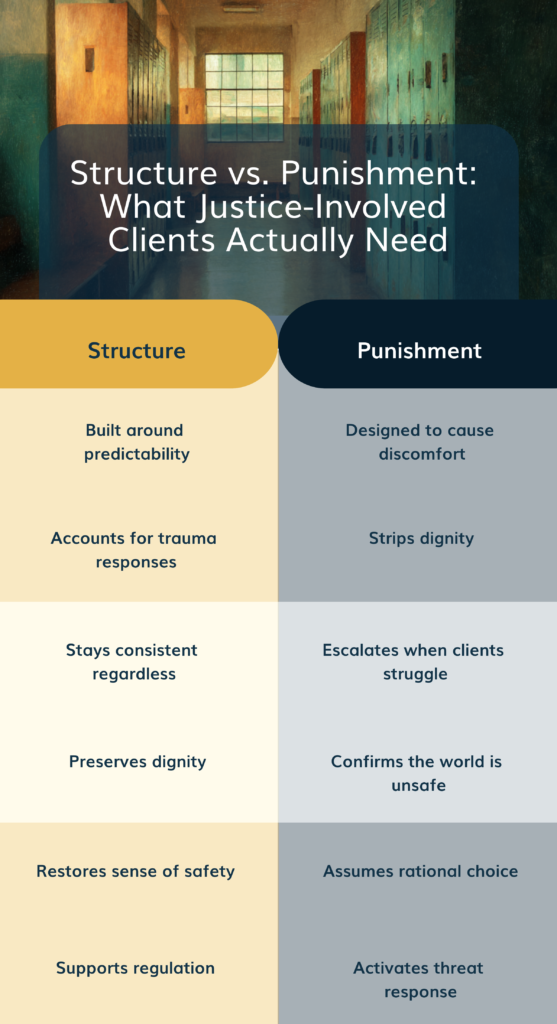
Structure is not punishment. Those are not the same thing and treating them like they are is one of the most damaging mistakes a system can make with this population.
Punishment is designed to cause discomfort. The logic is that if something hurts enough, the person will stop doing it. That model has shaky evidence behind it in general populations. In people who have experienced significant trauma it is actively counterproductive — because what punishment does to a dysregulated nervous system is not deter future behavior. It confirms that the world is unsafe. It activates the exact threat response you are trying to work with clinically. You are not going to punish someone out of a trauma response. You are not going to incarcerate someone into recovery.
Structure is different. Structure is predictability. Clear expectations, consistent follow-through, consequences that are proportionate and logical and don’t strip a person of their dignity. Structure actually helps trauma-affected people — because one of the things trauma takes from you is the sense that the world is safe and predictable, and structure gives some of that back.
I Am Not Soft on My Clients
I am not soft on my clients. I want to say that plainly because it is the assumption that gets made about clinicians who push back on punitive practices. That we’re naive. That we’ve been manipulated. That we don’t hold our clients accountable.
That has never been accurate for me. If a client needs more structure I say so. If someone needs a higher level of care I recommend it. If I have genuinely exhausted my clinical options I document that honestly. I am not in the business of enabling people or pretending that poor choices don’t have consequences.
But there is a line between structure and punishment and I will not cross it. And I will not pretend the line doesn’t exist because the system is frustrated and wants me to move faster.
I’ve watched kids get violated for outbursts that were startle responses. I’ve watched clients get sent to higher levels of care not because the clinical picture supported it but because everyone around them ran out of patience. I’ve sat in meetings where the proposed response to a positive drug test was an intervention that would have made the client’s life more chaotic, more unstable, more triggering — and therefore less likely to support recovery.
That is not getting tougher on the problem. That is getting tougher on the person. And those are not the same thing.
My job in those moments is to say so. Calmly. With documentation to back it up. As many times as necessary. If you want a deeper look at how to navigate the relapse conversation specifically — when the court is watching and the pressure to escalate is high — Article 6: Managing Relapse When the Court is Watching covers that ground directly.
How to Be the Trauma-Informed Person in a Room That Isn't
My voice is always low and steady. Even when people are shouting.
That is not a personality trait. That is a clinical strategy.
When you are working with trauma-affected clients — and when you are working alongside systems that are themselves operating from a place of frustration and exhaustion — your regulation is not just about you. It is about everyone in the room. If you come in escalated, the room escalates. If you come in calm, the room has somewhere to land. That is not a metaphor. That is the nervous system doing what nervous systems do in the presence of another nervous system that is signaling safety.
I learned this early and I have never forgotten it. If I walk into a group session frustrated, my group is frustrated. If I raise my voice, clients get triggered. If I overreact, they overreact. The same principle applies in a staffing, a court meeting, a conversation with a probation officer who is fed up with a client and looking for someone to validate that frustration.
This is more than clinical instinct — SAMHSA's Trauma-Informed Care in Behavioral Health Services explicitly addresses the role of the provider's own regulated presence in creating safety for trauma survivors. The clinician is not a neutral variable. How you show up changes what is possible in that room.
Your Regulation Is Not Just About You
There are moments in this work — sitting across from a system professional who is mocking your client, listening to a court representative demand immediate results from a kid who has been waiting six months for services, watching someone respond to a trauma response with a punitive measure you know is going to make things worse — where the impulse to match their energy is strong. Where you want to say, loudly and clearly, that they are wrong and they are causing harm and they should know better.
You can think all of those things. You can even be right about all of them. And you still have to keep your voice low and steady.
Because here is what I have learned: if I stay calm, other professionals in the room will eventually follow my lead. Not immediately. Not always. But a regulated presence is contagious in the same way that an escalated one is. If I am not showing alarm, if I am not feeding the urgency, if I am sitting in the middle of a heated conversation about a client and speaking about him with the same measured clinical tone I would use in any other professional setting — the temperature in the room comes down. Slowly, sometimes. But it comes down.
That is co-regulation at the systems level. Nobody calls it that. But that is what it is.
There is also a practical skill piece here that gets underestimated. Staying regulated in these rooms requires preparation. You need to know your clinical argument before you walk in. You need to have the documentation to back it up. You need to have thought through the likely objections and have responses ready — not defensive responses, not combative ones, but calm and factual ones. You need to know what you are willing to advocate for and what the limits of your advocacy are.
Validation is Not Agreement
And you need to know how to validate the system's concerns without abandoning your client in the process.
You do not have to agree with where their frustration is pointed. But you can absolutely validate that they are frustrated — and in most cases you should. A probation officer who has watched a client cycle through violations for eighteen months is carrying something real. A teacher who has had a student explode in her classroom three times this week is exhausted and scared. Saying "I hear you, this has been a long road and I understand why you're at your limit" costs you nothing clinically and builds exactly the kind of relational trust that makes your next recommendation land differently than it would if you'd walked in dismissing their concerns.
Validation is not agreement. It is acknowledgment. And in a room full of frustrated professionals, being the person who can hold both — I see your frustration AND I'm not changing my clinical position — is one of the most effective tools you have.
You still have to stay regulated while you do it.
Working With the System Without Losing Yourself
I have been described as passionate.
I know what that means. It means I talk about this too much. It means people get tired of hearing me bring the clinical argument back into a room that has already moved on. It means I write the letter even when someone rolls their eyes, show up to the staffing and say the same thing I said last time, keep educating the PO who has heard this before and is only half listening.
I'm okay with that. But I want to be honest about what it actually takes to sustain that over a career, because it doesn't happen by accident.
You have to accept that the system is what it is. Not as resignation — as a starting point. The system moves slow, has blind spots, and is not going to transform because you made a good argument in one meeting. The moment you start expecting it to be different than it is, you set yourself up for a kind of chronic disappointment that will grind you down over time. You work inside the reality in front of you while pushing consistently toward something better. That's the only version of this that's sustainable.
Relationships matter more than being right. The POs who trusted my recommendations over the years, who gave my clients the benefit of the doubt when I asked — that trust was built slowly. Showing up prepared. Following through. Making their job easier where I could. So that when I needed to push back on something, they already knew I wasn't doing it carelessly. You deposit before you withdraw. Every time.
Validate before you advocate. Every time. Not as strategy but because it's true — the people you're working alongside are carrying real pressures and they deserve to have that acknowledged. A PO who feels heard is more likely to hear you back. That's not manipulation. That's just how people work.
Stay in your lane — but know exactly where the edges of it are. You're not there to run the court or manage the probation caseload. But your lane is wider than some people want it to be and you don't have to apologize for that. Writing the letter is clinical work. Pushing back on an intervention you believe will harm your client's treatment is clinical work. Know your lane and fill it completely.
Keep Educating. Stay On It
And keep educating. The same concepts to the same people more times than feels reasonable. Not because you expect a dramatic shift but because change in systems is slow and incremental and someone has to keep putting the right information in the room. People will get tired of hearing it. You go at everyone's pace and you stay on it anyway.

What keeps you going — what has kept me going — is knowing concretely why you are there. Your clients need someone in that room who sees between the lines. Research on ACEs and protective factors shows that having a consistent trusted adult significantly moderates the long-term impact of adverse childhood experiences — reducing the likelihood of violence exposure and criminal justice contact even when ACE scores are high. That is what you are to these clients. Not just a clinician. A trusted adult in a system that isn't always acting like one.
In a system that is often working against them, having you in their corner is not a small thing.

📁 This Month's Toolkit: Log in or create a free account to download from the Justice-Involved Mastery Page
Article 7 comes with five downloadable tools for navigating a trauma-informed system that isn't always practicing what it preaches:
- Is This a Trauma Response? (Clinician Version) — Quick in-session reference card. Helps you identify when behavior that looks like noncompliance is actually a trauma response. Justice-involved specific scenarios, clinical language, immediate use.
- Is This a Trauma Response? (Staff & Professional Version) — Same framework, reframed for non-clinical audiences. Designed to hand to school staff, probation officers, and other professionals who need a starting point for understanding what they're actually seeing.
- Trauma-Informed Response Swaps — Two-column format. What clinicians and systems commonly say to justice-involved clients on the left, the trauma-informed version on the right. A language upgrade tool for real-time clinical use.
- Holding Your Clinical Ground: Scripts and Talking Points — Two sections in one. Top half covers script language for when someone in the room challenges your clinical approach directly. Bottom half covers broader talking points for system-level advocacy conversations with POs, courts, and supervisors.
- Documenting Progress When the System Wants Faster Results — A clinical documentation framework specifically for justice-involved clients. How to capture incremental change, treatment engagement, and clinical rationale in a way that holds up when a court or PO is pushing for a higher level of care or a violation.
This is Article 7 of the Justice-Involved Treatment Mastery Series — an 8-month deep dive for clinicians working with mandated clients, drug court participants, and anyone navigating treatment in justice settings.
Previous articles in this series:
- Month 1: Beyond Court Compliance: Harm Reduction with Mandated Clients →
- Month 2: When the Judge Says Abstinence but Evidence Says Harm Reduction →
- Month 3: From Compliance to Care: Why Justice-Involved Clients Need a Different Approach →
- Month 4: Documentation That Satisfies Courts AND Supports Recovery →
- Month 5: Motivational Interviewing for Mandated Clients
- Month 6: Managing Relapse
Browse the full Justice-Involved Treatment Mastery hub →
Not a member yet? Create a free account to access resources →
References
- Substance Abuse and Mental Health Services Administration. (2014). SAMHSA's Concept of Trauma and Guidance for a Trauma-Informed Approach. HHS Publication No. (SMA) 14-4884. https://library.samhsa.gov/product/samhsas-concept-trauma-and-guidance-trauma-informed-approach/sma14-4884
- Substance Abuse and Mental Health Services Administration. (2014). Trauma-Informed Care in Behavioral Health Services. Treatment Improvement Protocol (TIP) Series, No. 57. https://www.ncbi.nlm.nih.gov/books/NBK207195/
- Graf, G. H.-J., & Li, W. (2021). Adverse childhood experiences and justice system contact: A systematic review. Pediatrics, 147(1). https://pmc.ncbi.nlm.nih.gov/articles/PMC7786827/
- Baglivio, M. T., Epps, N., Swartz, K., Huq, M. S., Sheer, A., & Hardt, N. S. (2014). The prevalence of adverse childhood experiences (ACE) in the lives of juvenile offenders. Journal of Juvenile Justice, 3(2), 1–23.
- Felitti, V. J., Anda, R. F., Nordenberg, D., Williamson, D. F., Spitz, A. M., Edwards, V., Koss, M. P., & Marks, J. S. (1998). Relationship of childhood abuse and household dysfunction to many of the leading causes of death in adults. American Journal of Preventive Medicine, 14(4), 245–258.
- Marsac, M. L., Kassam-Adams, N., Hildenbrand, A. K., Nicholls, E., Winston, F. K., Leff, S. S., & Fein, J. (2016). Implementing a trauma-informed approach in pediatric health care networks. JAMA Pediatrics, 170(1), 70–77.
- Hughes, K., Bellis, M. A., Hardcastle, K. A., Sethi, D., Butchart, A., Mikton, C., Jones, L., & Dunne, M. P. (2017). The effect of multiple adverse childhood experiences on health: A systematic review and meta-analysis. The Lancet Public Health, 2(8), e356–e366.
- Purtle, J. (2020). Systematic review of evaluations of trauma-informed organizational interventions that include staff outcomes. Trauma, Violence, & Abuse, 21(4), 725–740. https://pmc.ncbi.nlm.nih.gov/articles/PMC12619370/
