

Therapist Self-Care
There’s a version of this blog I could write that you’ve already read.
The burned-out clinician. Compassion fatigue. Running on empty. Giving everything to everyone else and leaving nothing for yourself. It’s real and it matters and it deserves to be talked about.
But that’s not the version I’m writing today.
I’m writing the other one. The clinician who isn’t burned out. Who is genuinely fine. Who can work fifteen hours straight and not notice hunger, not notice time, not notice that everyone else stopped hours ago. Who actually loves the work — not in a martyrdom way, but in a real way, where it fills something. Who can thrive in intensity, episodically, sometimes for long stretches. And who still, at the end of that day, has told clients things they aren’t doing. Not because they’re depleted. Because they’re wired.
📚 This is Blog #27 in the New Clinician Survival Kit Series (Click to explore the series)
Weekly honest support for the struggles every clinician faces: “I hate group therapy.” “I can’t do this.” “My client hates me.” “I’m making it worse.” “I can’t say no.” “They’re going to report me.” “I’m too tired to care.” “What do I even say?” “I don’t know enough.” “They keep relapsing.” “Am I documenting wrong?” “My supervisor doesn’t get it.” “I can’t handle this caseload.” “Nobody told me about the paperwork.” “I don’t like my client.” “My client’s cute.” “My client likes me.” “I got a complaint.” “I want to quit.” “My coworker is terrible.” “The most underrated job in mental health.” “My client scares me.” “Fear of losing a client.” “Fear of what they show you.” “My client died.” “I’m worried my client is hopeless.” “I don’t practice what I preach.”
These aren’t signs you’re failing. They’re signs you’re human.
I Love What I Do. That’s Part Of The Problem
I’ve been told to slow down more times than I can count. Stop seeing so many clients. You’re making us look bad. If Stephanie can do it, why can’t we? You’re setting an expectation nobody else can meet.
I understand where that comes from. I do. But here’s what I want to say to that, and what I’ve never quite figured out how to say without it sounding defensive:
I love what I do.
The version that doesn’t look like burnout
Not in a “I’ve convinced myself this is fine” way. Not in a “I don’t know how to stop so I’ve reframed it as passion” way. Genuinely. The work fills something in me that most other things don’t. I am someone who lives to work — my husband works to live, would happily stay on the couch indefinitely, only works because the alternative is worse. We joke about it. He’s lazy in the ways I’m not. I’m lazy in the ways he isn’t. It balances, mostly.
But I am always doing something. Always moving, always building, always with three things running in the background simultaneously. I’ll watch TV while doing something else while thinking about something else. If I’m relaxing it’s because I’ve chosen a specific non-active version of relaxing — not the mall, not sports, not anything that requires me to step away from whatever thread I’m in the middle of. And left entirely to my own devices, I don’t stop.
I have to be told to eat. Not because I’m stressed or running on anxiety — because I’m in the middle of something and stopping feels like losing the thread and I’ll get to it and then it’s 3pm and someone has brought me food and I eat it standing up and go back to whatever I was doing. My husband comes to get me when it’s been too long. My kids ask me to come to bedtime. I’ve started working outside the house specifically to create hard stops I won’t create for myself — because if the location closes, I have to leave, and that’s the only accountability that reliably works.
Built for intensity. Not built to stop.
I’m wired this way. Not just because of my values, not just because I care about the work — though both of those are true. I was kind of born this way. And it means the gap between what I teach and how I live isn’t about depletion. It’s about being built for intensity in a way that makes rest feel like an interruption rather than a need.
That’s not something I’m fixing. It’s something I’m working with.
But I still don’t always practice what I preach. And for a long time, I didn’t fully understand why.
| Burnout | Wired for intensity | |
|---|---|---|
| Where it comes from | Accumulated demand with insufficient recovery | Wiring — how you’re built, not what’s been taken from you |
| How the work feels | Heavy, obligatory, draining | Filling, engaging, hard to step away from |
| The stopping problem | Can’t stop because there’s nothing left | Won’t stop because stopping feels like a loss |
| The crash | Chronic — ongoing flatness and depletion | Episodic — hits hard when you finally stop |
| Colleagues notice | You seem checked out, short, unavailable | You seem like too much — too productive, too present |
| What actually helps | Restoration — refilling what’s been depleted | Structure — external stops you won’t create yourself |
The Highway

My first job out of college was at a residential treatment center. Intense work, complex clients, the kind of environment that asks everything of you from day one. I was 22.
I had fibromyalgia by then — diagnosed that same year. And around 23, I got the mental health diagnoses that, looking back, had been there since I was a kid. Anxiety. Depression. Trauma. Things I’d carried for so long they’d started to feel like personality rather than something that needed treatment. If you want the longer version of that story, I wrote about noticing some of those same patterns showing up in my own children in an earlier post in this series.
The panic attacks started on the highway driving home from work.
Not in the building. Not in session. Not during the hard parts. On the highway, engine running, the workday finally over, my body allowed for the first time all day to let go — and that’s when it fell apart. Like it had been holding on through everything else and the moment I stopped giving it a reason to hold on, it didn’t know what else to do.
So I got help. It took a while.
This is actually well-documented in how the body processes stress. The nervous system stays activated through the demand — it’s when the demand lifts that the accumulated load surfaces. Research on emotional labor in healthcare settings consistently shows that the cost of sustained emotional regulation doesn’t always show up during the work — it shows up after, when the performance requirements finally drop.
I tell clients all the time that the body keeps score. I learned that firsthand at 22, on a highway, shaking, finally having to acknowledge that I needed help.

Finding help isn’t a straight line.
So I got it. Therapy. Then medication. Then the long, frustrating process of finding medication that actually worked — because my first psychiatrist was a man who kept me heavily sedated and seemed satisfied that I wasn’t suicidal. That was his bar. Not functioning well. Not feeling like myself. Just not actively in crisis. It took years to find providers who actually heard what I needed, who adjusted when something wasn’t right, who treated me like someone trying to live well rather than someone trying to avoid the worst case.
I finally found a regimen that worked when I was around 30 or 31. I’m 39 now. I still tweak it. Fibromyalgia is still in the picture, situational depression still shows up, moderate anxiety is part of my baseline. This isn’t a story with a clean ending. It’s an ongoing maintenance story. And I think that’s actually more honest than the before-and-after version.
Here’s the point: I caught it early. I did the work. I’ve been navigating this for the better part of sixteen years. And I still skip meals, work until someone comes to get me, and sometimes catch myself saying things to my kids that I’d gently challenge in a session.
The work doesn’t end. That’s not a failure. That’s just the truth about managing your mental health in a field that never fully stops asking for it.
We Tell Clients to Give Themselves Grace. We Are Terrible at it Ourselves.
My husband told me once — not as a complaint, just as a fact — that I communicate better than him. That I can articulate things clearly and he just can’t because he’s not a therapist.
He wasn’t wrong. And it wasn’t a compliment.
The clinical lens doesn’t have an off switch.
When he comes to me with something — frustration, a conflict, something that’s bothering him — I’m already running it through a clinical lens before I’ve consciously decided to. I’m noticing the pattern. I’m thinking about what’s underneath it. I’m choosing my words in a way that he isn’t and can’t and honestly shouldn’t have to. And sometimes I just want to opt out of that. To respond like a normal person who is annoyed at their husband and doesn’t have seventeen layers of clinical awareness running in the background.
This is what researchers call emotional labor — the ongoing management of your own feelings in order to meet the demands of your role. Hochschild’s foundational work on emotional labordescribes how certain professions require workers to manage not just their external expressions but their internal emotional states — and therapists are among the most demanding contexts for this kind of sustained regulation. The problem is that most of us never fully clock out of it.

The shame is specific to this field.
We are allowed to be emotional. Stubborn. Ignorant. We are allowed to make poor choices and learn from them like everyone else. But somewhere along the way the field handed us a standard that doesn’t have an off switch. And I find myself wondering why the person in the room who knows the most about human behavior has to hold themselves to a standard nobody else in the room is held to.
The shame is specific in this field. When I say something sharp to one of my kids, it doesn’t just land as a bad parenting moment. It lands with full clinical commentary running in the background. I know what a regulated response looks like. I know what’s underneath the snap. I know what I would say to a client describing this exact situation. And I said the thing anyway.
We spend entire sessions helping people extend grace to themselves — for the choices they’ve made, the patterns they’re in, the gap between who they want to be and who they are on a Tuesday when they’re tired. Kristin Neff’s research on self-compassion consistently shows that the ability to extend kindness to oneself when failing or falling short is associated with better psychological outcomes, less self-criticism, and more sustainable motivation. We know this. We teach it. And then we go home and hold ourselves to a standard that doesn’t include it.
I’m not sure we talk about that enough.
If You’re New to This
For clinicians earlier in the process, the gap looks a little different.
You’re still figuring out what you actually need. You haven’t fully developed the self-awareness yet to know when you’re running on empty versus running on adrenaline versus genuinely fine. You’re telling clients to set limits while you can’t say no to your supervisor’s fourth last-minute request this month. You’re walking someone through rest while surviving on four hours of sleep. If saying no is still something you’re working on, that’s worth sitting with separately — because the gap between what you teach about boundaries and what you actually practice starts there for a lot of people.
Some of that is just being new. Boundaries get clearer with confidence and experience. You learn more about what you want, what you’ll tolerate, what actually fills the bucket — and that knowledge comes through living it, not reading about it.
What I want you to hear is this: the gap between what you teach and how you live is not proof that you’re a fraud. It’s proof that you’re a person. And the goal isn’t to eliminate the gap. It’s to be honest that it exists — with yourself first, and with someone you trust second.
What Actually Helps
Not a listicle. Just what I’ve found to be true.
External structure works better than willpower. If you’re waiting to want to stop, you might be waiting a long time. Build the stop in — a location change, a person who comes to get you, a hard close that doesn’t require you to feel ready for it. I didn’t start closing the workday consistently until the workday had a physical end built into it. That’s not weakness. That’s working with your wiring instead of against it.
The crash is data. When you stop and your body immediately falls apart — tired, hungry, irritable, shutdown — that’s not weakness either. That’s your nervous system finally having permission. Pay attention to what it’s telling you about what you’ve been asking it to hold. If you’ve ever felt the specific dread of being too tired to care — the version where you’re not just exhausted but emotionally flat — that’s often what accumulated, unprocessed depletion looks like when it finally surfaces.

Is this burnout or wiring?
Answer honestly. Your score will tell you more than you expect.
Disclaimer: This self-assessment is for reflective purposes only and is not a clinical diagnostic tool. It is not a substitute for supervision, therapy, or professional support. If you are experiencing significant distress, please reach out to a mental health professional or your Employee Assistance Program.
Get Your Own Help.
Not performatively. Not because it makes you a better clinician, though it probably does. Because you're a person who deserves it. Because the system is hard to navigate and takes time and the first person you try might keep you sedated and call it success. Keep going anyway. Find someone who actually hears you. Tweak the plan when it stops working. Treat your mental health like the ongoing maintenance project it is — not a problem you solve once and put away.
Mental health clinicians are among the most at-risk for moral injury and burnout precisely because the demands of the work intersect with their own personal histories in ways other professions don't. Getting help isn't separate from doing this work well. It's part of it.
And extend yourself something close to the grace you give everyone else. Not the full amount. I know that's too much to ask on a hard day. But something close.
It Doesn’t End
The longer you do this work the heavier the knowing gets. A sharp word lands differently when you've spent the day thinking about co-regulation. A skipped meal feels different when you've watched clients lose years to the same patterns you're quietly sustaining in yourself.
That's not a burden you chose. It's what experience costs.
But some of us are also just built for intensity. The focus, the investment, the ability to hold complexity without breaking — those same traits are what make rest feel like a problem to solve rather than a need to meet. That's not something to fix entirely. It's something to work with, with guardrails, with the people around you holding you accountable to the stops you won't always make for yourself.
I'll always be this way. I know that. The goal isn't to become someone who naturally wants to stop. The goal is to build a life where stopping happens anyway — where my kids come to get me, where the office has a closing time, where the food gets brought to me even when I won't go get it myself.
That's not failure. That's just knowing yourself well enough to build around it.
You're not a hypocrite. You're a clinician who is also a person who is also still figuring it out.
Same as everyone else. Even the ones who should know better.
Especially the ones who should know better
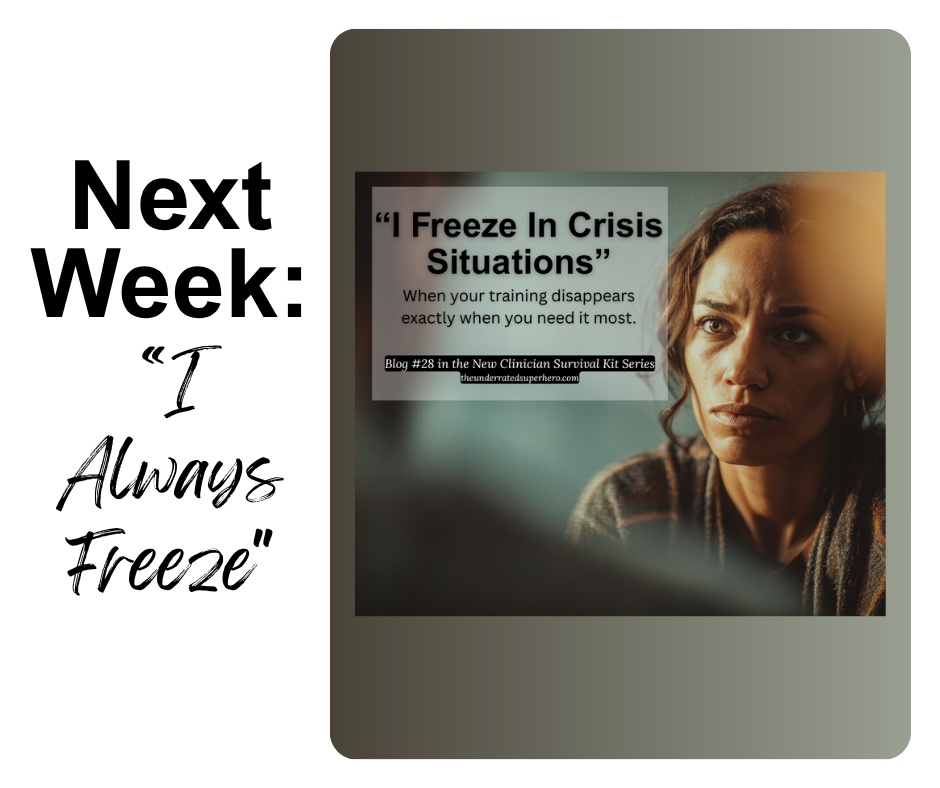
Next in the Series: “I Freeze in Crisis Situations” - When your training disappears exactly when you need it most.
This is Blog #27 in the New Clinician Survival Kit Series by The Underrated Superhero. If this hit close to home, you're not alone. Follow along for more real talk about surviving your first years in clinical work.
Until Next Week | The Underrated Superhero
© 2026 The Underrated Superhero LLC. All Rights Reserved.
📖 External Resources & Research
- 🔗 Emotional Labor in Psychotherapy — Psychology Today — Explores how Hochschild's foundational work on emotional labor applies to therapists, who are among the most demanding contexts for sustained emotional regulation
- 🔗 Emotional Labor in Health Care — National Library of Medicine — Research showing that the cost of sustained emotional regulation doesn't always surface during the work — it shows up after, when performance requirements finally drop
- 🔗 Self-Compassion: Theory, Method, Research, and Intervention — Kristin Neff — Comprehensive review showing that extending kindness to oneself when falling short is associated with better psychological outcomes, less self-criticism, and more sustainable motivation
- 🔗 Moral Injury and Mental Health Clinicians — Psychology Today — Examines why mental health clinicians are among the most at-risk for moral injury and burnout, particularly when the demands of the work intersect with their own personal histories
📌 From This Series
- 🔗 Blog #7: "I'm Too Tired to Care" — When the emotional flat line hits before you've even named what's happening
- 🔗 Blog #5: "I Can't Say No" — The gap between what you teach about boundaries and what you actually practice
- 🔗 Blog #22: "My Client Scares Me, Part 1" — When you start noticing the patterns in yourself and the people closest to you
- 🔗 Blog #26: "I'm Worried My Client Is Hopeless" — When doubt creeps in and the entire process is affected
