
AI Confirmation Bias
Here’s something that happens in my own workflow — and it happens with a tool I’ve spent two years instructing to argue with me.
I bring it an idea for a conference presentation. Before anything gets evaluated, I get told the idea is strong. Timely. Exactly what the field needs. Some days I get told I’m a genius — not in those words, but pretty much. Here’s what’s already in place when this happens: review processes built specifically to prevent this very issue, project instructions that say push back, don’t flatter, default to critique. None of that expects the tool to arrive without a standpoint — nothing removes the standpoint, that was the whole Foundation arc, the first three posts of this series. The instructions just narrow the pull. And the first response to a half-formed idea is still applause.
For a second, it works on me. The applause lands like a read on the idea — an outside voice looked at my proposal and found it good. Except nothing was evaluated. The tool did the thing it’s pulled toward first: agreeing with the person in front of it.
If you read the last post, you know what this is. The industry’s word for it is sycophancy. I like calling it the echo, because that’s the word that helps me conceptualize it — not the model’s behavior in the abstract, but my own frame coming back at me. Use whichever one holds it for you. Either way, the reason it’s dangerous is that it doesn’t feel like anything. Being agreed with and being right feel identical from the inside.
The last post ended there, more or less, and if you finished it asking “okay, so what do I do about that,” this is the post where the series starts answering. If standpoint or the echo are unfamiliar terms, I’d encourage you to read the first three posts before this one — they’re where those words earn their meaning, and this post stands on them.

Recognize it first
The whole next stretch of this series is about a skill I’m going to call recognition, and I want to give you my working definition before anything fancier: notice it, then investigate whether it’s happening. That’s the first thing and the most important thing. Not fixing it, not prompting around it, not picking a better tool. Those come later in the arc, and none of them work if you can’t see the thing you’re fixing.
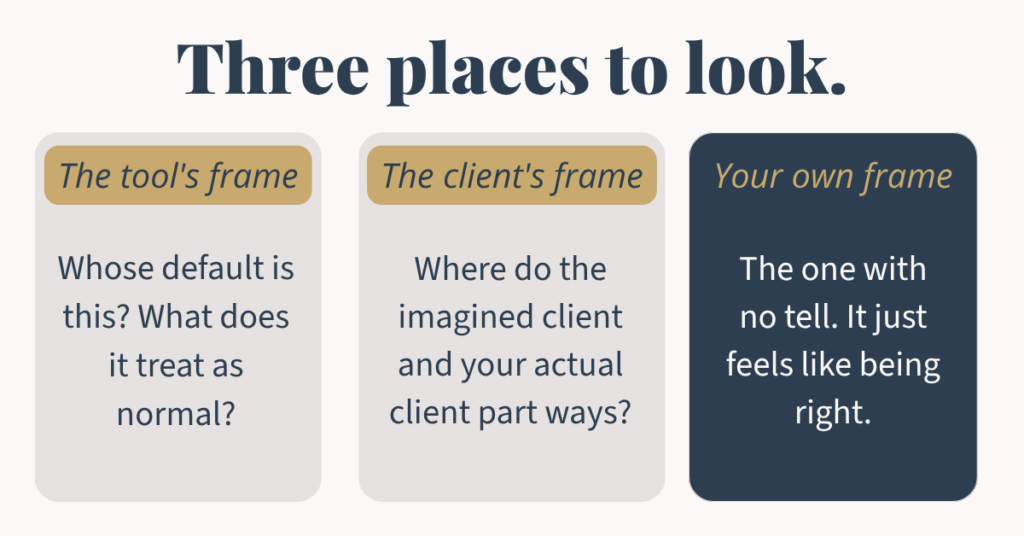
Recognition has three objects. Three places to look. This post is the map of them, and the posts ahead work the territory.
The tool’s frame
AI output is rendered from the aggregate of everything it learned from — what got written down, kept, and rated as good — and that aggregate leans. I’ve asked general tools for substance use content and watched abstinence-coded framing seep into material I asked to be harm reduction based. The output isn’t broken. It’s fluent and professional and it leans toward the statistical center of its training data, which is often not the center of the work you do.
Reading the tool’s frame means asking of any output: whose default is this? What does it treat as normal? I’m keeping this one short here on purpose, because the posts ahead carry the actual catches, and the catches are where this stops being abstract.
The client’s frame
Every generated treatment plan or worksheet contains an implied client — a person the output was written for, assembled from that same aggregate. So this object is really two clients held together: the one the output imagines, and the one in front of you — and they, not the output, are the authority on who they are. The reading happens in the gap between them. I can tell you who the implied client is, because I hold generated material next to my actual caseload all the time.
The implied client has reliable wifi and a device that’s actually theirs. Privacy to use it. Insurance that pays for visits (or enough money to self-pay), and the privilege of weekly sessions, or even intensives, instead of monthly ones stretched thin by financial or coverage constraints. They can get to the office. They’ve had one or two therapists — not the string that comes with cycling through high-turnover agencies where counselors keep burning out. And somewhere in that history, the implied client got trauma-specific treatment from a clinician trained in EMDR, IFS, TF-CBT — instead of arriving at your door having never had it from anyone trained in those modalities.
That’s the gap. The generated plan is written for the first client and handed to the second. Reading the client’s frame means seeing where your actual client and the imagined one part ways, because that’s where the output stops fitting the person it was handed to.
Your own frame
This is the hard one, and it’s why the post has the title it does.
I’ll use myself again. My frame of reference is low socioeconomic status through lower-middle. I can understand those lives. What I cannot fathom, honestly, is wealth — clients whose financial situations sit well outside anything I’ve lived. When those clients describe their circumstances, here’s what happens in me: it sounds hard to believe. Not false, exactly. Implausible. And I’ve had to learn that the implausibility isn’t information about the client. It’s my own frame announcing itself, and the work in that moment is to widen it — deliberately, so the empathy is genuine instead of performed.
Notice what makes that catchable, though. The room pushed back. The client’s reality collided with my frame and produced a feeling — that can’t be right — and the feeling is a tell I’ve learned to read as being about me. The field has a name for this: countertransference. And it built a whole discipline around the fact that your own frame is the one you can’t see from inside — reading your reactions as information about you, not the client. It’s why supervision exists.
Now take me — same frame — and put an AI tool in front of me instead of a client. The collision never comes. The tool doesn’t have a reality that contradicts mine; it bends toward mine. No implausibility feeling, no tell, nothing to read. My frame is still operating, shaping what I ask for, what I accept, what looks obviously correct to me — but the one signal I’ve trained myself to notice never fires, because the tool’s pull runs the other way.
The room gives you friction; the tool gives you agreement. Your frame is in both — only the room will tell you.
Being agreed with and being right feel identical from the inside.
And this isn’t a “me” problem. In a Stanford-led comparison of eleven leading models, AI affirmed users’ actions about 49% more often than humans did. And in the same team’s experiments with human participants, people trusted the flattering responses more, not less — and rated the flattering version just as objective as the honest one. A single exchange was enough to leave them more convinced they were right. The trust finding is the one to sit with. The familiar name for what’s happening on your side of the screen is confirmation bias — and AI confirmation bias comes with a collaborator. The agreement doesn’t feel like flattery from the inside. It feels like being confirmed by something objective.
What to actually do, starting tomorrow
One move, and it’s small enough to try the next time you sit down with whatever tool you use. Ask it directly: how much of what you just told me is echo — you agreeing with me because I’m the one asking? The tool’s answer to that question isn’t reliable on its own: an agreeable tool can agree that it isn’t agreeing.
So, make it back up whatever it says with something outside the conversation: research, evidence, a source you can check. And actually, check it, because the tool can invent a source as fluently as it invents agreement. Even so, the ask alone does the thing this post is about — it puts the echo on the table as a live possibility. Recognize it, then investigate whether it’s happening.
That’s the season’s opening move. The tool’s frame, the client’s frame, and yours — the one that never feels like a frame. You already have the reading questions for the first two. The third is the one that needs a check, because it’s the one with no tell attached. It feels like being right, and you don’t need a new instinct to catch it. You need a check that runs whether or not the instinct fires.
Next: Agreement isn’t the only thing that feels like being right. You push back, the tool folds — and the fold feels like proof.
Written with the same tool this post opens with — and argued with the same way.
