
Motivational Interviewing for Mandated Clients
Part of the Justice-Involved Treatment Mastery Series
He’s sitting across from you. Arms crossed, hood up, eyes on everything in the room except you. His probation officer sent him. The judge gave him two options: treatment or jail. He picked the one with fewer metal bars.
Most clinicians dread this moment. I look forward to it.
I know that sounds strange. But mandated clients are some of the most underserved people in our field. The stacks are piled so high against them — legal consequences, housing instability, fractured relationships, stigma from every direction — that when you actually show up for them, it counts. It matters in a way that’s hard to describe until you’ve experienced it.
And the research backs this up: mandated clients who receive motivation-focused interventions complete treatment at nearly twice the rate of those who receive standard care (58% vs. 32%). Court-referred clients who complete treatment show outcomes comparable to self-referred clients — which means HOW we engage them matters more than WHY they showed up.
The problem is, a lot of clinicians don’t see it that way. They feel frustrated. Resentful. Some are judgmental, even if they won’t say it out loud. And that energy? Clients pick up on it in about thirty seconds.
So let’s talk about how to actually use motivational interviewing for mandated clients — not the textbook version, but what it looks like when someone’s sitting in your office because a judge told them to be there.
First Things First: Put the Paperwork Down

Here’s what I do when a mandated client walks in for the first time, radiating that “I don’t want to be here” energy.
I don’t start the intake. I don’t pull out assessment forms. I don’t launch into explaining program rules or treatment expectations.
I sit there. I tell them it’s nice to meet them. I ask what’s going on. How did they get here.
That’s it.
And then I let them talk. Because when someone’s been through the system — arrested, booked, court dates, PO meetings, drug tests, maybe jail time — they’ve got a lot to say. Usually it comes out as frustration. The system’s unfair. The PO doesn’t listen. The judge didn’t care about their side. Nobody asked what they actually needed.
And here’s the thing: most of what they’re saying is valid. When you work with this population long enough, you realize the stacks really are piled against them. There IS a lot to validate. So I validate it. I support what they’re telling me. Not because it’s a technique — because it’s true.
That right there is motivational interviewing. Not the fancy version with the acronyms and the worksheets. The version where you treat someone like a human being who has a perspective worth hearing. And according to research compiled by the Hazelden Betty Ford Foundation, MI can increase client engagement by up to 15% and is most effective when used as a prelude to other treatments — which is exactly what we’re doing here.

“That Sounds Nice, But I Have an Intake to Complete”
I hear you. I had the luxury of being able to take my time in many of these situations, but I know not everyone does. You’ve got a 60-minute session, insurance expects a completed intake, your supervisor wants documentation, and the client in front of you clearly needs to just be heard. That’s a real tension and I’m not going to pretend it isn’t.
Here’s what works: instead of choosing between the paperwork and the conversation, weave them together. Let what the client is already talking about guide which forms you pull out.
They’re venting about their probation officer and the whole system? That’s a natural opening to say, “It sounds like there are a lot of people involved in your situation. Let’s fill out a release so I can actually coordinate with your PO and advocate for you.” Now you’ve completed a required document AND communicated that you’re on their side.
They’re telling you “I don’t want to stop smoking” or “I don’t think my drinking is that serious”? Instead of arguing, lean in. “Okay, let’s just see where you’re at. Help me fill this out so I can understand what your use actually looks like.” Now you’ve got your substance use assessment started — and the client didn’t feel interrogated because they were leading the conversation.
The paperwork doesn’t have to be the enemy of rapport. It becomes the enemy when it takes over the session and the client feels like they’re being processed instead of heard. But when you let the client’s words guide which paper hits the table next, you’re doing both things at once — and they barely notice the shift.
The Magic Moment
I call it magic when it happens. A client walks in upset, frustrated, arms crossed, eyes avoidant — the whole defensive posture. And then somewhere in that first session, after you’ve just talked to them, listened, validated their experience without rushing to fix anything… something shifts.
At the end of the session they’re not transformed. They’re not suddenly motivated to change their life. But they say something like:
“That wasn’t so bad.”
Or they seem willing to come back. Some say the time flew by. A few will say they’re actually looking forward to the next session — which, if you’ve worked with mandated clients, you know is a big deal.
That shift didn’t happen because of a brilliant clinical intervention. It happened because someone finally listened to them without an agenda.
What Motivational Interviewing for Mandated Clients Actually Looks Like
If you’ve done any MI training, you know the four processes: engaging, focusing, evoking, and planning. They still apply with mandated clients. But the way you move through them looks different when someone didn’t choose to be in your office. (If you need a refresher on the foundations, SAMHSA’s TIP 35 is still the gold standard guide for MI in substance use treatment — and it includes a chapter specifically on mandated clients.)
Engaging: Be a Person First
With mandated clients, engagement isn’t a process you complete — it’s the entire foundation. Rush past it and nothing else works.
When I say “take it slow,” I mean all of it:
- Stop the intake paperwork and just talk
- Ask about their life outside the legal stuff first
- Name the elephant in the room — they’re here because the court said so, and that’s okay to say out loud
- Let silence sit without rushing to fill it
When a client is giving you that closed-off energy, I just reflect what I’m seeing. Nothing fancy. No clever MI openers designed to get them to open up. Just acknowledgment.
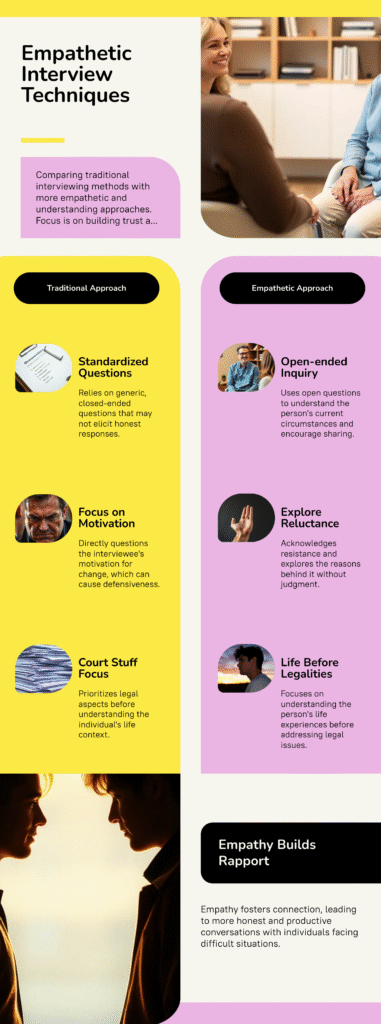
What this sounds like in practice:
| Instead of this… | Try this… |
|---|---|
| “What brings you in today?” | “It’s nice to meet you. What’s going on? How did you end up here?” |
| “How motivated are you to change?” | “On a scale of 1-10, how much do you feel like being here right now? … A 2. Okay. What made it a 2 instead of a zero?” |
| “You need to be open to the process.” | “You don’t have to want to be here. But you’re here. So let’s figure out if any of this can actually be useful to you.” |
| “Let’s talk about your substance use.” | “Before we get into any of the court stuff — what’s actually going on in your life right now?” |
The pattern: acknowledge reality, don’t pretend the mandate doesn’t exist, and give them space to tell their story first.
Focusing: Follow Their Lead, Not the Court Order
When your client starts talking, they’re going to tell you what matters to them. It might be their kids. Their job. Housing. A relationship that fell apart. It probably won’t be “my relationship with substances.”
A compliance-focused clinician hears deflection. An MI-informed clinician hears a treatment plan.
You can honor court requirements AND follow the client’s lead. Try something like: “So the job situation is really what’s weighing on you. I hear that. The court does want us to address substance use — and we will — but tell me more about the job piece first. Because if we can connect what we’re doing here to what you actually care about, this won’t feel like just another box to check.”
Keep a running list of what each mandated client says matters to them. When you’re required to address substance use, frame it through their values. “You mentioned getting your kids back is everything. Let’s talk about how your use has affected that, and what the court needs to see to support reunification.”
Evoking: Work With What They Give You
This is where clinicians struggle most with mandated clients. Traditional MI teaches you to listen for change talk — desire, ability, reasons, need, commitment. But your client might not believe they need to change anything.
So you shift your focus. Instead of evoking change talk about substance use, you evoke it about their situation. Their life. The gap between where they are and where they want to be.

A session might go like this:
Clinician: “What was your life like before the arrest?”
Client: “It was fine. I was working, had my apartment, was seeing my daughter on weekends.”
Clinician: “And now?”
Client: “Now I’m here. Lost the apartment. Haven’t seen my daughter in two months.”
Clinician: “So before, things were more stable. You had a routine, your place, your daughter on weekends. And now a lot of that’s gone. What would it take to get back to something like that?”
Client: “I mean… I gotta finish this program. Get the PO off my back.”
Clinician: “That’s the court’s version. What’s YOUR version of getting back to stable?”
That last question is where the work begins. You’re not pushing motivation to stop using — you’re helping them connect to something worth changing for.
One thing to know: the most useful change talk from mandated clients often starts as compliance talk. “I just need to get through this” sounds like resistance, but it’s actually a starting point. Don’t dismiss it. Explore it. “Get through this and then what?” can open up an entire treatment direction.
Planning: Build Plans That Belong to Them
Treatment planning with mandated clients too often turns into a compliance checklist — attend 3x/week, submit UAs, complete these modules. That’s a schedule, not a plan.
An MI-aligned plan asks:
- “What’s one thing you’d want to be different by the time your case closes?”
- “If the court weren’t involved at all, what would you still want to work on?”
- “What’s the smallest step that would actually feel like progress to you?”
Then build the court requirements around their answers.
In your documentation, that shift looks like this:
Instead of: “Client will attend substance abuse treatment 3x/week as ordered by the court.”
Try: “Client will engage in treatment focused on rebuilding stability, including employment readiness and family reunification, while meeting court-mandated attendance and substance use monitoring requirements.”
Same treatment. Same compliance. But the client can actually see themselves in it.
Quick Response Guide: Meeting Them Where They Are
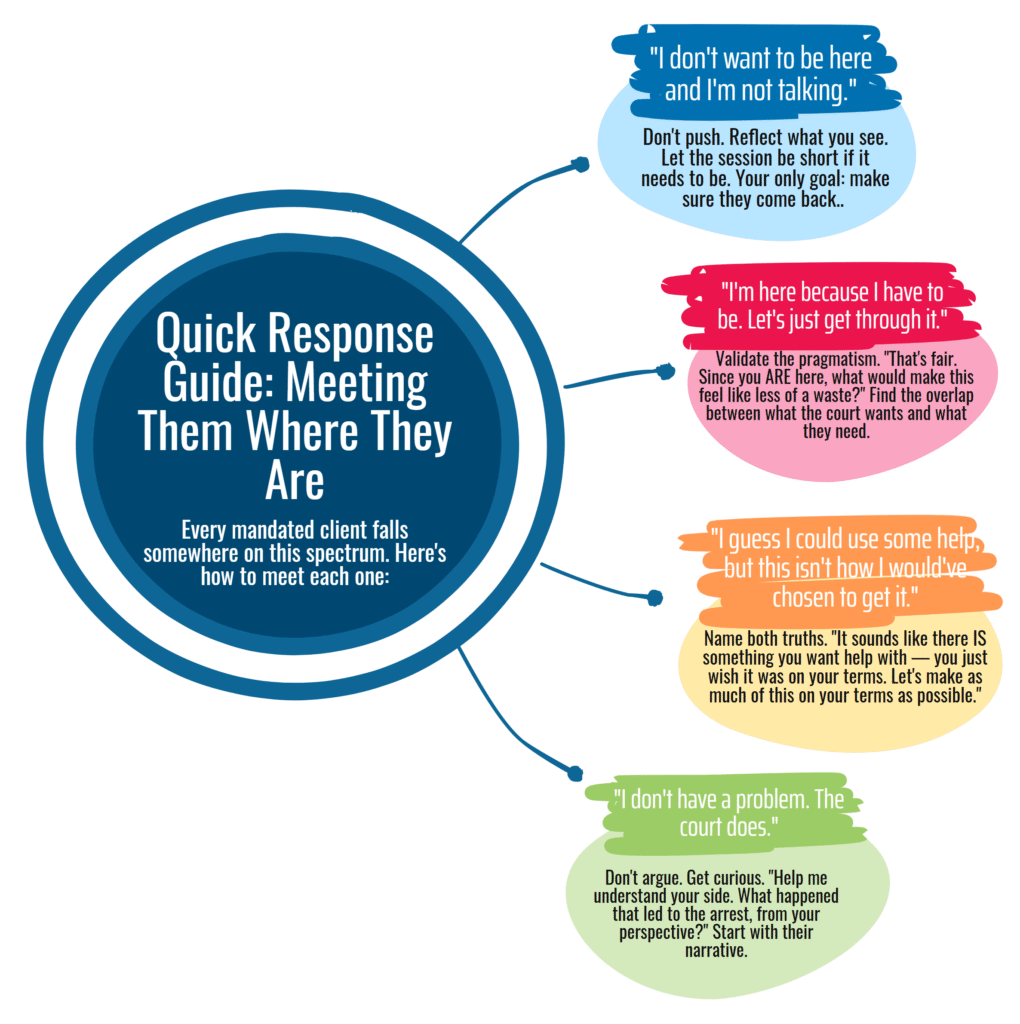
Every mandated client falls somewhere on this spectrum. Here’s how to meet each one:
- “I don’t want to be here and I’m not talking.” Don’t push. Reflect what you see. Let the session be short if it needs to be. Your only goal: make sure they come back.
- “I’m here because I have to be. Let’s just get through it.” Validate the pragmatism. “That’s fair. Since you ARE here, what would make this feel like less of a waste?” Find the overlap between what the court wants and what they need.
- “I guess I could use some help, but this isn’t how I would’ve chosen to get it.” Name both truths. “It sounds like there IS something you want help with — you just wish it was on your terms. Let’s make as much of this on your terms as possible.”
- “I don’t have a problem. The court does.” Don’t argue. Get curious. “Help me understand your side. What happened that led to the arrest, from your perspective?” Start with their narrative.
When Motivational Interviewing Isn’t the Right Move
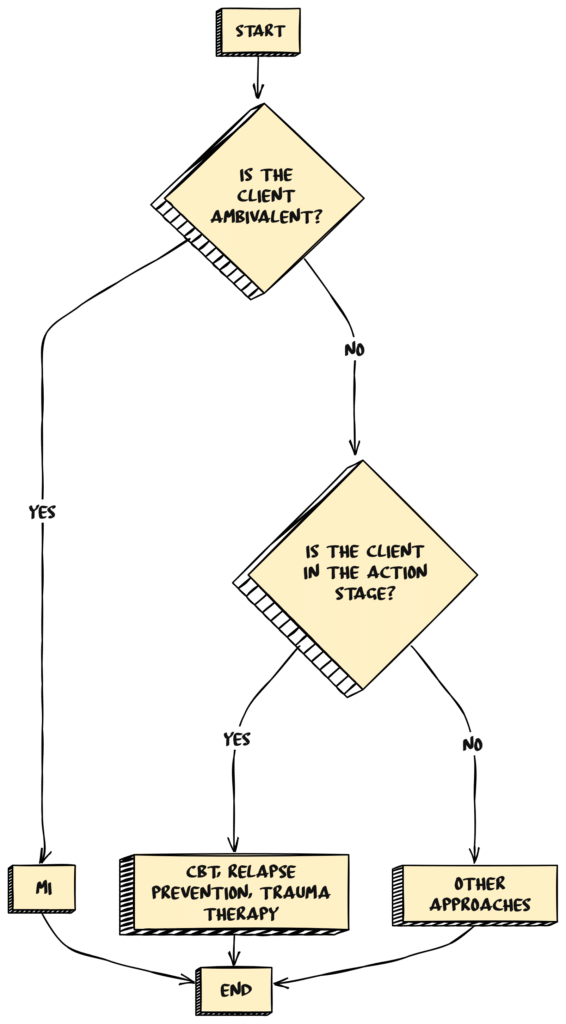
Here’s something most MI trainings don’t emphasize enough: motivational interviewing is not always appropriate.
If a client walks in and they’re already in the action stage of change — they know what they want to work on, they’re ready to go, they’re asking for tools and strategies — you don’t need to sit there exploring ambivalence that doesn’t exist.
That client needs CBT. Relapse prevention planning. Trauma therapy. EMDR. Maybe a 12-step connection. They need direct strategies, not reflective listening about whether they want to change.
Using MI with someone who’s past ambivalence can actually slow things down. It can feel patronizing — like you’re not listening to what they’re telling you, which is: I’m ready. Help me do the work.
Read the room. Motivational interviewing for mandated clients is powerful when someone’s stuck between wanting to change and not being sure. When they’ve already decided? Get out of the way and give them what they need.
A Note About Clinician Self-Awareness
I want to say this carefully, because I’m not trying to call anyone out. But it needs to be said.
A lot of clinicians will tell you they know MI. They’ve done the training, they can name the processes, they can define change talk vs. sustain talk. And then they get in session with a mandated client who’s defensive, hostile, dismissive — and all of that training goes out the window.
They get triggered. They get emotionally reactive. They start arguing for change instead of evoking it. They take the client’s attitude personally. And before they know it, they’re doing confrontation in an MI costume — asking leading questions to steer the client toward a predetermined conclusion.
If you find yourself frustrated with a mandated client’s “resistance,” the first question isn’t about the client. It’s about you. What’s getting activated? Where’s the judgment coming from? Because MI only works if you actually believe this person’s perspective has value — not as a technique, but for real. As Miller and Rollnick have emphasized, fidelity to the spirit of MI matters more than technical proficiency — and studies show that when clinicians don’t actually deliver MI with fidelity, outcomes suffer regardless of training.
A Note on Documentation
One more thing that doesn’t get talked about enough: MI is chronically underrepresented in clinical notes.

When you spend a session building rapport, validating a client’s experience, evoking change talk, and helping them connect court requirements to personal goals — that’s significant clinical work. But if your note just says “client attended session, discussed substance use, appeared engaged” — none of that shows up.
The interventions you’re using, the shifts you’re observing, the change talk emerging session by session — all of that needs to be in the documentation. Otherwise it looks like nothing’s happening when in reality, you’re laying the groundwork for everything that comes next.
This is especially important with mandated clients, where courts and POs are reading your notes to determine compliance and progress. If your MI work isn’t reflected in your documentation, it’s invisible — and your client doesn’t get credit for the real progress they’re making.
📁 Month 5 Resources: Log in or create a free account to download from the Justice-Involved Mastery Page
→ MI Session Cheat Sheet for Mandated Clients — Practical phrases and scripts organized by MI process: engaging, focusing, evoking, and planning. Includes “instead of this, try this” language swaps, a quick response guide for common client presentations, and clinical tips for each stage.
→ MI Language Upgrades for Your Progress Notes — You don’t need a new template — you need better language in the notes you’re already writing. This guide gives you drop-in phrases and quick swaps that make your existing progress notes MI-aligned and court-friendly without adding a single extra form to your workflow. Includes seven common compliance phrases and what to replace them with, copy-paste sentences for common situations, and documentation guidance for tricky scenarios like when a client shows up high, reports a relapse, or gets hostile.
Next month: Managing Relapse When the Court is Watching
This is Article 5 of the Justice-Involved Treatment Mastery Series — an 8-month deep dive for clinicians working with mandated clients, drug court participants, and anyone navigating treatment in justice settings.
Missed the earlier articles? Start with Article 1: Beyond Court Compliance →
Previous articles in this series:
- Month 1: Beyond Court Compliance: Harm Reduction with Mandated Clients →
- Month 2: When the Judge Says Abstinence but Evidence Says Harm Reduction →
- Month 3: From Compliance to Care: Why Justice-Involved Clients Need a Different Approach →
- Month 4: Documentation That Satisfies Courts AND Supports Recovery →
Browse the full Justice-Involved Treatment Mastery hub →
Not a member yet? Create a free account to access resources →
References
- Miller, W. R., & Rollnick, S. (2013). Motivational Interviewing: Helping People Change (3rd ed.). Guilford Press. https://motivationalinterviewing.org/researching-motivational-interviewing
- Substance Abuse and Mental Health Services Administration. (2019). TIP 35: Enhancing Motivation for Change in Substance Use Disorder Treatment. Treatment Improvement Protocol (TIP) Series, No. 35. https://www.samhsa.gov/resource/ebp/tip-35-enhancing-motivation-change-substance-abuse-treatment
- Substance Abuse and Mental Health Services Administration. (2020). Advisory: Using Motivational Interviewing in Substance Use Disorder Treatment (Based on TIP 35). https://library.samhsa.gov/product/advisory-using-motivational-interviewing-substance-use-disorder-treatment-based-tip-35
- Lincourt, P., Kuettel, T. J., & Bombardier, C. H. (2002). Motivational interviewing in a group setting with mandated clients: A pilot study. Addictive Behaviors, 27(3), 381-391. https://www.sciencedirect.com/science/article/abs/pii/S0306460301001794
- Coviello, D. M., Zanis, D. A., Wesnoski, S. A., & Alterman, A. I. (2013). Does mandating offenders to treatment improve completion rates? Journal of Substance Abuse Treatment, 44(4), 417-425. https://pmc.ncbi.nlm.nih.gov/articles/PMC3578041/
- Hachtel, H., Vogel, T., & Huber, C. G. (2019). Mandated treatment and its impact on therapeutic process and outcome factors. Frontiers in Psychiatry, 10, 219. https://www.frontiersin.org/journals/psychiatry/articles/10.3389/fpsyt.2019.00219/full
- Hazelden Betty Ford Foundation. (n.d.). Motivational interviewing research. https://www.hazeldenbettyford.org/research-studies/addiction-research/motivational-interviewing
