
Monthly Strategies for the Underdog Clinician
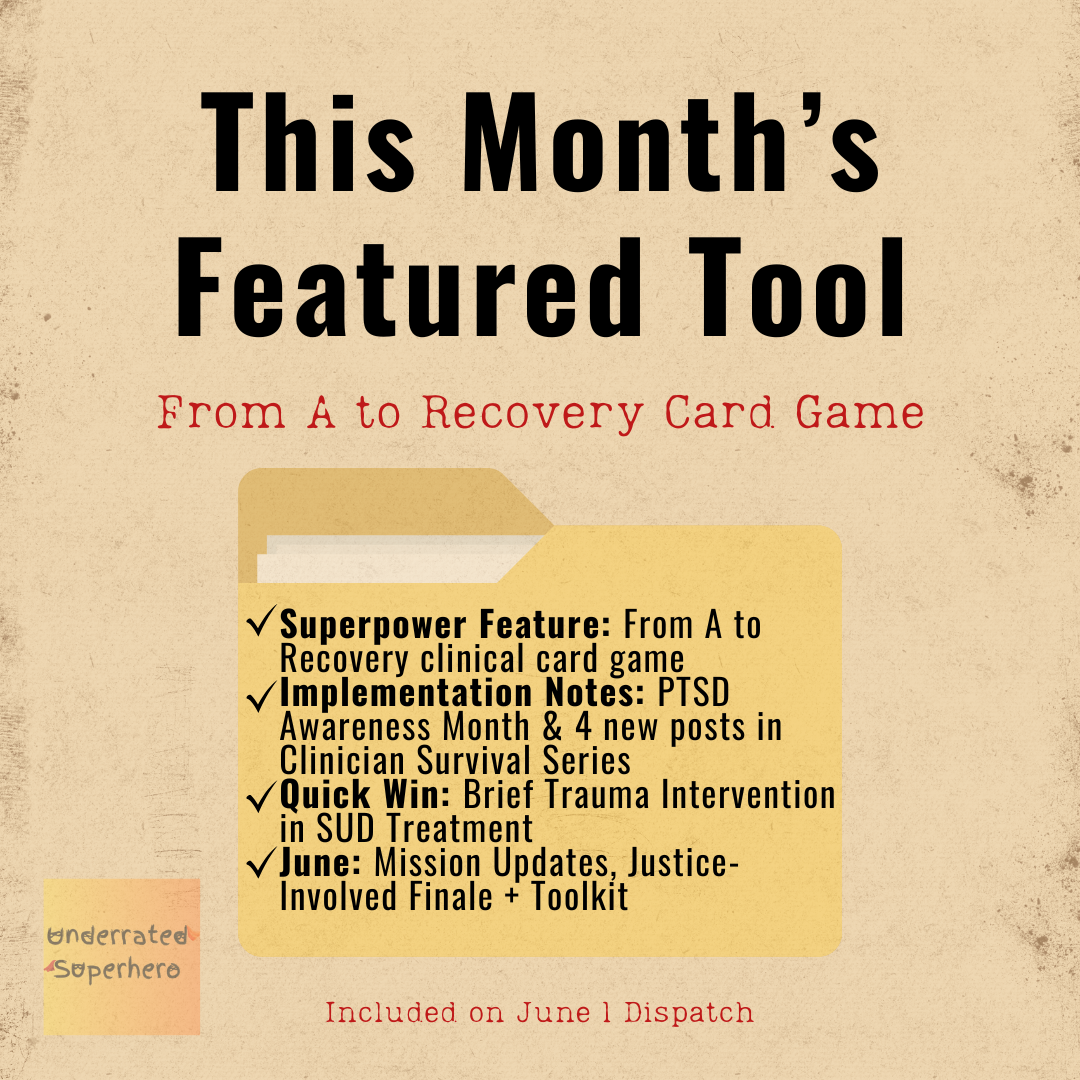
FEATURED HIGHLIGHT: From A to Recovery
This is Vol 11 of The Underrated Dispatch.
PTSD Awareness Month. Men’s Mental Health Month. Pride Month. Juneteenth. June is full.
It’s also the month From A to Recovery gets its formal spotlight - a clinical card game system built for the moments when traditional talk therapy isn’t reaching where the work needs to go.
THE CLINICAL PROBLEM IT SOLVES
You know the clients. The teenager who shrugs at every open-ended question. The adult in early recovery whose vocabulary for what’s happening inside them hasn’t caught up to what’s happening. The group session where two clients dominate and three stare at the floor. The kid in family therapy who can’t sit still long enough to talk about anything.
Verbal processing has limits. Some clients can’t yet name what they’re feeling. Some have been asked to name it so many times it’s lost meaning. Some need a structure that takes the pressure off direct disclosure. Some need play, or distance, or a third object in the room that isn’t them and isn’t you.
From A to Recovery is a letter-based clinical card game system built for exactly those moments. Four base editions — Substance Use, Mental Health, Youth, and Kids — each designed for a specific clinical population. Plus specialty add-ons that layer onto the core game: Stereotypes & Stigma, Grief & Loss, Trauma, Co-occurring, and Justice-Involved.
Print-at-home PDFs. Built for individual sessions, family work, and groups across the full treatment continuum.
For PTSD Awareness Month specifically — the Co-occurring add-on ($5, universal — works with either the Substance Use or Mental Health base edition) is built for clinicians working at the trauma–SUD intersection where direct conversation isn’t yet possible.
Pricing: Core editions are $15 each as digital downloads. Add-ons start at $5.
A lighter version is also available for paid members.
THIS MONTH IS REALLY ABOUT TRAUMA
Most SUD clinicians already know what the research keeps confirming: trauma exposure runs high in the populations we serve. Co-occurring PTSD is the rule, not the exception. The question was never whether the clients in front of us have trauma histories. The question is what we do with that — within scope, without being reckless, and without staying on the sidelines.
PTSD Awareness Month is a useful frame because it lets us name something the field is quiet about: trauma exposure remains undetected in a majority of treatment-seeking SUD clients. Not because clinicians don’t care. Because the barriers to trauma inquiry are real — feeling uncomfortable asking, fear of retraumatizing, fear the client will terminate treatment, uncertainty about reporting requirements, lack of local trauma-specific referrals. Those barriers are legitimate. They’re also not a reason to do nothing.
This month’s resources are about what happens between recognizing trauma is there and referring out — the work most resources skip. Brief intervention. Stabilization. Acknowledging without processing. Keeping the SUD work intact when trauma is shaping it.
This is what the SUD counselor’s lane actually looks like when trauma is in the room. Most of you are already doing more of it than you realize. Some of you are doing less of it than your clients need. This month is about closing both gaps.
Important June Updates
🟢 IT’S PTSD AWARENESS MONTH
June is PTSD Awareness Month — and for most of the clinicians reading this, PTSD isn’t an awareness campaign, it’s a clinical reality in nearly every caseload. Co-occurring PTSD is the rule in SUD treatment, not the exception. This month’s content and resources reflect the intersection of trauma and substance use, and the clinicians sitting at that intersection every day.
⚖️ IT’S ALSO PTSD AWARENESS DAY (JUNE 27)
PTSD Awareness Day falls on June 27 this year. A specific date to bring trauma forward in your work — not by pushing every client into trauma conversations, but by noticing which clients you’ve been keeping the topic away from, and asking yourself why.
JUNE MISSION UPDATES
Here’s everything happening this month:
- Featured Highlight (6/1) — From A to Recovery Lite Version Released
- Featured Board (6/1) – Men’s Focused Interactive Board
- New Clinician Series (6/7; 6/14; 6/21; 6/28) — Four new posts this month
- Monthly Content Drop (6/15)
- AI In Clinical Practice (6/15) – First blog in the series, with subsequent blogs released on 1st and 15th of month
- Justice Involved Mastery Series Now Live – Complete toolkit unlocked 5/31, free for all subscribers
- PTSD Awareness Month – All of June
BONUS SPECIAL: New Clinician Survival Series – Ongoing
Weekly strategies that bridge theory and reality
June’s series moves into some of the harder professional territory in this work — the moments where new clinicians find themselves in over their head, and where staying upright depends on knowing what’s yours to carry and what isn’t.
Recent Posts You May Have Missed:
- “My Client Isn’t Getting Better and I Don’t Know Why” – When the work stops making sense, and you can’t tell if it’s the client, the approach, or you.

- “I’m Tired of Waiting” – When clinical practice wears thin, and what the impatience is actually telling you

- “When Someone Tells You They Want to Die” – The moment most clinicians fear above all else
Coming in May:
- Blog #34 “My First DCFS Call” (6/7) — The phone call you don’t get to take back, and how to think before you make it
- Blog #35 “My Client Just Asked If I’ve Been Through It” (6/14) — One of the trickiest moments in early-career work, and how to handle it without losing the relationship or losing yourself
- Blog #36 “My Client Knows More About This Than I Do” — The humility this work requires that nobody trains you for
- Blog #37 “I’m Not Ready To Discharge Yet” — When the system makes the decision and you have it deliver it
What Makes This Series Different:
Unlike generic “new professional” advice, this series specifically addresses the unique challenges of behavioral health work. Each post includes the uncomfortable thought, why it happens, what to do about it, and tools you can use immediately—decision trees, scripts, and reflection prompts.
Follow along: New posts drop every Sunday.
FEATURED BOARD: Men’s Focused Interactive Board
Men’s mental health is one of the most underserved corners of behavioral health work, and the intersection with substance use is where it shows up hardest. Men present for SUD treatment, and the depression, trauma, and emotional dysregulation underneath often go unscreened, unnamed, or labeled as character problems.
The Men’s Board is built for the clinicians working with that reality — the SUD counselors and mental health clinicians sitting across from male clients whose presentations don’t match the textbook, whose disclosures come sideways if they come at all, and whose cultural and family contexts shape what’s possible in the room.
Perfect For:
- Clinicians doing SUD work with predominantly male caseloads
- Mental health clinicians whose male clients aren’t engaging the way the textbook says they should
- Justice-involved treatment settings where most clients are men
- Anyone working at the intersection of masculinity, mental health, and substance use
- Clinicians who suspect they’re missing something with male clients and want to understand what
Quick Win Tool of the Month
Brief Trauma Intervention in SUD Treatment
A Clinical Decision Frame + Companion Containment Quick Reference Card
In honor of PTSD Awareness Month, this month’s Quick Win Tool addresses the part of trauma work most resources skip — the brief intervention that happens in the SUD counselor’s office, before, alongside, or instead of trauma therapy.
The clinical decision frame walks through five questions: what’s within your expertise, what’s your containment plan, what’s the referral picture, what to do when it doesn’t go well, and how to document without overclaiming. Plus cultural considerations and a clinician self-check.
The companion Containment Quick Reference Card is for the in-the-moment work — what to do when trauma surfaces unexpectedly in session. Going-well vs. going-sideways distinctions, specific grounding tools, and how to respond when a client dysregulates, dissociates, shuts down, gets angry, or leaves.
This isn’t a screener. It isn’t a training. It’s a decision frame for SUD counselors who want to be capable, contained, and never reckless when trauma is in the room.
Free for all subscribers
UNDERRATED TACTIC: Brief Intervention as the Bridge for the Client Who Won’t Go
Male SUD clients refuse trauma therapy referrals at high rates. The reasons vary — stigma, distrust of mental health systems, “I’m not crazy,” the assumption that talking about it will make it worse, the cultural messaging that says men handle things alone. The result is the same: he’s in your SUD treatment, trauma is shaping his use, and the trauma therapy you’ve referred him to isn’t happening.
This is where brief intervention earns its place. Not as a substitute for trauma therapy — going deeper because he won’t go elsewhere is exactly the recklessness this work warns against. But as the stabilization that keeps trauma from collapsing the SUD work. Acknowledging what’s there. Building skills he can use when activation drives his urge to use. Naming the connection between what he’s survived and what he’s using to manage it. Holding hope that trauma therapy might one day feel possible — without making it a condition of the work.
The client who won’t go anywhere else needs you to know the difference between filling the gap and staying in your lane. This month’s Quick Win Tool gives you the frame.
PAIRS PERFECTLY WITH THIS MONTH’S QUICK WIN: The Brief Trauma Intervention Decision Frame
SOMETHING NEW – AI In Clinical Practice
I’ve started a series on something I’ve been doing quietly for two years — using AI in clinical work, carefully, and learning where it helps and where it quietly goes wrong. The first posts are about a single idea: AI can draft a lot of things now, but reading what it hands you is still clinical work, and that work doesn’t go away as the tools get better. It’s not anti-AI and it’s not a sales pitch for it. It’s the middle position, from someone actually doing the work.
First post goes live June 15 — I’d love for you to read it and tell me what lands.
FINALE – Justice-Involved Treatment Mastery Series
Mastery Series Update
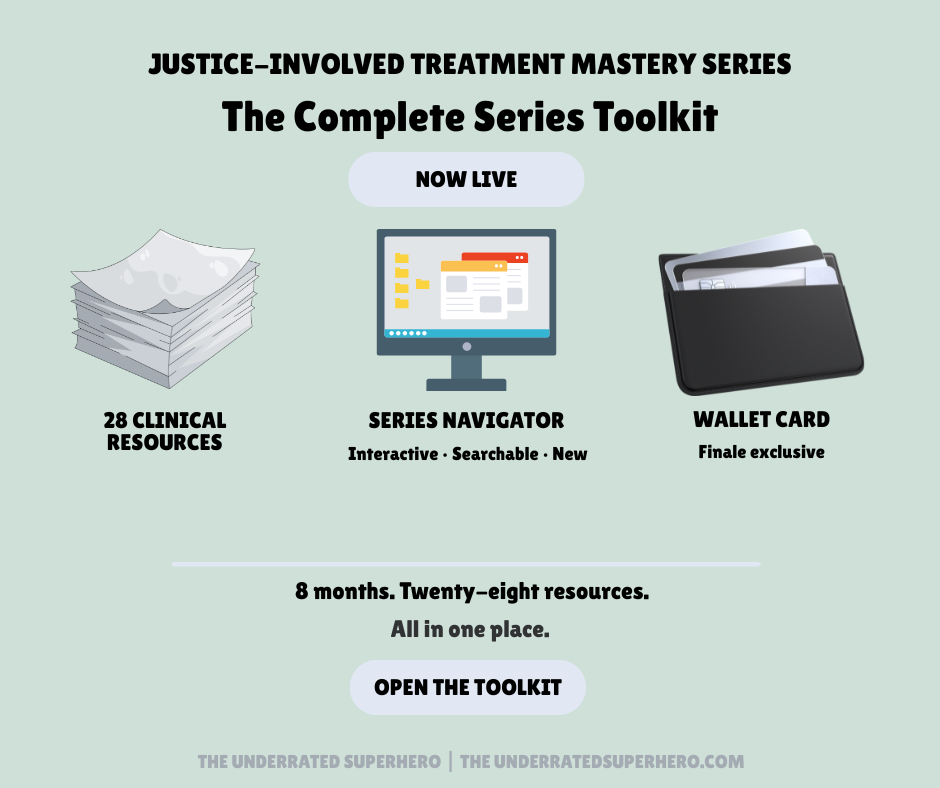
The Justice-Involved Treatment Mastery Series toolkit unlocked May 31st. The complete series — all eight articles and every resource — is available now, free for all subscribers. If you didn’t catch the series as it rolled out, this is the time. It’s one of the most clinically dense resources on the platform.
Trauma is already in your caseload. The question isn’t whether to address it. The question is whether you have the frame, the tools, and the discipline to address it within scope.
The Underrated Superhero Resource Hub has ready-to-use tools, templates, and clinical resources built by someone who still sits across from clients every week. Use them.
— The Underrated Superhero
Prefer to download and read later?
