
Scared of a Client

There’s a fear that doesn’t make it into supervision.
Not the fear of saying the wrong thing — we’ve talked about that one. Not the fear of not being good enough — that one too. This is the other one. The one most new clinicians carry alone because it feels like something you’re not supposed to have if you chose this field on purpose.
It’s the fear that lives in your body before your brain catches up. The tight chest before you walk into a room. The sick feeling on the drive in. The weird, almost subconscious awareness of exactly where the door is.
It’s the fear that your client actually scares you.
📚 This is Blog #22 in the New Clinician Survival Kit Series (Click to explore the series)
Weekly honest support for the struggles every clinician faces: “I hate group therapy.” “I can’t do this.” “My client hates me.” “I’m making it worse.” “I can’t say no.” “They’re going to report me.” “I’m too tired to care.” “What do I even say?” “I don’t know enough.” “They keep relapsing.” “Am I documenting wrong?” “My supervisor doesn’t get it.” “I can’t handle this caseload.” “Nobody told me about the paperwork.” “I don’t like my client.” “My client’s cute.” “My client likes me.” “I got a complaint.” “I want to quit.” “My coworker is terrible.” “The most underrated job in mental health.” “My client scares me.”
These aren’t signs you’re failing. They’re signs you’re human.
This Is a Three-Part Series
Fear in clinical work doesn’t come from one place, and it didn’t feel right to cram all of it into one post. So here’s how we’re breaking it down:
- Part 1 (this one): The fears we feel we aren’t supposed to admit — raw, physical, gut-level fear. The vulnerability post.
- Part 2 (March 22): The high-stakes client — suicidal clients, mandated clients, trauma histories. Fear of getting it wrong when wrong has real consequences.
- Part 3 (March 29): Fear of what they show you — countertransference, your own stuff, the client who holds up a mirror.
We’re starting with the one that’s hardest to say out loud.
The Fear Rarely Talked About in Grad School
Programs teach you a lot. Rapport. Holding space. Evidence-based interventions. How to write a treatment plan. How to manage parallel process in supervision.
What they don’t teach you is what to do when you’re standing in a hallway and a client is walking toward you and your gut says:
something is wrong here.
They don’t tell you your body might register a threat before your brain has even caught up. And they really don’t tell you that this is going to happen, that it’s not a sign you’re in the wrong field, and that you’re not the only one it’s happening to.

The Post-Session Replay
For a lot of new clinicians the first version of fear isn’t physical. It’s the mental audit that kicks in the second a session ends.
Did I say the right things? Did I probe enough? Did I miss something? What if I just caused harm and have no idea?
The loop itself
It runs on a loop. Drive home, shower, 2am. Every pause, every moment you weren’t sure what to say, every client who looked at you like you weren’t getting it — all of it comes back.
This is the fear of harm through omission. Not I did something wrong — I might have missed something and I don’t know what it was. It’s quiet, it’s relentless, and almost no one names it out loud.
It’s also not the same as imposter syndrome. Imposter syndrome says I’m bad at this. This fear says something bad might happen because of what I didn’t catch. Different problem. Different response needed.
🚨 Signs Your Body Is Scared Before Your Brain Is
Check anything that sounds familiar.
The Fear That Lives in Your Body
Okay. The harder one.
I worked in residential treatment with youth for a while. And for that time, I guess I was scared. Not in a way I ever said out loud. But in a real, physical way — the kind your body knows even when your brain is insisting you’re fine.
By the time I left that job I had been hit, bitten, and punched. I was short. Not physically intimidating. Working with kids in crisis every single day, some of them unpredictable in ways that were hard to anticipate.
I wasn’t alone in that experience. Research in the National Library of Medicine found that roughly three-quarters of clinicians in drug and alcohol services reported at least one incident of workplace violence over the course of their career. [1] Three quarters. That’s not an edge case. That’s just the job.
The Client With the Glazed Eyes
There’s a client I still think about. A tween. One day she looked at me with this glazed, unfocused stare — like the lights were on but she’d stepped out. And before I had processed what I was seeing, she started moving her hands toward my throat.
I blocked her hands. Slowly. Without making a scene. Called out to another staff member like I was asking them something routine. Kept my face neutral the whole time.
I did everything right.
I was also terrified.
Not because I thought she’d seriously hurt me. Because I’d just watched a client go somewhere I didn’t have words for, and I had no language for what dissociation actually looks like in real time, and I was alone in that hallway. That was the first time I understood that clients can lose it in a quiet, clinical way — not a movie way. And my training hadn’t prepared me for what that actually looked like in front of me.
When They All Run at You
There was another moment. A group of kids — all of them about my height, all of them angry, all moving at the door at once.
I should have held it. I’d held it before.
I moved.
Not a decision. My nervous system made the call before I did. The other staff member looked at me. I knew exactly what that look meant. I carried the shame of that for days.
What I know now that I didn’t know then: my body wasn’t wrong. It was scared because the situation was scary. The shame wasn’t telling me I’d failed. It was telling me I’d been trained to distrust myself.
What Trained Fear Looks Like vs. Untrained Fear
The starkest version of this I ever witnessed was during a restraint. Working with kids in a residential setting means you train for physical intervention. You learn least restrictive. You learn how to use your body without causing harm. You learn that the goal is de-escalation, not control.
One day a kiddo escalated to the point where the police were called. It had taken two of us to get that kid safely contained — two trained clinicians, least restrictive holds, the whole protocol. When the officers arrived, they took over. It took four of them.
Not because the kid got stronger. Because they were scared.
They were doing exactly what they were trained to do — protect themselves first. That’s not a criticism. That’s just what fear without a clinical framework looks like in a body. And watching it happen, watching a child become more distressed, watching the other kids in the unit absorb what was happening around them — that’s when I understood something about what our training actually does.
It doesn’t eliminate the fear. It gives the fear somewhere to go that isn’t onto the client.
Why We Don’t Say It
At that job, I probably could have told someone I was anxious. My supervisor wasn’t unapproachable. The door was open.
I never walked through it.
I had spent years being the person who could handle things. I didn’t get rattled. And honestly? I had judged colleagues who did seem scared — the ones who seemed fragile or too timid for this kind of work. I was not going to be one of them.
So, I kept showing up. Kept the face on. Kept doing the mental math of I’m fine, I can handle this while my body was doing something else entirely.
I think a lot of new clinicians do the same thing — especially in high-acuity settings. Not because they’re in denial, exactly. Because naming fear costs something. Your identity. The version of yourself you’ve been building since you decided to do this work. The fear of what it would mean if you admitted it.
For a lot of us, the scariest thing isn’t the client. It’s what saying I’m scared would say about us.
The Gap Between the Performance and the Body
There’s a gap. Between the clinician you’re performing and what’s actually happening in your body in that room.
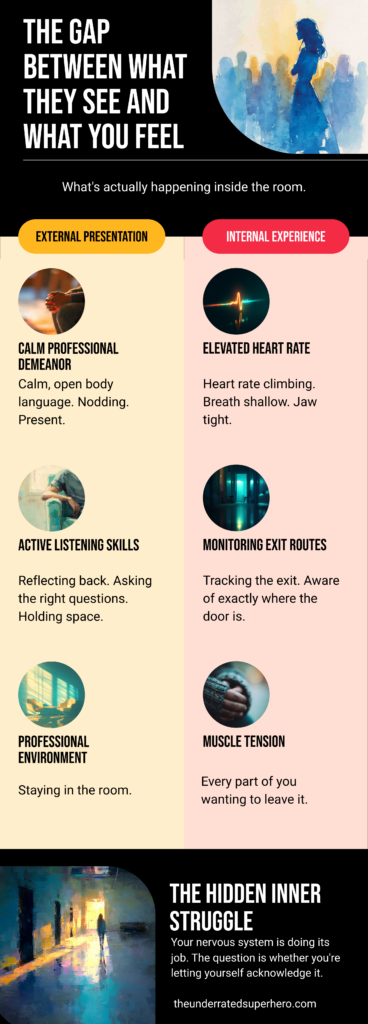

You’re nodding, reflecting, holding space. And underneath that, your heart rate is up, and your jaw is tight and some part of you is tracking the nearest exit.
Most new clinicians don’t catch this in the moment — they’re too busy keeping the face on. They catch it later. In the car. In their own therapy. In the quiet moment where they think, I don’t know how long I can keep doing this. If that’s where you are, it’s worth reading the burnout post too — fear and burnout are usually in the same room.
Your nervous system doing that? Not a malfunction. It’s doing exactly what it’s supposed to do. The question is whether you’re letting yourself acknowledge it.
The System That Made This
I want to say something that doesn’t get said enough in this field.
A lot of this fear — maybe most of it — is a predictable outcome of a system that underinvests in the people doing the hardest work.
New clinicians get thrown into residential, crisis, corrections, community mental health with inadequate training, no real support structure, and pay that makes self-care feel like a joke. The Bureau of Labor Statistics puts the median wage for addiction and behavioral disorder counselors at $59,190 [2] — that’s for work that includes routine exposure to trauma, crisis, and in a lot of settings, physical danger. And when clinicians struggle under those conditions, the unspoken message is usually that struggling means they’re not cut out for this.
That’s not true. That’s just what the system needs you to believe so it doesn’t have to change.
If you’ve been blaming yourself for being scared in conditions that would scare most people, I want you to hear that the blame is in the wrong place. And if you need tools for navigating high-pressure environments without building them from scratch, the resource hub has a lot of what we never got handed.
Some Things That Actually Help
I’m not going to give you a tidy list of five steps. That’s not what this is. Some of what makes this work scary can’t be fixed with a blog post — it’s systemic and it’s going to take longer than we’d like.
But a few things that are actually within reach:
Name it to yourself first. You don’t have to tell your supervisor. You don’t have to bring it to group. Just stop pretending it isn’t there. That’s it. Just stop lying to yourself about it. Because every time you override the fear response without acknowledging it, you’re training yourself to distrust your own instincts — and those instincts are the thing keeping you safe.
Find one person safe enough to say it to. One. Doesn’t have to be your supervisor. Could be a colleague, a therapist, a person in your cohort who you actually trust. Say it once. See what happens. It moves differently when it’s been said out loud instead of just living in your head at 2am.
Trust the read.
If something feels off, pay attention to that. Your nervous system is processing information faster than your conscious mind. That uneasy feeling you can’t quite name? It’s data. You don’t have to act on it immediately. But you shouldn’t talk yourself out of it, either.
Know what your plan is. Knowing where the exits are isn’t paranoia. Knowing who you call isn’t catastrophizing. Knowing the de-escalation protocol before you need it isn’t being dramatic. Having a plan means you’re not making decisions from pure adrenaline if something goes sideways. OSHA has guidelines on workplace violence prevention in healthcare settings that most agencies never hand you. You’re allowed to read them. [4]
You can say no. You’re allowed to decline working with a client. You don’t need a dramatic reason. “I don’t think I’m the right fit for this client” is a complete sentence. Protecting yourself isn’t abandonment. It’s clinical judgment.
What Happens to the Client If You Recognized Yourself in Any of This

This was for you.
Not the version of you who has it together and handles everything and never lets them see you sweat. The other one. The one who moved when you should have held the door and felt the shame of it for days. The one who blocked a client’s hands in a hallway and kept your face completely neutral while your heart was doing something else.
That one. You’re not weak. You’re not in the wrong field. You’re doing a hard job in a system that doesn’t support you the way it should, and you’re still showing up. That matters.
The fear doesn’t mean you’re bad at this. It means you’re paying attention.
Part 2 is next week. We’re going to talk about what happens when the fear isn’t about your physical safety — it’s about the stakes. Suicidal clients. Mandated clients. The ones where getting it wrong has real consequences. That one’s different. And it also needs to be said.
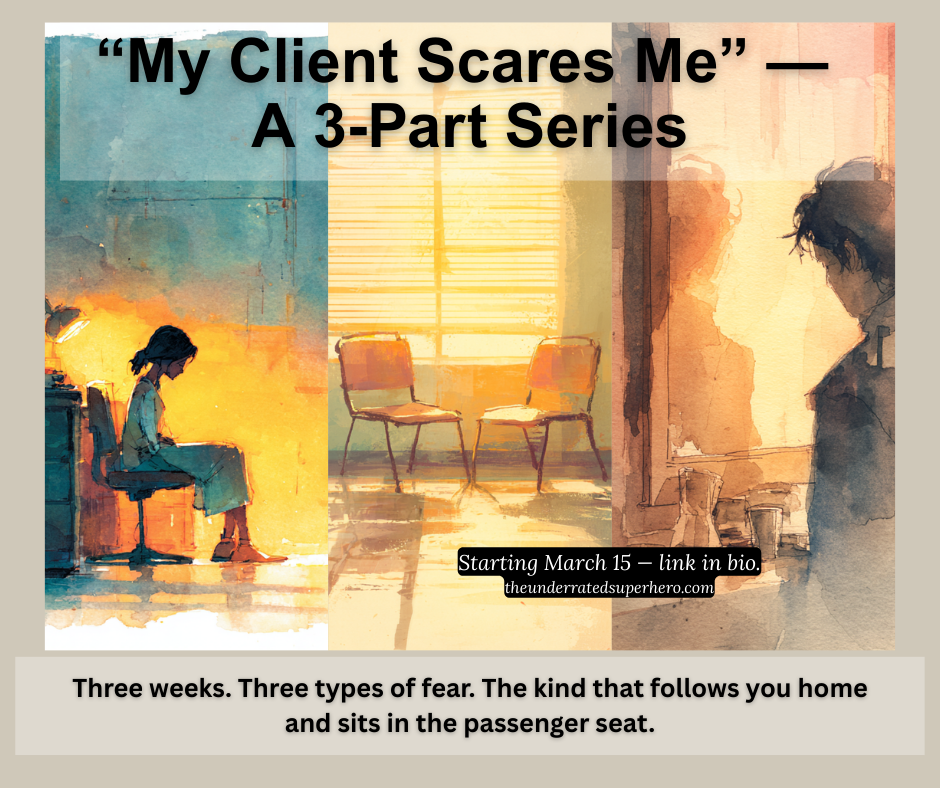
Next in the Series: “My Client Scares Me, Part 2: The High Stakes Client” — because some clients don’t just make you nervous. They make you terrified of getting it wrong. The suicidal client. The mandated client. The one where the weight of the session follows you home and sits in the passenger seat long after you’ve clocked out.
This is Blog #22 in the New Clinician Survival Kit Series by The Underrated Superhero. If this hit close to home, you’re not alone. Follow along for more real talk about surviving your first years in clinical work.
Until Next Week | The Underrated Superhero
© 2026 The Underrated Superhero LLC. All Rights Reserved.
📖 External Resources & Research
- 🔗 Patient Violence Towards Counselors in Substance Use Disorder Treatment Programs — PMC — Research finding that roughly three-quarters of clinicians in drug and alcohol services reported at least one incident of workplace violence over the course of their career
- 🔗 Substance Abuse, Behavioral Disorder, and Mental Health Counselors — Bureau of Labor Statistics — 2024 data showing median salary of $59,190 for addiction counselors, with 17% projected job growth through 2034
- 🔗 Workplace Violence Prevention in Healthcare — OSHA — Federal guidelines on workplace violence prevention that most agencies never hand to new clinicians
📌 From This Series
- 🔗 Blog #2: “I Can’t Do This” — On imposter syndrome and the fear that you’re not cut out for this work
- 🔗 Blog #8: “What Do I Even Say?” — When you freeze in session and your training doesn’t show up
- 🔗 Blog #7: “I’m Too Tired to Care” — When exhaustion stops being a bad week and starts being your baseline
- 🔗 Blog #13: “I Can’t Handle This Caseload” — Drowning in clients and running out of air
- 🔗 Blog #19: “I Want to Quit” — When burnout becomes a career question
- 🔗 Blog #20: “My Coworker Is Terrible” — When the disrespect is coming from inside the building
