
Monthly Strategies for the Underdog Clinician
Featured Highlight: NEW — CLINICAL WALLET CARDS: TOOLS THAT FIT IN YOUR POCKET
Your clients don’t need another handout that ends up in the trash. They need something they’ll actually keep.
Something small enough to fit in a wallet. Sturdy enough to survive a back pocket. Something they can pull out in a parking lot before a craving wins, or in a waiting room when everything feels like too much.
Introducing the Clinical Wallet Card Collection:
HALT Check-In Card — Hungry, Angry, Lonely, Tired. Four questions that interrupt a craving before it takes over. The most widely used self-check in addiction treatment — now your clients can carry it with them.
Mindfulness Grounding Card — The 5-4-3-2-1 sensory grounding exercise on a laminated card. Simple enough to use without instruction. Perfect for clients dealing with anxiety, trauma responses, or early recovery overwhelm.
Regulate Card — A quick-reference emotional regulation tool for clients who struggle with emotional flooding, impulsive behavior, or shutting down under stress. Identify the feeling. Choose a response. Skip the reaction.
Each card is printed on cardstock, laminated for durability, and designed for real life — not a therapist’s Pinterest board. Available in 4-packs and 10-packs for caseload-ready ordering.
Hand them out in group. Tuck them into discharge packets. Keep a stack in your office for the moments when a client needs something concrete to hold onto.
IMPORTANT MARCH UPDATES
🎉 IT’S SOCIAL WORK MONTH
March is Social Work Month — and this month’s content honors the people doing the work. With honest conversations about what this profession actually costs the people inside it.
MARCH MISSION UPDATES
Here’s everything happening this month:
- Featured Board (3/1) – Outpatient Settings
- Monthly Content Drop (3/15)
- New Clinician Series (3/1; 3/8; 3/15; 3/22; 3/29) — Five new posts this month
- Justice Involved Mastery Series (3/8) – 6th Article Release: Justice-Involved Treatment Series
Bonus Special: New Clinician Survival Series – Ongoing
Weekly strategies that bridge theory and reality
This month’s series tackles the stuff that doesn’t show up in job descriptions: the coworker who makes you want to quit and the profession that demands everything but pays like it doesn’t matter. Real talk for Social Work Month.
Recent Posts You May Have Missed:
- “I Got a Complaint” — The panic, the shame, the “am I going to lose my license” spiral

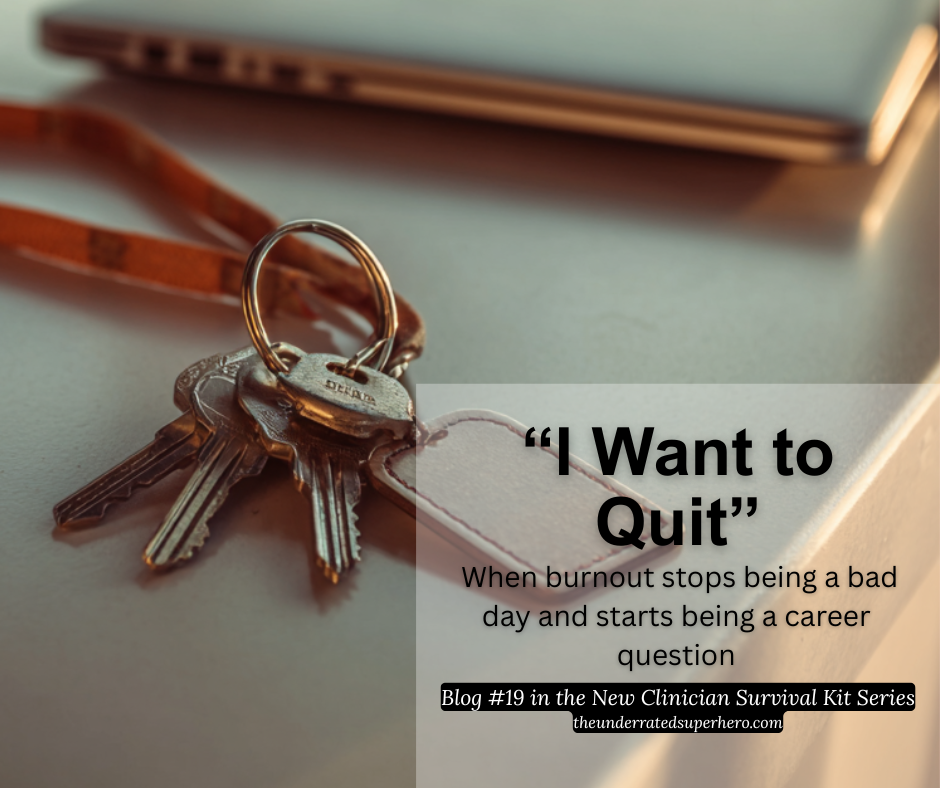
- “I Want to Quit” — When burnout becomes a career question
- “My Client Likes Me” — When transference gets personal

- “My Client’s Cute” — Countertransference, guilt, and what to actually do about it

Coming in March:
- “My Coworker Is Terrible” (3/1) — When the hardest part of the job isn’t the caseload. It’s the person ten feet away from you.
- “Nobody Respects What We Do” (3/8) — The cost of being essential and invisible. This one’s got data. And it’s going to make you feel seen.
- Plus three more posts dropping 3/15, 3/22, and 3/29.
What Makes This Series Different:
Unlike generic “new professional” advice, this series specifically addresses the unique challenges of behavioral health work. Each post includes the uncomfortable thought, why it happens, what to do about it, and tools you can use immediately—decision trees, scripts, and reflection prompts.
Follow along: New posts drop every Sunday.
IMPLEMENTATION NOTES
March brings Social Work Month — and with it, an honest look at why this profession burns through people faster than it can replace them.
The field is projected to be short over 100,000 addiction counselors by 2037. The median salary is $59,190. The average student loan debt for counselors is $79,500. The math doesn’t work. And the people inside the profession know it.
This month’s content doesn’t pretend that passion is enough. It meets you where you actually are — overworked, underpaid, dealing with coworkers who drain you before your first client walks in, and wondering if anyone notices what this job actually takes.
FEATURED BOARD: Outpatient Settings
Community mental health is where most clinicians start — and where most of the burnout happens.
High caseloads. Revolving-door staffing. Documentation demands that feel disconnected from actual client care. Leadership that talks about wellness in meetings and then assigns you ten more clients.
This interactive board provides frameworks, tools, and strategies specifically designed for community mental health settings — whether you’re surviving your first year or trying to figure out if it’s time to go.
Perfect For:
- Early-career clinicians in agency settings
- Counselors managing 40+ caseloads
- Clinicians navigating team dysfunction and office politics
- Anyone wondering if community mental health is sustainable long-term
QUICK WIN TOOL OF THE MONTH
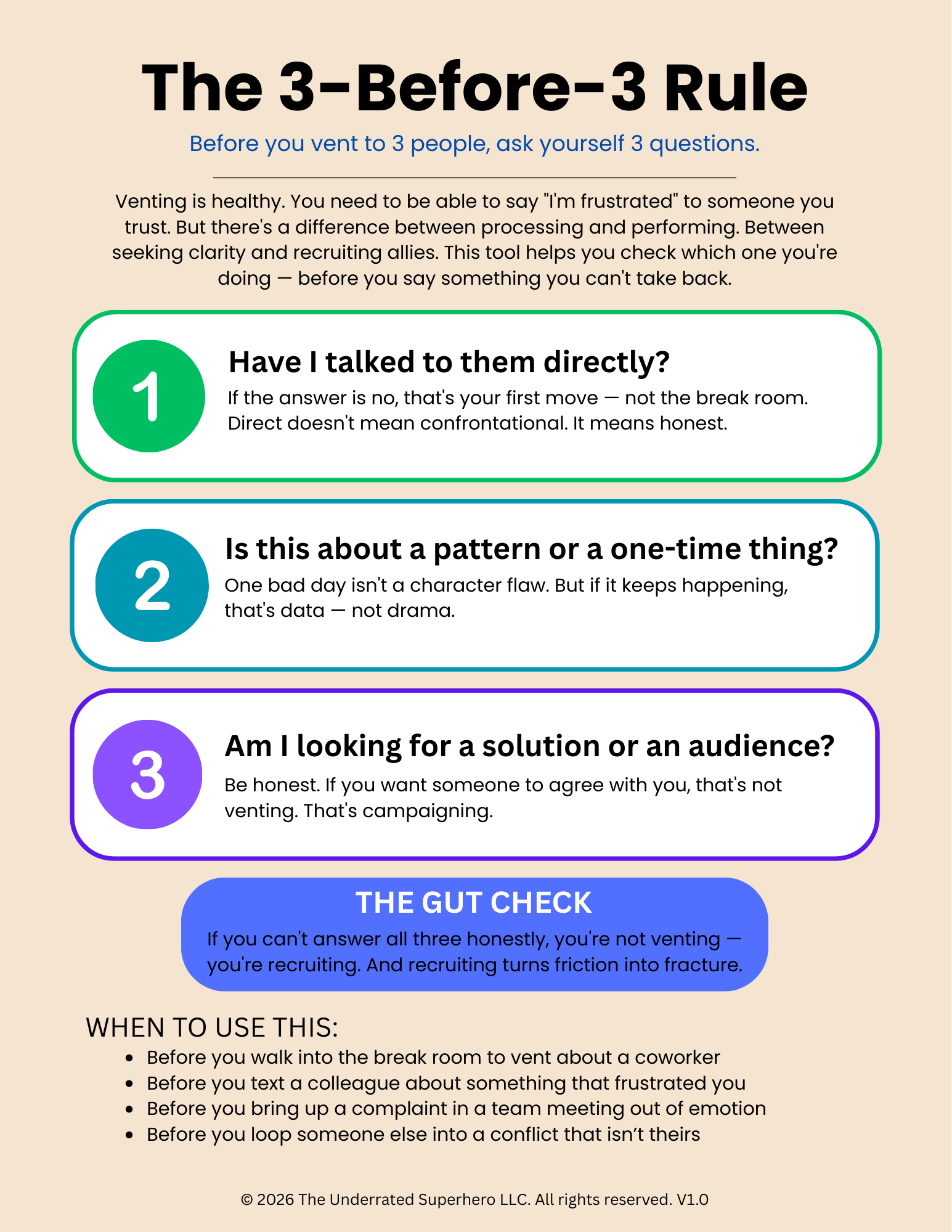
THE 3-BEFORE-3 RULE
FIND IT NOW IN YOUR PROFESSIONAL RESOURCES
3 questions. 2 minutes.
You’re frustrated with a coworker. You want to talk about it. That’s normal. But before you vent to three people, ask yourself three questions:
The 3 Questions:
- Have I talked to them directly? (If the answer is no, that’s your first move — not the break room. Direct doesn’t mean confrontational. It means honest.)
- Is this about a pattern or a one-time thing? (One bad day isn’t a character flaw. But if it keeps happening, that’s data — not drama.)
- Am I looking for a solution or an audience? (Be honest. If you want someone to agree with you, that’s not venting. That’s campaigning.)
Why This Matters:
There’s a difference between processing and performing. Between seeking clarity and recruiting allies. One helps you move forward. The other poisons the room.
How to Use It:
Before you walk into the break room to vent about a coworker. Before you text a colleague about something that frustrated you. Before you bring up a complaint in a team meeting out of emotion. Before you loop someone else into a conflict that isn’t theirs.
UNDERRATED TACTIC: THE RECRUITING TEST
STOP VENTING. START CHECKING.
Most clinicians don’t realize when venting crosses into toxicity. The difference isn’t volume — it’s intent.
Healthy venting sounds like: “I’m frustrated that I keep ending up with extra work. I need to figure out how to address this.”
Toxic venting sounds like: “Let me tell you what she did now — and did you hear what she said to the client in Room 3?”
One is processing. The other is performing. And if you’re being honest with yourself, you know the difference. You’ve probably been on both sides of it.
The Fix:
Next time you’re about to talk about a coworker, run the 3-Before-3. If you haven’t talked to them, it’s a one-time thing, and you’re looking for agreement not solutions — close your mouth. Open your journal. Call your therapist.
The coworker might be the problem. But the way you handle it determines whether YOU become one too.
PAIRS PERFECTLY WITH THIS MONTH’S QUICK WIN: THE 3-BEFORE-3 RULE
Use the tool to check yourself before you vent, then notice what shifts — in your energy, your team, and your own integrity.
JUSTICE-INVOLVED TREATMENT MASTERY SERIES
Month 6: Article Releasing March 8th
The Justice-Involved Treatment Mastery Series continues this month with our 6th article.
If you’ve been following along, you know this series tackles the unique challenges of working with clients in the criminal justice system — the population everyone wants to help but few are trained to actually serve.
Previous Articles:
- Understanding the Justice-Involved Client

- Building Trust When the System Sent Them

- Navigating Mandated Treatment

- Documentation That Satisfies Courts AND Supports Recovery

- Motivational Interviewing for Mandated Clients

Coming March 8th:
Month 6’s article drops with subscriber-exclusive resources and practical tools you can use immediately.
Based on our comprehensive Justice-Involved Interactive Board
Ultimately, remember that you don’t have to reinvent the wheel. Explore The Underrated Superhero Resource Hub for ready-to-use tools, templates, and strategies that save you prep time and keep you focused on care.
– The Underrated Superhero
Prefer to download and read later?
