

Client Transference

You’re mid-session and your client says something that shifts the air in the room.
Maybe it’s direct: “I think I love you.”
Maybe it’s indirect: lingering eye contact, finding reasons to extend the session, asking if you’re single.
Either way, you feel it. And now you have to figure out what to do with it.
This is going to happen to you. Probably more than once. And how you handle it matters — for your client, for your career, and for your own sense of what kind of clinician you want to be.
📚 This is Blog #17 in the New Clinician Survival Kit Series (Click to explore the series)
Weekly honest support for the struggles every clinician faces: “I hate group therapy.” “I can’t do this.” “My client hates me.” “I’m making it worse.” “I can’t say no.” “They’re going to report me.” “I’m too tired to care.” “What do I even say?” “I don’t know enough.” “They keep relapsing.” “Am I documenting wrong?” “My supervisor doesn’t get it.” “I can’t handle this caseload.” “Nobody told me about the paperwork.” “I don’t like my client.” “My client’s cute.” “My client likes me.”
These aren’t signs you’re failing. They’re signs you’re human.
Why Client Transference Happens (And Why It’s Not Your Fault)
Therapy is intimate. Not romantically intimate — but emotionally intimate in a way most people have never experienced.
Think about what happens in session: someone shares their deepest struggles, their trauma, their shame. And you — the clinician — actively listen, give your full attention, hold space without judgment. For many clients, this is the first time anyone has ever done that for them.
That’s powerful. And it can get confusing.
Clients aren’t always equipped to distinguish between “this person really sees me” and “I have feelings for this person.” The intimacy of the therapeutic relationship can feel like romantic intimacy, especially for clients who haven’t had healthy attachment experiences.
Research shows this is nearly universal — studies have found the vast majority of therapists will experience some form of attraction or intense feelings from clients over the course of their career.
Signs of Client Transference Before the Disclosure
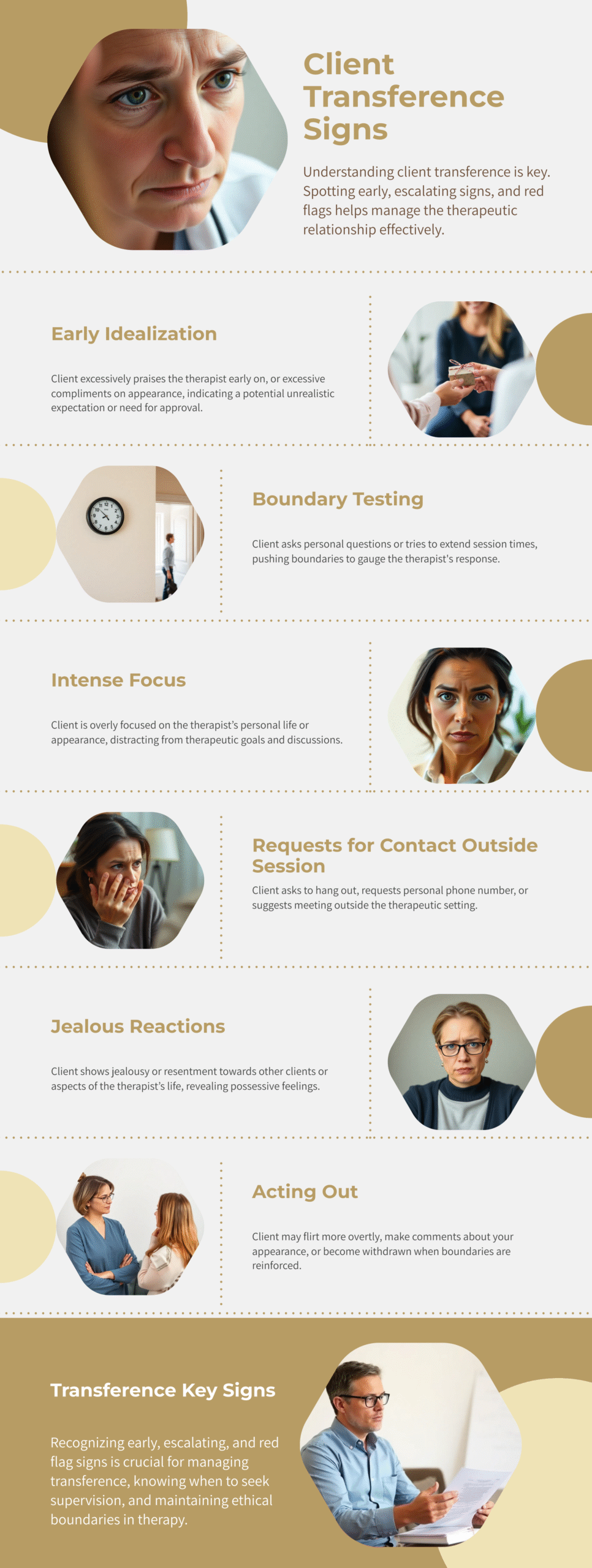
Sometimes clients come right out and say it. But usually, there’s a buildup. Here’s what I’ve noticed over the years:
Early signs:
- Coming by more often than scheduled
- Not wanting to leave when the session is over
- Finding reasons to extend conversations
- Flirting — sometimes subtle, sometimes not
Escalating signs:
- Getting jealous when others pay attention to you (other clients, staff who stop by)
- Mentioning or reacting to your interactions with others
- Asking personal questions about your life, your relationship status
- Directly asking to meet outside of session, to hang out
Red flags:
- Possessiveness over your time
- Disclosures that border on sexual advances without being genuine
- Close physical proximity, pushing boundaries
- Comments about what you’re wearing, how you look
Now — some of these behaviors in isolation aren’t necessarily concerning. Plenty of clients enjoy sessions, want to stay longer, or develop a healthy attachment to their therapist. But when you start seeing a pattern, pay attention.
When It Actually Happens: A Real Example of Client Transference
Several years ago, I worked with a high school student who eventually told me he loved me.
I could feel it building over time. He’d come by more than necessary, didn’t want sessions to end, got visibly bothered when other clients wanted my attention or when staff would stop by and chat with me. He asked to hang out outside of session.
I held my boundaries. Stayed professional. But eventually, he said he couldn’t take it anymore and told me how he felt.

Here’s what I said (or something close to it): “This is normal. This can happen sometimes because therapy is intimate — you share things here that are really hard to share with anyone else, and I’m actively listening, giving you my full attention. That’s something a lot of people haven’t had before. But it doesn’t have to be the end of our work together. We can talk about it, reaffirm the boundaries, and use this as part of your growth.”
I also made it clear: it would never happen. Not maybe, not someday — never.
When the Therapeutic Relationship Ends — And When It Doesn’t Due to Counter Transference
He decided he didn’t want to continue. I offered a referral. He declined that too.
That was hard. I was sad knowing he wouldn’t get services anymore. But I also wasn’t entirely surprised — looking back, he probably started therapy partly because of the interest, not just the clinical need. I didn’t feel he was high-risk by terminating, and I felt I’d handled it appropriately.
Here’s the thing though: it didn’t end there.
A couple years later, I got a Facebook friend request from him. Denied. A few years after that, another one. Denied again.
People hold onto things, especially things that happened during adolescence. Those milestones stick. That’s not my responsibility to fix — my job is to handle it well on my end, every time.
What to Actually Say
When a client discloses feelings, you need to do a few things at once:
- Normalize without encouraging. “This happens sometimes in therapy. The relationship we have here is intimate — not romantic, but emotionally close. It makes sense that feelings can get confusing.”
- Be clear and direct. “I care about your wellbeing and our work together, but a romantic relationship is not something that will ever happen between us. That boundary is permanent.”
- Open the door for continued work. “This doesn’t have to end our work. We can use this moment to understand what’s happening for you and strengthen your ability to navigate these feelings. But if it feels too uncomfortable, we can also talk about next steps.”
- Let them decide. Some clients can work through it and come out stronger. Some can’t. Both are okay.
When You Can Work Through Client Transference (And When to Refer Out)

Ideally, you work through it together. That’s the therapeutic gold — rupture and repair. The client experiences rejection from a safe person, practices those social skills, learns that intimacy doesn’t always mean romance. With risk comes reward.
Continuing can work when:
- The client is willing to acknowledge the boundary and keep working
- They can tolerate the discomfort without it derailing treatment
- You feel comfortable and can maintain your professionalism
- The therapeutic goals are still being addressed
Referral makes sense when:
- The client can’t move past it
- Their behavior escalates despite the conversation
- You feel uncomfortable in a way that would impact the work
- The client explicitly says they can’t continue
And here’s something people don’t talk about enough: the clinician’s comfort matters too. If a client made a move — something physical, something that crossed a line — and you feel genuinely uncomfortable, that’s not something you just push through. The client will pick up on it, and the work won’t be effective anyway.

The Hazardous Zone: When Both Sides Have Feelings
Here’s where we need to get serious.
In Blog #16: “My Client’s Cute”, we talked about counter-transference — when you, the clinician, notice attraction to a client. That’s normal. It happens to almost everyone.
But what happens when BOTH things are true? You find the client attractive, AND they’ve expressed feelings for you?
That’s the danger zone.
This is where careers end. This is where clients get hurt. This is where the horror stories come from — blurred boundaries, physical activity, special favors, favoritism. I’ve heard them. You probably have too, or you will.
If you find yourself here, the protocol is clear:
- Immediate supervision. Not next week. Now. You need outside perspective before you do anything else.
- Close ongoing supervision if you’re going to continue with the client. Not occasional check-ins — regular, honest conversations about what’s happening.
- Referral if you can’t maintain objectivity. This isn’t failure. This is protecting your client and yourself.
- Document appropriately. Not every feeling needs to go in the chart, but the client’s disclosure and your clinical response should be noted.
The APA Ethics Code is clear on this — sexual intimacies with current clients are prohibited, full stop.
If you’re unsure how to bring this up, research on supervision and countertransference shows that normalizing these conversations actually strengthens the therapeutic work.
A Note on Gender and Power
I’m a woman. The client I described was a male high school student. Does that change the dynamics? In some ways, yes.
Young male clients — especially adolescents — are often curious, sometimes sexually active, and can easily confuse the emotional intimacy of therapy with romantic feelings. They may not have the developmental tools yet to distinguish between “she really listens to me” and “she likes me.”
This isn’t exclusive to any gender combination, but it’s worth being aware of who’s in your office and what developmental stage they’re in. Adolescents in particular are navigating identity, sexuality, and attachment all at once. Feelings toward a therapist are almost predictable in that context.
The key is recognizing it early and addressing it directly rather than hoping it goes away.
Signs to Watch For
In your client:
- Lingering after sessions, finding reasons to extend time
- Jealousy when you interact with others
- Personal questions about your life
- Requests to meet outside of session
- Flirting, compliments on appearance
- Possessiveness over your attention
- Physical boundary pushing
In yourself:
- Looking forward to seeing this client more than others
- Dressing differently on days you see them
- Extending sessions without clinical reason
- Thinking about them outside of work
- Feeling flattered by their attention
- Avoiding documentation of concerning interactions
If you’re checking boxes in both columns — stop. Get supervision. Today.
What to Say: Scripts for Common Scenarios

When a client asks you out: “I appreciate you sharing that with me, but meeting outside of therapy isn’t something I do with clients. Our relationship exists in this space, and that boundary helps keep the work effective.”
When a client says “I love you”: “I hear you, and I want you to know that what you’re feeling makes sense given the work we do here. Therapy is intimate. But my feelings toward you are professional — I care about your growth and wellbeing, and that’s what our relationship is built on.”
When a client pushes after you’ve set the boundary: “I’ve been clear about where the boundary is, and that’s not going to change. If this is making it hard to continue our work, we can talk about what other options might help you.”
When you need to refer out: “I think at this point, it would be better for your treatment to work with someone else. That’s not a punishment — it’s about making sure you get the best care possible.”
The Bottom Line on Counter Transference
Clients are going to develop feelings for you. It’s not a matter of if — it’s when.
Your job isn’t to prevent it from ever happening. Your job is to handle it professionally when it does, protect the therapeutic relationship where possible, and know when to step back.
Most of the time, this can be a growth moment for the client. They experience boundaries held firmly but kindly. They practice hearing “no” from someone safe. They learn that emotional intimacy doesn’t have to mean romance.
Sometimes it ends the relationship. That’s okay too. You can’t force someone to stay in therapy, and you can’t work effectively with someone who can’t tolerate the boundaries.
What you can do is stay grounded, seek supervision when you need it, and remember why you’re in that room in the first place.

Until Next Week | The Underrated Superhero
© 2026 The Underrated Superhero LLC. All Rights Reserved.
📖 External Resources & Research
- 🔗 Pope et al: Sexual Attraction to Clients — Research on therapist experiences with client attraction, including how transference manifests
- 🔗 APA Ethics Code — Standard 10.05 on sexual intimacies with current therapy clients
- 🔗 PMC: Managing Transference and Countertransference in Supervision — Research on using supervision to process boundary challenges
📚 More From the New Clinician Survival Kit Series
- ✨ Browse the Full Series — Every post from “I Hate Group Therapy” to now
- 🔗 “My Client’s Cute” — Counter-transference, guilt, and what to actually do about it
- 🔗 “I Don’t Like My Client” — The flip side of this conversation
- 🔗 “I Can’t Say No” — Setting boundaries with clients
