
New Counselor Knowledge Gaps

I used to sit in group next to this seasoned counselor and just watch him. He knew everything. Every term, every concept, every question a client threw at him—he had an answer. His exercises were honestly kind of boring, but it didn’t matter because he delivered them like he’d been doing this forever. Because he had.
Me? I was frantically Googling exercises the night before, printing out handouts, looking for anything that would make me look like I knew what I was doing.
I figured out pretty quickly that I could take his boring exercise and make it better. Add some humor, throw in an analogy, make it actually engaging. But the core material? The knowledge? That was all him. I was just the one making it pretty.
I was hiding behind worksheets because I didn’t trust myself to just stand up there and talk.
📚 This is Blog #9 in the New Clinician Survival Kit Series (Click to explore the series)
Weekly honest support for the struggles every clinician faces: “I hate group therapy.” “I can’t do this.” “My client hates me.” “I’m making it worse.” “I can’t say no.” “They’re going to report me.” “I’m too tired to care.” “What do I even say?” “I don’t know enough.”
These aren’t signs you’re failing. They’re signs you’re human.
The Questions That Froze Me

The worst wasn’t even group though. It was when clients asked me direct questions.
- “How do I stop?”
- “What should I do?”
Deer in headlights. Every time.
Because I thought I was supposed to have the answer. Like being a counselor meant I was the expert, and they were there to learn from me. I had it completely backwards and I didn’t figure that out for a while. If you’re also freezing up when clients ask you things, I wrote about that too.
They already have the answers. That’s what I know now. I’m not the expert on their life—I’m just a guide helping them find what’s already there. But back then? If I didn’t have an answer I felt like I was failing them.
New Counselor Knowledge Gaps Start in Grad School
Here’s the thing about grad school. It barely prepared anyone for this.
Not enough role play. Not enough practical stuff. I’d look around at my classmates and they looked terrified. I wasn’t—but only because I’d already done a very thorough drug and alcohol certification at a community college before my master’s. That certificate and associate’s degree gave me way more practical preparation than grad school ever did.
I was already doing counseling by the time I hit my master’s program, just in addiction. And addiction doesn’t ease you in. You get clients with trauma and co-occurring disorders and stories that will wreck you if you let them. Day one.
So, I had a head start. I knew the material. But knowing the material and knowing how to deliver it confidently in clinical sessions? Two different things.
Filling New Counselor Knowledge Gaps the Hard Way
📋 Knowledge Gaps Every New Counselor Has
(Click to expand)
Don’t worry—we all started here
The Underrated Superhero | theunderratedsuperhero.com
You want to know how I actually learned?
Free trainings. Every single one I could find. Not just for CEUs—I looked for stuff that actually interested me. Free trainings through SAMHSA, NAADAC, and state agencies. There’s a ton out there.
I asked a lot of questions. Probably annoying amounts of questions. I watched how other clinicians ran groups and sessions. What worked, what flopped.
Supervision though? I just wasn’t good at that. I’d sit there with nothing to say, no idea what to even ask. And yeah, some of my supervisors weren’t great but honestly how fair is that when I never brought anything useful to them? I wish I’d had something like my Supervision Prep Pad back then just to have a starting point. I made that thing because I remember what it was like to sit there with nothing.
📊 View Infographic: School vs Real World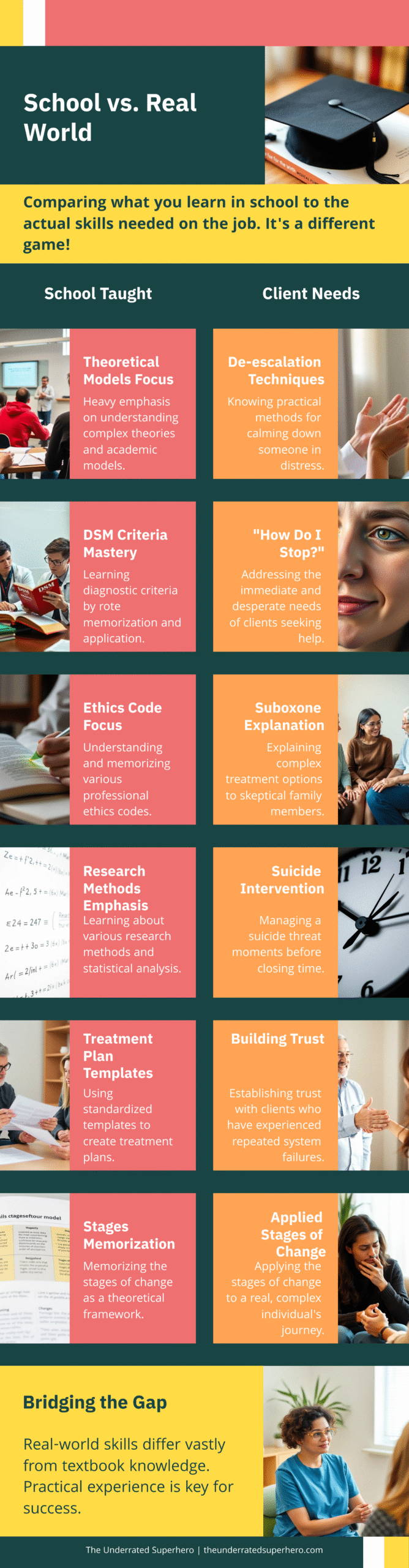
When It Finally Clicked
The shift happened around year two. That’s when I started making my own stuff—my own activities, my own worksheets, my own way of doing things. I’d finally built up enough that I could trust my own voice.
Two years before I stopped feeling like a fraud. Just so you know.

What I Still Don’t Know

Drug trends change constantly. New stuff, new slang, new patterns. I don’t hang out with people who are actively using so I’m not hearing this stuff naturally. I have to go looking for it—asking clients, watching YouTube videos, going to trainings. I check NIDA’s trends page when I need actual data on what’s happening with substances nationally. And even the people presenting at trainings? Most of us are like a year behind what’s actually happening on the streets.
That’s just how it is. You’re never going to know everything. The field moves too fast.
📊 View Infographic: Knowledge Toolkit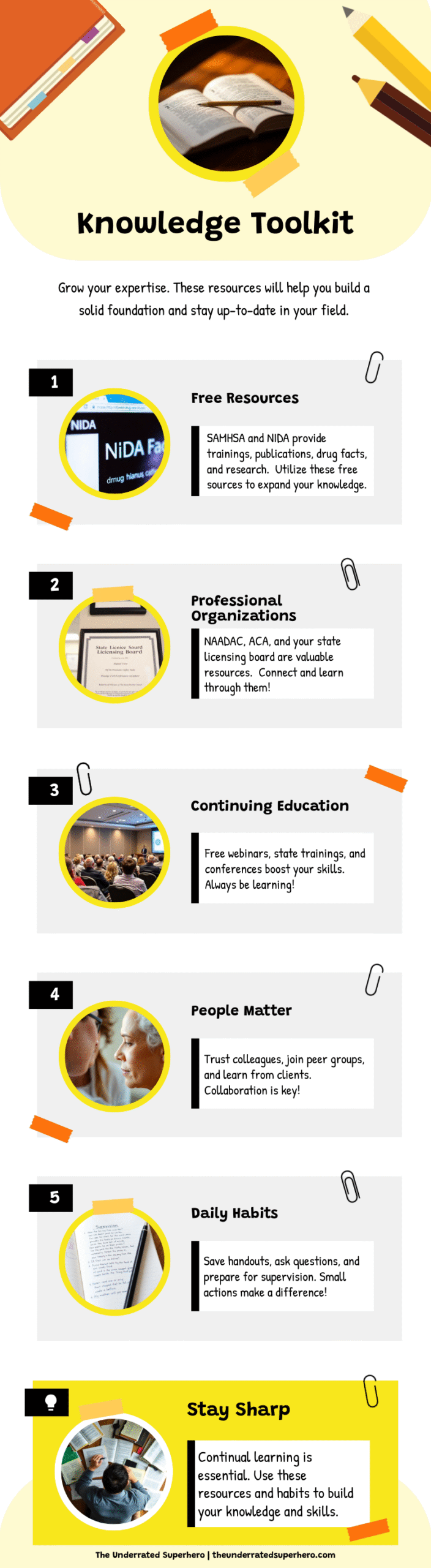
What I’d Tell You Right Now
So, if you’re sitting in group right now watching your co-facilitator and wondering if you’ll ever know that much—yeah. I felt that exact same way.
I was convinced I’d never know enough. That I’d never be able to help anyone like the “real” counselors could.
Here’s what I wish someone had told me: play to your strengths.

I wasn’t the expert with decades of knowledge. But I was creative. I could make boring stuff interesting. I could connect with people through humor and analogies and activities that didn’t feel like a lecture.
Those seasoned counselors you’re watching. They actually like having new people around. Fresh perspectives. Different energy. You’re not supposed to be a copy of them.
The knowledge comes. It takes time but it comes. What you bring right now—your way of seeing things, your willingness to try something different—that matters too.
You don’t have to know everything to help someone. You just have to show up and remember that they already have the answers. You’re just helping them find it.
Some Stuff That Actually Helped Me
📊 View Infographic: When to Google vs Refer
“Just wait three years” isn’t particularly helpful advice when you’re drowning right now. So here’s what actually worked for me:
Ask clients directly. They know what’s current. Be humble enough to say “I haven’t heard of that, tell me more.” And don’t take it personally when they hit you with “Shouldn’t you know this?” or “Aren’t you supposed to be the expert?” Because that will happen. They’re testing you. It’s not about your competence—it’s about whether you’re real enough to admit you don’t know everything.
Free trainings through SAMHSA and state agencies. There’s a ton out there.
Watch your colleagues but don’t try to copy them. Just learn what works.
Use Supervision Better Than I Did
Come to supervision with something. Anything. A question, a case you’re stuck on, something you want to get better at. Don’t just sit there waiting like I did. Grab my Supervision Prep Pad if you need a starting point. It’s part of the Fall 2025 Quarterly Kit.
Start a folder for every good handout and exercise you find. You’ll use it forever.
The Truth About Expertise
The counselors you admire didn’t start out knowing everything. They sat where you’re sitting feeling exactly what you’re feeling.
The only difference is time.
You’ll get there.
Next Week: We’re tackling another brutal truth that keeps clinicians up at night. See you then!
Until Next Week | The Underrated Superhero
© 2025 The Underrated Superhero LLC. All Rights Reserved.
Resources Referenced in This Post
- SAMHSA Training and Technical Assistance – Free trainings, webinars, and professional development resources for substance use and mental health counselors
https://www.samhsa.gov/about-us/who-we-are/training-technical-assistance - National Institute on Drug Abuse (NIDA): Trends and Statistics – Current data on substance use patterns, emerging drug trends, and national statistics to keep your knowledge current
https://nida.nih.gov/research-topics/trends-statistics - Research on Counselor Preparedness – Studies showing most addiction counselors enter the field unprepared to implement evidence-based practices, with training occurring on the job rather than in school
https://www.ncbi.nlm.nih.gov/pmc/articles/PMC3275814/
Additional Support from The Underrated Superhero
- 📋 Supervision Prep Pad – Stop sitting in supervision with nothing to say. This tool gives you a starting point for making the most of your supervision time
- 🛠️ New Clinician Survival Kit – Quarterly tools including clinical resources, professional development frameworks, and strategies for building your knowledge base without burning out
- 📝 Free Clinical Tools – Downloadable resources to start building your clinical toolkit. Requires free account.
- 📧 Subscribe to the New Clinician Survival Kit Series – Weekly honest support for the struggles every clinician faces—no fluff, no toxic positivity, just real talk
Previous posts in the New Clinician Survival Kit Series:
Week 1: I Hate Group Therapy: How I Went from Dreading sessions to Loving Them
Week 2: I Can’t Do This: When Imposter Syndrome for Therapists Hits Hardest
Week 3: My Client Hates Me: When Resistance Feels Personal
Week 4: I’m Making It Worse: Fear of Harming Clients
Week 5: I Can’t Say No: Setting Boundaries with Clients
Week 6: They’re Going to Report Me: Professional Fear & Compliance Anxiety
Week 7: I’m Too Tired to Care: Burnout and Compassion Fatigue
Week 8: What Do I Even Say: Filling 45-Minute Sessions with Confidence
