You spend your days supporting others in recovery. But what do YOU need to recover from? Burnout, compassion fatigue, imposter syndrome—these are real, and they require their own recovery process.
💡 September Tip
🔄
What do YOU need to recover from? Burnout? Compassion fatigue? Imposter syndrome? Recovery is possible—I see it every day. Including in myself.
Want the full 2026 calendar? It's included in the Winter 2026 Quarterly Kit.
Get it →
🎯
Personalize Your Calendar
The Winter 2026 Kit includes stickers to personalize your calendar with dates that matter to you—client milestones, personal reminders, or trigger dates.
💚 World Suicide Prevention Day
September 10, 2026
Screen everyone. Ask directly. People with SUD are 5-10x more likely to die by suicide. Don't wait for a crisis to bring it up.
🎗️ National Recovery Month
Recovery looks different for everyone. Honor that.
This month celebrates recovery in all its forms—and that includes yours. Use this month to:
Celebrate client wins, no matter how small
Share recovery stories (with consent) to reduce stigma
Reflect on your own recovery journey—professional and personal
Advocate for recovery-oriented policies and practices
Connect with the recovery community beyond your caseload
Recovery is possible. You see it every day. Including in yourself.
🔄
Recovery Month: Including Yours
This three-page self-assessment helps clinicians turn the recovery lens inward. It starts with a checklist of what you might be carrying — burnout, compassion fatigue, imposter syndrome, vicarious trauma, boundary erosion, grief about clients, or feeling stuck in your career. For each item you check, there's space to reflect on how long it's been going on and what triggered it. The middle section offers a checklist of what your recovery might need (time off, therapy, better boundaries, smaller caseload, peer support, a career change conversation). The worksheet ends with space to commit to one concrete step this month — not a complete overhaul, just one thing.
Quick Overview: Self-assessment checklist for burnout, compassion fatigue, and vicarious trauma, plus a recovery needs inventory and one-step commitment.
Best for: Clinicians who spend all their time supporting others' recovery and haven't stopped to consider their own. Particularly useful during National Recovery Month as a prompt for self-reflection, or as a conversation starter in supervision or therapy.
Available September 1st
💚
Suicide Prevention Screening Guide
This two-page guide equips addiction counselors with the tools to screen for suicide risk directly and confidently. It opens with why universal screening matters for clients with substance use disorders — who are 5-10x more likely to die by suicide than the general population — and addresses the common fear that asking about suicide increases risk (it doesn't). The guide provides exact language for opening the conversation, follow-up questions when a client says yes, and what to say when they say no to keep the door open. The middle section lists warning signs to watch for, from talking about being a burden to sudden calmness after depression. The final section walks through what to do if a client is at risk: staying calm, reducing access to means, creating a safety plan, involving supports, following agency protocol, and documenting everything. Crisis resources are included at the end (988, Crisis Text Line, Veterans Crisis Line, Trans Lifeline, SAMHSA).
Quick Overview: Ready-to-use language for screening clients for suicide risk, warning signs to watch for, step-by-step response when a client is at risk, and crisis resources.
Best for: Addiction counselors who want exact scripts for suicide screening conversations, especially during Suicide Prevention Month (September) or around World Suicide Prevention Day (September 10). Also useful as a quick-reference guide to keep handy year-round, or for training new clinicians on direct screening approaches.
Watch for: Clients returning after "taking a break" over summer. Meet them without judgment—shame keeps people out of treatment.
They came back. That's the win.
For you: Brace for busier days. Protect your boundaries now before the surge hits.
September is when the work ramps back up—make sure you're ready.
Part of the Justice-Involved Treatment Mastery Series Your client just had a positive drug test. You’re looking at the results. They’re looking at you. And
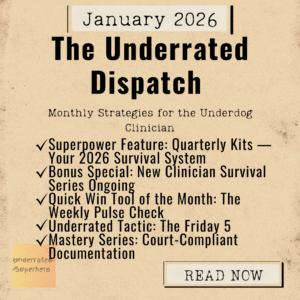
Monthly Strategies for the Underdog Clinician Featured Highlight: NEW — CLINICAL WALLET CARDS: TOOLS THAT FIT IN YOUR POCKET Your clients don’t need another handout
Difficult coworker They told you about the caseloads. The paperwork. The compassion fatigue and the clients who don’t want to be there. They prepared you—sort