Some clients stay in your head after they leave. That's not weakness—it's proof you cared. This month is about honoring grief, remembering the ones we've lost, and finding ways to keep going.
💡 August Tip
💔
Some clients stay in your head after they leave. That's not weakness—it's proof you cared. Grief is part of this work. I don't have to carry it alone.
Want the full 2026 calendar? It's included in the Winter 2026 Quarterly Kit.
Get it →
🎯
Personalize Your Calendar
The Winter 2026 Kit includes stickers to personalize your calendar with dates that matter to you—client milestones, personal reminders, or trigger dates.
🕯️ International Overdose Awareness Day
August 31, 2026
Honor the lives lost. Check in on clients who've lost someone to overdose. And check in on yourself—clinicians carry grief too.
🌿 National Wellness Month
You can't give what you don't have. Take care of yourself.
This month, recommit to your own wellness—not as a luxury, but as a professional necessity:
When's the last time you took a real day off?
Are you sleeping enough? Eating well? Moving your body?
What used to bring you joy that you've stopped doing?
Do you have support outside of work—friends, family, community?
Are you using supervision, therapy, or peer support?
What's one small thing you could do this week for yourself?
Your wellness isn't selfish. It's what allows you to keep showing up.
💔
The Clients Who Stay With You
This three-page worksheet is for processing clients who linger in your mind — whether they left treatment, relapsed, or died. It starts with space to name who's staying with you and what happened, then moves into a feelings checklist (sadness, guilt, anger, relief and guilt about feeling relief, numbness, helplessness). The middle section addresses the questions that linger — the "what ifs" and "should haves" that keep you up at night — with prompts to reality-test those thoughts. There's also a section to counter grief's tendency to erase the good by remembering what you did right and what progress was made. The worksheet ends with a needs checklist to identify what support you need right now.
Best for: Clinicians carrying grief about clients they can't stop thinking about — especially those who've experienced client death, relapse after significant progress, or clients who left treatment against advice. Also useful for supervision conversations or processing with a therapist.
Available August 1st
🕯️
International Overdose Awareness Day Guide
This two-page guide helps addiction counselors navigate August 31st — a day that can be heavy for both clients and clinicians. It covers how to support clients (checking in before the day, on the day, and after), with specific language for clients who've lost someone to overdose. There's also a section for clinicians — acknowledging that you've likely lost clients too, and offering prompts for connecting with colleagues or processing your own grief. The guide includes information on the late summer overdose spike (why risk increases this time of year) and ends with a naloxone review checklist to use with all clients, regardless of perceived risk level.
Best for: Addiction counselors who've lost clients to overdose and need support navigating the day, or who want to proactively support clients who've experienced overdose loss. Also useful for program directors planning team support around this date.
Available August 1st
⚠️ Late Summer Overdose Spike
Trend: Overdose deaths spike in late summer. This isn't a coincidence.
Summer disrupts routines—treatment attendance drops. Clients who "took a break" are at higher risk.
Supply changes mean clients may encounter unfamiliar sources or stronger doses. Heat increases physical risk.
Action: Review naloxone access with ALL clients this month—not just those you think are at risk.
Ask: Do you have it? Is it expired? Do you know how to use it? Does your family have it too?
🎒
Back-to-School Stress
Watch for: Back-to-school stress for parents in recovery. Routines shift again, childcare changes,
and there's financial strain from school supplies, fees, and new schedules.
For parents: The transition back to school can be just as destabilizing as summer break.
Morning routines, homework battles, navigating school systems—it's a lot.
Action: Ask about back-to-school plans. What's changing? What support do they need?
How will their treatment schedule adapt to the new routine?
Part of the Justice-Involved Treatment Mastery Series Your client just had a positive drug test. You’re looking at the results. They’re looking at you. And
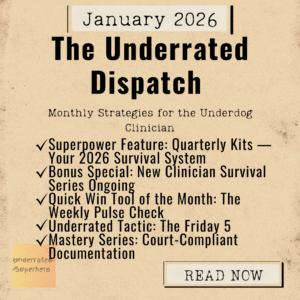
Monthly Strategies for the Underdog Clinician Featured Highlight: NEW — CLINICAL WALLET CARDS: TOOLS THAT FIT IN YOUR POCKET Your clients don’t need another handout
Difficult coworker They told you about the caseloads. The paperwork. The compassion fatigue and the clients who don’t want to be there. They prepared you—sort