April
"the art of not knowing"
You don't have to have all the answers. "I don't know, but I'll find out" is a complete clinical sentence. This month is about embracing curiosity over certainty—and learning to sit with not knowing.
💡 April Tip
Want the full 2026 calendar? It's included in the Winter 2026 Quarterly Kit. Get it →
Personalize Your Calendar
Your quarterly kit includes stickers for dates that matter to you—client milestones, personal reminders, or trigger dates to watch. Make it yours.
🐰 Easter
Family gatherings can be triggering. Check in with clients before the holiday—especially those with complicated family dynamics or who associate holidays with use.
💰 Tax Day
Financial stress peaks. Clients may be anxious, overwhelmed, or facing consequences of financial decisions made during active use. Normalize the stress.
🌿 4/20
Cannabis culture is loud this day. Don't avoid it—use it as an opening. Ask how they're thinking about their use. "It's just weed" dismissals may signal ambivalence.
📋 Q2 Reset Check-In
You're starting the second quarter. A good time to check in on momentum—or lack of it.
- Did Q1 go the way you hoped? What surprised you?
- Are your original goals still relevant, or do they need adjusting?
- What's one thing you learned about yourself as a clinician?
- What support do you need for Q2 that you didn't have in Q1?
The Art of Not Knowing
This two-page guide gives new clinicians scripts for the moments when they don't have all the answers — and permission to be okay with that. It covers five common situations: when you genuinely don't know something, when you're uncertain about clinical direction, when a client challenges your experience, when you've made a mistake, and phrases that keep you curious instead of defensive. Each section includes ready-to-use language that models honesty, builds trust, and keeps you from making things up just to appear competent. Ends with a brief reflection prompt.
Best for: New clinicians who feel pressure to have all the answers, struggle with imposter syndrome, or freeze when clients ask something they can't immediately respond to. Also useful for anyone who wants to model intellectual humility without losing credibility.
Available April 1stCannabis Conversations
This two-page guide helps addiction counselors navigate conversations about cannabis — a topic that often gets dismissed with "it's just weed" or avoided altogether. It covers why the conversation matters (especially for clients using cannabis alongside other substances), responses to common client dismissals, ways to open the conversation around 4/20, assessment questions for deeper exploration, and harm reduction approaches when abstinence isn't the goal. The tone is non-judgmental and curiosity-driven, meeting clients where they are while still addressing cannabis use as clinically relevant.
Best for: Addiction counselors who avoid cannabis conversations, feel unsure how to respond when clients minimize use, or want practical language for addressing weed in a legalization landscape — especially around 4/20.
Available April 1stApril Awareness Months
April is packed with awareness opportunities. Here's how each might show up in your work.
🍷 Alcohol Awareness
Screen everyone. Alcohol hides in plain sight. Use AUDIT-C as a quick check.
🧠 Stress Awareness
Clinician stress counts too. What's your stress telling you right now?
💛 Counseling Awareness
Celebrate the profession. You chose a hard job—that matters.
💙 Child Abuse Prevention
Many SUD clients carry childhood trauma. Stay trauma-informed. Know your mandated reporting duties.
Stress Awareness: A Check-In for You
Stress Awareness Month isn't just for clients. Take a minute to check in with yourself:
• Where are you holding tension right now—physically?
• What's the thing you keep putting off because "there's no time"?
• When was the last time you took a real lunch break?
• Who can you talk to when the work gets heavy?
• What's one small thing you could do this week to decompress?
Your stress is data. It's telling you something. Don't ignore it.
📝 Related Reading
Managing Relapse When the Court is Watching
Part of the Justice-Involved Treatment Mastery Series Your client just had a positive drug test. You’re looking at the results. They’re looking at you. And

The Most Underrated Job in Mental Health: I’m Not Being Dramatic
Most Underrated Job in Mental Health I want to tell you about a colleague of mine. She was a substance abuse counselor placed in a
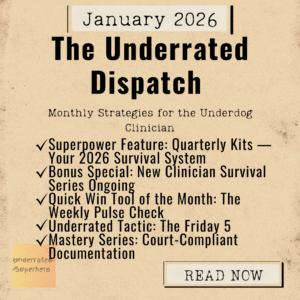
📰 March 2026 Newsletter – The Underrated Dispatch
Monthly Strategies for the Underdog Clinician Featured Highlight: NEW — CLINICAL WALLET CARDS: TOOLS THAT FIT IN YOUR POCKET Your clients don’t need another handout
My Coworker Is Terrible: When the Hardest Part of the Job Is the Person in the Next Office
Difficult coworker They told you about the caseloads. The paperwork. The compassion fatigue and the clients who don’t want to be there. They prepared you—sort
I Want to Quit: When Burnout Becomes a Career Question
I Want to Quit You haven’t said it out loud yet. Maybe not even to yourself. But it’s there. Somewhere between the third no-show of
When a Client or Family Complains About You — and the Ground Drops Out
Client Complaint You’re going to get a complaint. Maybe not today. Maybe not this month. But at some point, in your career, someone — a