
I Want to Quit
You haven’t said it out loud yet. Maybe not even to yourself.
But it’s there. Somewhere between the third no-show of the day and the stack of treatment plans you haven’t touched. Somewhere between the client who cursed you out in session and the email from compliance about your late notes.

“I want to quit.“
Not the dramatic kind. Not the throw-your-badge-on-the-desk kind. The quiet kind. Where you’re still showing up every day but something inside you stopped showing up months ago.
If that’s you right now, keep reading. And the first thing I need you to hear is this: thinking about quitting doesn’t make you weak. It makes you honest.
📚 This is Blog #18 in the New Clinician Survival Kit Series (Click to explore the series)
Weekly honest support for the struggles every clinician faces: “I hate group therapy.” “I can’t do this.” “My client hates me.” “I’m making it worse.” “I can’t say no.” “They’re going to report me.” “I’m too tired to care.” “What do I even say?” “I don’t know enough.” “They keep relapsing.” “Am I documenting wrong?” “My supervisor doesn’t get it.” “I can’t handle this caseload.” “Nobody told me about the paperwork.” “I don’t like my client.” “My client’s cute.” “My client likes me.” “I got a complaint.”
These aren’t signs you’re failing. They’re signs you’re human.
It Doesn’t Happen All at Once
Most clinicians don’t hit the quitting point because of one terrible day. They hit it because of a hundred unremarkable ones.
The caseload that never shrinks. The paperwork that multiplies overnight. The 12-hour days that became normal so gradually you forgot they weren’t. You haven’t had a real lunch break in weeks. Maybe months. You can’t remember. If you’ve been living in that caseload overwhelm for a while, you know exactly what I mean.
I lived it.
For years I worked at a Federally Qualified Health Center. Caseload hit 80 at one point. Mondays I was at a high school — individual sessions, groups — then to the office or home for more sessions after school. Tuesdays, different school, same routine, leaving between 8 and 10 PM. Wednesdays were the killers. Alternative school in the morning, another school after that, back to the office for a community group in the evening with individual sessions packed around it. I’d leave around midnight. Sometimes 1 AM. Thursdays, two more schools. And then Fridays, Saturdays, and Sundays I worked my second job at a private practice — sessions all day and evening with maybe a scattered free hour if I was lucky.
That was every week.
And I loved the work. I loved my clients. I felt genuinely fulfilled. But fulfillment doesn’t pay your electric bill twice, and passion doesn’t replace sleep. I wasn’t burning out in some dramatic, made-for-TV way. I was just… leaking. Patching the holes with coffee and stubbornness until the patches stopped holding.
You don’t notice the water rising until your shoes are wet. And according to SAMHSA’s workforce data, the behavioral health field is facing significant shortages across the board — in part because this kind of slow drain pushes people out faster than training programs can replace them.

When the Environment Turns on You
Sometimes it’s not the work. It’s the place.
I worked at a local private practice for a while. Things were fine at first — the boss was professional, even warm. I could tell she played favorites and I was grateful to be one of them. I just prayed I’d never end up on her bad side.
Then I mentioned I was thinking about opening my own business.
Everything changed. Not overnight — that would’ve been easier to name. It was passive-aggressive emails. “Why did you do that? What were you thinking?” The kind of messages where you walk away feeling gaslit but you can’t quite point to what happened. You’re not sure if you actually messed up or if you’re being punished for having ambition.
One time a client told her I said there were no people of color in the practice. What I actually said was that it might take a while to place her child because there may not be women of color available at that location who specialize in play therapy. Reasonable. Honest. Clinical. Didn’t matter. It got twisted and I was the one defending myself.
That kind of thing doesn’t break you all at once. It just makes you dread Monday a little more each week until Sunday nights feel like a countdown. And if you’re dealing with a supervisor who doesn’t get it on top of all of that, the walls close in even faster.

When the Clients Break You
And then there’s the work itself.
I’ve supervised interns who came in ready to change the world. And I’ve watched some of them hit a wall so hard they didn’t know how to get back up.
One of my supervisees attended a few groups at a middle school and told me she was never doing group again. I couldn’t even argue with her. It was an awful group. Middle school in general can feel like a jungle. The kids were rude, refused to engage, showed up intoxicated on more than one occasion, interrupted her constantly, walked out mid-session. She was trying to facilitate a therapeutic experience and they were treating it like a free period to act out.
That’s not a failure of technique. That’s a reality of the setting. But when you’re new and you’ve never experienced that level of chaos, it doesn’t feel like a setting problem. It feels like a you problem.

Now multiply that. The client who threatens you. The family member who screams at you in the lobby. The adolescent who tells you exactly where you can put your coping skills worksheet. Maybe you just got your first complaint on top of it. Stack enough of those and you start to understand why new clinicians don’t just think about quitting — they think about it regularly.
Research backs this up. A SAMHSA report on substance abuse treatment facilities found that staff turnover in the SUD treatment field runs as high as 50 percent in some settings, with average annual turnover around 32 percent for counselors. That’s not a retention problem. That’s an exodus.
So Which One Is It?
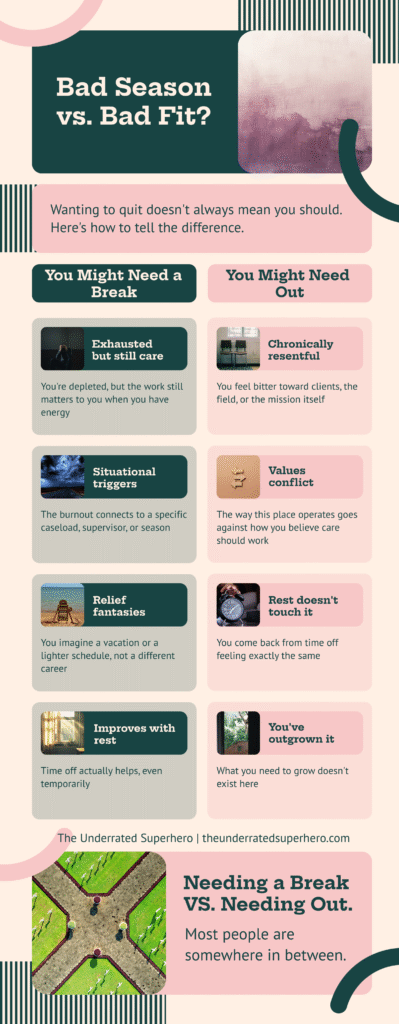
Here’s the question that actually matters: Is this a bad season or a bad fit?
Because there’s a difference. And most clinicians can’t tell which one they’re in because every conversation about it ends with someone saying “practice self-care” or “remember your why.”
So let me just lay it out.
You probably need a break if…
You still care about the work. You still believe in it. But your body is done. You’re irritable, you’re getting sick, you’re snapping at people you love. The quitting thought comes on the worst days but it doesn’t stick. You can still picture yourself doing this work under better conditions. Different caseload, different supervisor, different schedule. The problem isn’t the career. It’s the conditions. I wrote about what that exhaustion actually looks like in I’m Too Tired to Care — if that one hit you hard, you might be here.
You might need out if…
You’ve stopped caring and that scares you. You go through the motions in session but you’re checked out. You’ve tried different settings, different populations, different supervisors — the feeling follows you. The quitting thought doesn’t come and go anymore. It just lives there. You don’t daydream about better clinical jobs. You daydream about doing literally anything else.
But here’s where most people actually are: somewhere in between. The problem isn’t you and it isn’t the field. It’s this specific job, this specific agency, this specific caseload, at this specific moment in your life. You don’t need to leave the profession. You need to leave the situation.
What’s Showing Up for You Right Now?
Check everything that feels true. No one’s keeping score — this is just for you.
Where to take this next
Whatever your results, the next step isn’t a resignation letter — it’s a conversation. Here’s where to start:
About the Glass Ceiling

I want to say something that might sting.
If you’re a substance use disorder counselor, the system was not designed for your career growth.
I sat in a Zoom meeting once with peers and the director of behavioral health at a former employer. They were discussing staff morale. I asked a direct question: Why do the supervisory and leadership positions advance on the mental health side but not substance abuse?
Silence. Then the answer — and it was worse than the silence. They were genuinely surprised. In their minds, substance use counseling was a stepping stone to mental health. Not a career. A phase you go through on your way to “real” therapy.
I challenged that. I asked them to think about what kind of message that sends. That maybe the reason we have a workforce crisis in addiction treatment is because we treat the people doing the work like they’re temps. The National Council for Mental Wellbeing’s research confirms what we already know: a third of behavioral health workers spend most of their time on administrative tasks, and 68 percent say it takes away from direct client care. But despite all of that, the majority remain passionate about the work. The problem has never been the people. It’s the systems.
That moment made something very clear. I was never going to reach the professional heights I wanted inside that system. Not because I wasn’t capable. Because the system wasn’t built to let me.
And I still stayed for years after that. Because leaving is complicated when the clients need you, the paycheck is steady, and starting over is terrifying.
What I Actually Say

When a clinician sits in front of me and says “I want to quit,” I don’t talk them out of it. I don’t give a pep talk. I don’t say “remember why you started.”
I say: “Let’s talk about that. You may decide that’s the best thing for you. But let’s think about it rationally, not passionately.”
Because the worst career decisions happen in the heat of the worst moment. The client who just screamed at you. The supervisor who just embarrassed you. The note you forgot that just got flagged. Those moments make quitting feel urgent. Sometimes it is. But most of the time, the urgency is the emotion, not the logic.
So we slow it down. We look at what’s actually happening. Is this about the career, the job, the setting, the population, the supervisor, or just the season? Because each one has a different answer. And only one of them is “leave the field.”
I Didn’t Quit. I Pivoted.
I worked at a local health department for over a dozen years. I wasn’t impatient to leave the work — I was impatient to rest. Saying goodbye to my clients was hard. Having only one job for the first time in years felt like putting down something very heavy.
The private practice ended differently. I was winding down, open to keeping a small caseload while I built my business. My boss told me not to come back. Changed the locks. Moved my stuff out before I could even pack it myself. When she met with me to hand over my things, she told me I’d made poor choices and let everyone down. I found out later she told some of my clients I could have lost my license — for what, I still have no idea. There were tears. She was cruel. And I understand that more clearly now with distance.

Neither of those exits was quitting. One was planned and bittersweet. One was forced and ugly. Both led me to where I am now — running my own platform, building resources for clinicians, creating something that didn’t exist before.
And that’s what a lot of clinicians are doing right now. With the weight of politics, the pay disparity, and the burnout levels in this field, people aren’t necessarily leaving. They’re pivoting. Going from agencies to private practice. From clinical work to consulting. From traditional roles to teaching, training, writing, advocacy. They’re not abandoning the field. They’re reshaping their relationship with it.
That’s not quitting. That’s adapting,
Before You Make a Move
If you’re sitting with this right now, do me a favor before you do anything.
Name what you’re actually leaving. The job? The setting? The population? The supervisor? The field? “Everything” isn’t an answer — it’s an emotion. Get specific.
Talk to someone who isn’t in it with you. Not the coworker who’s equally miserable. Not the partner who’s tired of hearing about it. Someone with distance. A therapist, a mentor, a former supervisor you trust.
Give yourself a checkpoint. Not an ultimatum. A timeline. Ninety days. During those 90 days, change one thing, have one hard conversation, apply somewhere, explore something. Then reassess.
And stop performing recovery from burnout you haven’t actually dealt with. If the Saturday yoga isn’t touching the Sunday dread, the yoga isn’t the issue. Something structural has to change.

Here’s the Part That’s Hard to Hear
You can love this work and hate what it’s doing to you. Both things can be true at the same time.
You can leave a job that’s destroying you and still be a good clinician. You can want more than what this field has traditionally offered and not be ungrateful. You can stay and fight for better conditions from the inside — be the supervisor you never had, build the program that doesn’t exist yet. Or you can go build something entirely different.
Both are valid.
What’s not valid is pretending you’re fine when you’re not. That’s how good clinicians disappear from a field that can’t afford to lose them.

Next in the series: “My Coworker Is Terrible” — because sometimes the thing making you want to quit isn’t the work. It’s the person two desks over.
This is Blog #19 in the New Clinician Survival Kit Series by The Underrated Superhero. If this hit close to home, you’re not alone. Follow along for more real talk about surviving your first years in clinical work.
Until Next Week | The Underrated Superhero
© 2026 The Underrated Superhero LLC. All Rights Reserved.
📖 External Resources & Research
- 🔗 SAMHSA: Behavioral Health Workforce — Federal data on workforce shortages, training priorities, and the scope of the staffing crisis across behavioral health
- 🔗 SAMHSA: Quality Assurance in Substance Abuse Treatment Facilities — Research showing counselor turnover as high as 50% in some settings, with annual averages around 32%
- 🔗 National Council for Mental Wellbeing: Help Wanted — Workforce study finding 68% of providers say administrative burden takes away from direct client care
- 🔗 HRSA: State of the Behavioral Health Workforce, 2025 — Federal brief projecting significant shortages of addiction counselors, with burnout and scope-of-practice barriers limiting retention
- 🔗 U.S. GAO: Behavioral Health Workforce — Government accountability report on workforce shortages and federal recruitment and retention efforts
- 🔗 Empathy, Vicarious Trauma, and Burnout in Mental Health Practitioners — PMC — Research showing burned-out clinicians become less involved in the therapeutic process and deliver poorer outcomes
📌 From This Series
- 🔗 Blog #5: “I Can’t Say No” — Boundary-setting and the cost of people-pleasing
- 🔗 Blog #7: “I’m Too Tired to Care” — When exhaustion stops being a bad week and starts being your baseline
- 🔗 Blog #12: “My Supervisor Doesn’t Get It” — When the person who’s supposed to help can’t
- 🔗 Blog #13: “I Can’t Handle This Caseload” — Drowning in clients and running out of air
- 🔗 Blog #18: “I Got a Complaint” — Handling grievances without spiraling
