

Client Complaint
You’re going to get a complaint.
Maybe not today. Maybe not this month. But at some point, in your career, someone — a client, a parent, a family member — is going to file a client complaint that makes your stomach drop
And here’s how you’ll find out: not from the client directly. Not in a conversation where you could respond, clarify, or even apologize. You’ll find out from your boss. In an office. With the door closed.
However, the complaint itself is survivable. The way it arrives is what wrecks you.
📚 This is Blog #18 in the New Clinician Survival Kit Series (Click to explore the series)
Weekly honest support for the struggles every clinician faces: “I hate group therapy.” “I can’t do this.” “My client hates me.” “I’m making it worse.” “I can’t say no.” “They’re going to report me.” “I’m too tired to care.” “What do I even say?” “I don’t know enough.” “They keep relapsing.” “Am I documenting wrong?” “My supervisor doesn’t get it.” “I can’t handle this caseload.” “Nobody told me about the paperwork.” “I don’t like my client.” “My client’s cute.” “My client likes me.” “I got a complaint.”
These aren’t signs you’re failing. They’re signs you’re human.
The Confession: My First Real Client Complaint
I had one. A real one — not the small stuff parents mutter in the parking lot, but the kind where my boss sat me down and another colleague used it as ammunition.
The client was a 13-year-old boy I’d been seeing for ADHD, depression, and anxiety. His parents were involved — his father came to sessions regularly, sometimes full sessions, sometimes just the beginning, occasionally parent-only meetings. They were engaged, motivated, and had high expectations.
And I met those expectations. At first.
When 110 Percent Becomes the Expectation
When I started with that family, I was giving 110 percent. Creative interventions, consistent parent communication, extra check-ins, the works. I set the bar high because that’s what I do. That’s what most of us do when we start with a new family — we come in with energy, a vibe, ready to save the world.
The problem with 110 percent is that you can’t sustain it. I was overworked, dealing with chronic health issues, and eventually I started giving 90 to 100 percent. Which, for the record, is still good work. But when you’ve trained someone to expect exceptional, normal feels like a letdown. I’ve talked about the toll that caseloads take on us before — and this was a textbook case of what happens when burnout meets high expectations.

Research backs this up, by the way. A study published in the International Journal of Environmental Research and Public Health found that burned-out mental health professionals become less involved in the therapeutic process, emotionally distant from clients, and generally lower the quality of their work — often without realizing it. And the APA estimates that somewhere between 21 and 61 percent of mental health professionals experience burnout symptoms at some point in their careers. So if you’re reading this thinking “that could be me” — statistically, it probably will be.
I didn’t see the complaint coming.
The Fax That Started It
Sometimes clients come right out and say it. But usually, there’s a buildup. Here’s what I’ve noticed over the yOne Sunday — a Sunday — the father messaged me needing a letter for insurance purposes. He needed it the next day.
One day. For a clinical letter. On a weekend.
I should have said no. I should have said, “That’s not a reasonable timeline, and I need to consult with my supervisor to make sure this is a letter I can write.” I should have set the boundary. If you’ve been following this series, you know I’ve struggled with saying no before. Old habits.
But I said yes. I wrote the letter the next day while traveling. Then I couldn’t get the fax to go through. And instead of just calling the father and saying, “Hey, the fax isn’t working — can I email it to you or hand you the physical copy?” I waited. I kept trying the fax. Two days went by.
By the time I sent it, the damage was done. The father messaged me — upset. Said I’d really let him down. Said the letter had an error. Said they weren’t coming back.
I apologized. Refunded the documentation charge. Warned my office about the situation. I thought it was handled — painful, but handled.
It wasn’t.
The Blindside: When a Client Complaint Reveals More Than You Expected
About a week later, my boss called me in. And the colleague who had never liked me — the one who’d made comments like, “You’re making the rest of us look bad” — was there too.
And suddenly it wasn’t just about the fax.
The parents had said I went from excellent to terrible. That I wasn’t listening. That I kept trying to work on family dynamics when they wanted to work on other things. That they were disappointed and they didn’t feel heard.
Some of it was fair. Some of it I’d never heard before.
That’s the part that hit hardest — not the complaint itself, but the depth of it. I knew the parents were frustrated, but I thought it was with their kid’s ongoing issues. Progress had stalled, and I figured that’s what was bothering them. I had no idea the frustration was aimed at me — at my quality of care, my approach, my attention. They smiled in sessions. They engaged. They never said, ‘Hey, this isn’t working for us.’ They performed satisfaction while building a case I didn’t know existed.
If you work in addiction treatment or family therapy, you’ll recognize this pattern. Claudia Black’s work on family systems and addiction describes the unspoken rules that dysfunction teaches don’t talk, don’t trust, don’t feel. Those rules don’t just live in families affected by addiction — they show up in any family that hasn’t learned to communicate directly about hard things. And sometimes, those families end up in your office, smiling at you while stewing about everything they’re not saying.
Still — it was my responsibility to create space for that feedback. I should have been checking in with those parents more regularly. That’s on me.
When the Complaint Becomes a Weapon
And my colleague? She was energized by this complaint. I could tell. She emphasized the parents’ frustration, told me it’s never okay to make excuses for why we don’t bring our best selves to session, and that parents should never have to explain why they’re disappointed. She was passionate in a way that had nothing to do with the family and everything to do with the fact that she’d been waiting for me to slip.
My boss handled it more fairly — tried to balance the colleague’s intensity with acknowledging the steps I’d already taken. But the damage was done. Not just to my confidence, but to my understanding of how complaints actually work in the real world.
What I Learned (the Hard Way)

Complaints don’t land in neutral territory. They land in whatever office dynamic already exists. If someone likes you, a complaint gets handled with grace and support. If someone has been waiting for you to slip, a complaint becomes a weapon.
- That colleague had been fishing for years. She’d even asked before, kind of probing — “Don’t you ever get burned out?” And I’d say, “Have you heard of a complaint?” And she’d say no. And I’d say, “Exactly.” So, when she finally caught something, she ran with it. She had some valid points about the actual complaint, and I needed to hear those. But the energy behind the delivery — that wasn’t about helping me grow. That was about winning.
What the Client Complaint Actually Taught Me
Parents don’t always tell you they’re unhappy. They smile. They show up. They engage in session. And then they tell your boss everything they never told you. Is that fair? Not entirely. But honestly, that communication pattern is probably part of why their kid is in therapy. Communication styles run in families. And it’s still our job to create space for that feedback before it becomes a formal complaint.
The bar you set on day one is the bar they’ll hold you to forever. I came in hot. Creative, available, over-communicating, going above and beyond. And when life caught up — health issues, burnout, the normal erosion that happens in this field — the gap between my best and my normal looked like decline. It wasn’t decline. It was sustainability. But perception doesn’t care about context.
- The research on this is real. Vicarious trauma — the cumulative emotional toll of hearing client stories day after day — changes how we show up over time. The National Center for PTSD describes it as negative changes in a clinician’s view of self, others, and the world that result from repeated empathic engagement with clients’ trauma. It doesn’t mean you’ve failed. It means you’ve been doing this work long enough for it to cost something.
The Boundary I Didn’t Set
“No” is a clinical skill. One day to write a letter on a Sunday? One day? That’s not reasonable. My boss even told me later that it wasn’t a letter I should have been writing in the first place.
If I’d said, ‘Let me consult with my supervisor to make sure I can provide this, which will take a few days at minimum,’ would the father have been frustrated? Probably. But it would have been normal frustration directed at the process — not personal disappointment directed at me. Instead, I said yes, couldn’t deliver, and turned an unreasonable request into a broken promise. That’s worse.
I talked about the struggle of saying no early in this series, and this situation is proof of where that inability leads.
What Actually Happens When You Get a Client Complaint
So let’s get practical, because the panic in your chest is telling you that you’re about to lose your license, your job, and your career. You’re probably not.
Most complaints fall into a few buckets. Administrative mistakes are the most common — late documentation, missed calls, scheduling errors, the fax that didn’t go through. These are fixable. Unmet expectations come up a lot too, especially in child and family work — the parent thinks therapy should look different, or they want faster progress, or they’re confused about why you’re “just playing” with their kid instead of doing “real therapy.” (Every child therapist reading this just nodded. We’ve all gotten that comment. Play IS therapy. Therapeutic rapport takes time. But try explaining that to a parent who’s paying out of pocket and wants results by Tuesday.)
Then there are clinical disagreements — you’re working on something the client or family doesn’t think is the priority. That was my situation. The parents wanted to focus on specific behaviors, but in session, family dynamics kept surfacing. Both perspectives had merit. And then there are genuine clinical errors — you said something harmful, crossed a boundary, or made a decision that negatively impacted the client. Those are rarer than you think, but they happen.
Here’s the thing: a complaint — even a valid one — is not the end. Doctors make mistakes. Lawyers lose cases. Teachers have bad days. We are human professionals doing human work.
The question isn’t whether you’ll ever get a complaint. It’s what you do when it arrives.
The First 24 Hours After a Client Complaint
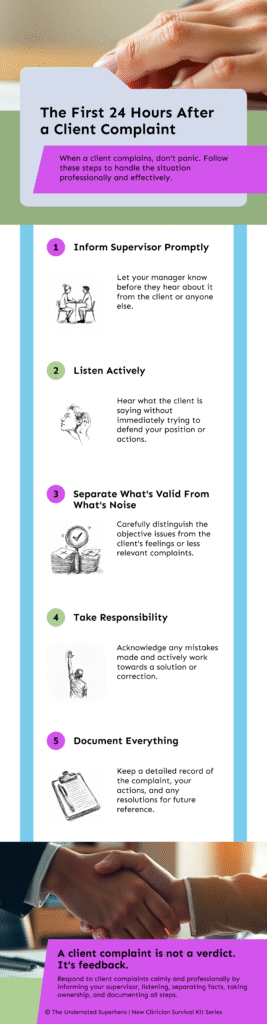
Tell your supervisor before they hear it from someone else. When a client complaint lands on your supervisor’s desk this is the most important thing you can do. Walk in and say: “I need to let you know about a situation with a client.” Give them the facts. What happened, what you’ve already done, what the client or family is saying. Supervisors who get blindsided handle complaints worse than supervisors who are looped in early. And if your supervisor is someone you can’t trust with this — that’s a bigger problem, and we’ve talked about that too.
Listen without defending. When the complaint is relayed to you, your gut is going to scream explain yourself. Justify. Say “but that’s not what happened.” Resist that. Hear what they’re actually saying first. Some of it might be unfair. Some of it might be spot on. You can’t sort that out while you’re in defense mode.
Separate what’s valid from what’s noise. Not every complaint carries the same weight. A parent frustrated that you’re using play therapy doesn’t understand your modality — that’s a conversation, not a clinical failure. A parent frustrated that you stopped returning calls? That’s valid feedback. You have to learn to tell the difference, especially when you’re panicking and every criticism feels like proof that you’re terrible at this.
Respond, Don’t React
Own what’s yours and fix it. If you messed up, say so. Apologize to the client. Refund a charge if it makes sense. Change the behavior going forward. Document the corrective action. This isn’t weakness — the NAADAC Code of Ethics actually frames this as a professional obligation: when we become aware that our actions have caused harm, we take steps to repair it. That’s not groveling. That’s practicing with integrity.
Document everything. The complaint. Your response. The corrective steps. The supervisor consultation. All of it, in writing. This protects you if things escalate, and it demonstrates you took the situation seriously. If you’re unsure about what to document and how, the paperwork blog has some practical frameworks for that.
Office Politics
Complaints don’t exist in a vacuum.
In community mental health, there’s usually a handbook, an HR department, a chain of command, some kind of process. It’s not always great, but there’s structure. In private practice? There’s often nothing. Your boss is the owner. Your colleague might also be your supervisor. There’s not exactly an HR department to escalate to if the complaint is handled unfairly or weaponized by someone who’s had it out for you.
Be aware that in any setting — but especially in private practice — the wrong person can use almost anything as ammunition. Take good notes. Document everything. Save emails and messages. And remember: you can validate a complaint without accepting a distorted version of events. Those are two different things.

If you suspect someone is using a complaint to advance their own agenda — and you’ll know, because the energy won’t match the situation — stay factual. Don’t get pulled into emotional back-and-forths. Respond to the actual complaint, not the politics wrapped around it. And find someone you trust outside the situation — a mentor, a colleague at another agency, a peer consultant — to help you process. If that coworker dynamic is already toxic, that’s a whole separate issue worth examining.
What I Do Differently Now
I check in with parents. Not when things go wrong — regularly. My goal is biweekly minimum, weekly when I can swing it. And I don’t just ask, ‘How’s everything going?’ — because that gets ‘Fine’ every time. I ask the harder questions: ‘Is there anything about our work together that isn’t sitting right with you?’ ‘Is there something you wish I was doing differently?’ ‘Are we focusing on the right things?’
Those questions feel awkward. But they’re a lot less awkward than hearing the answer for the first time from your boss. Because if those parents had told me they were frustrated three months in, I could have adjusted. I could have said, ‘I hear you. Let’s shift the focus.’ Instead, they stewed quietly while I stayed oblivious, and by the time I heard about it, the relationship was unsalvageable.
I set boundaries from day one. Not after I’m burned out and resentful — from the first session. “Here’s my response time. Here’s what I can and can’t provide. Here’s how we’ll communicate.” When those expectations are established early, saying no later doesn’t feel like betrayal. It feels like the agreement you already made.
I remember that things can be weaponized. Not in a paranoid way — in a smart way. I document more carefully. I communicate more proactively. I don’t assume that doing good clinical work protects me from office politics, because it doesn’t. Good work doesn’t make you bulletproof. It makes you good at your job. Those are different things.
And I accept that sometimes I’m not at my best. I was overworked. I had health issues. I was giving 90 percent instead of 110. That’s not a moral failing — that’s a season. And yes, a complaint landed during that season, because complaints tend to find you when you’re already stretched thin. It’s not an excuse. It’s just reality. And pretending it doesn’t happen helps nobody.
The Real Talk

You’re going to get a complaint. It might be fair. It might be unfair. It’ll probably be some messy combination of both.
You will take it personally. Of course you will. You became a clinician because you care about people, and hearing that you let someone down is going to sting no matter how many years you’ve been at this.
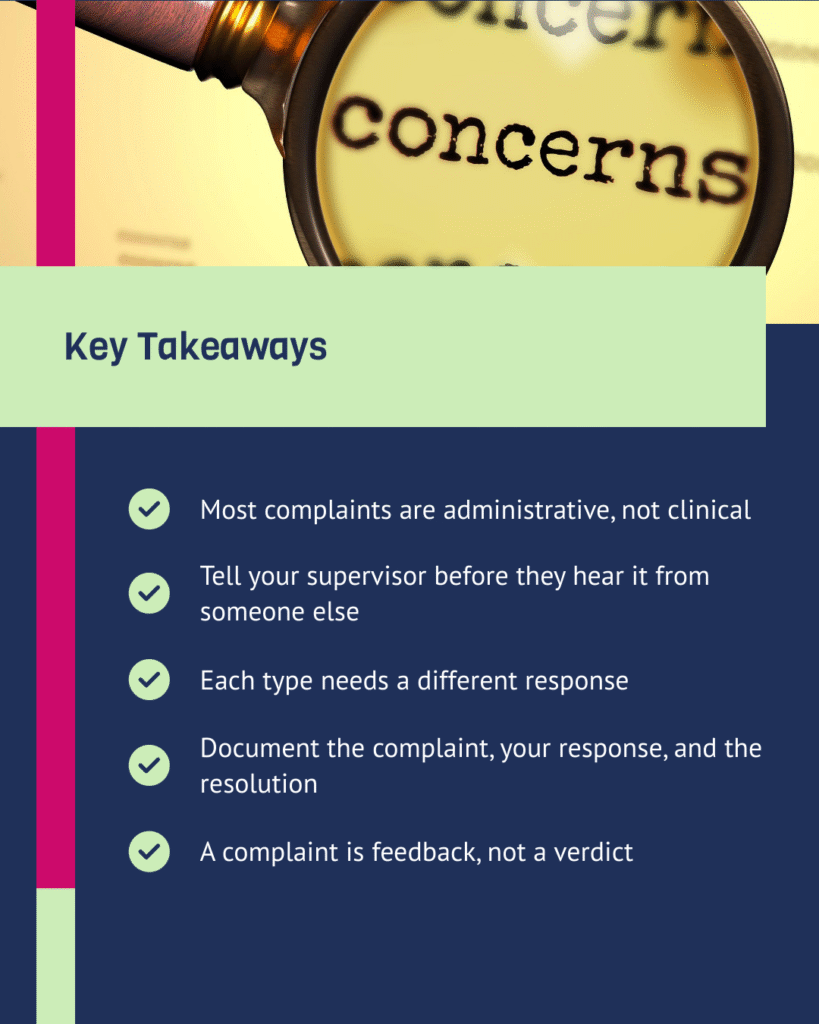
A client complaint is not a verdict on your career. It’s feedback — sometimes delivered poorly, sometimes filtered through office politics, sometimes tangled up with valid frustration and unreasonable expectations in ways that are hard to separate.
Listen to it. Figure out what’s real. Fix what you can. Stand your ground where you should. And keep showing up.
Because the clinician who never gets a complaint isn’t necessarily the best one in the building. They might just be the one who never set the bar high enough to fall short of. Or the one who never challenged a family. Or the one who played it so safe they never risked anything meaningful.
You set the bar high. Sometimes you’ll miss it. That’s not the end of the story — it’s just a chapter.
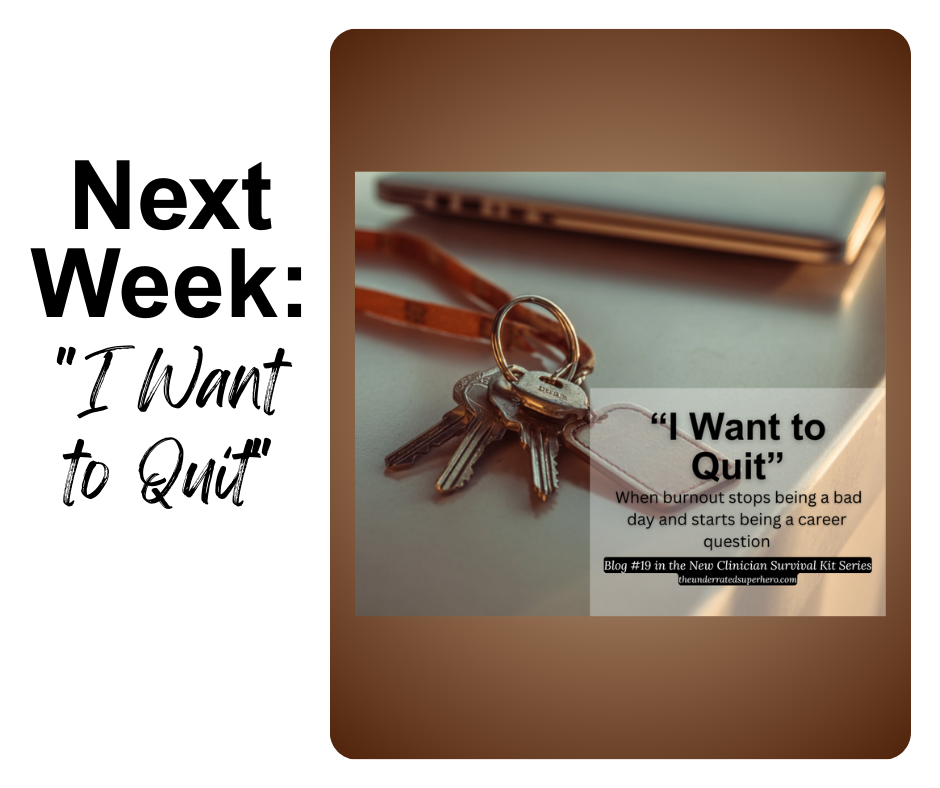
Next week: “I Want to Quit” — When burnout stops being a bad day and starts being a career question.
This is Blog #18 in the New Clinician Survival Kit Series by The Underrated Superhero. If this hit close to home, you’re not alone. Follow along for more real talk about surviving your first years in clinical work.
Until Next Week | The Underrated Superhero
© 2026 The Underrated Superhero LLC. All Rights Reserved.
📖 External Resources & Research
- 🔗 NAADAC Code of Ethics — The professional standard for addiction counselors; see principles on client welfare, competence, and professional responsibility
- 🔗 NAADAC: How to File a Complaint — Understanding the formal ethics complaint process so you know what you’re dealing with
- 🔗 Vicarious Trauma in Clinicians — Psychiatric Times — Research on how empathic engagement with clients changes clinicians over time
- 🔗 Working with Trauma Survivors — National Center for PTSD — Toolkit covering burnout, secondary traumatic stress, and vicarious traumatization in providers
- 🔗 Empathy, Vicarious Trauma, and Burnout in Mental Health Practitioners — PMC — Research showing burned-out therapists deliver poorer client outcomes
- 📚 Claudia Black, It Will Never Happen to Me — The foundational text on family rules in addiction: don’t talk, don’t trust, don’t feel
📌 From This Series
- 🔗 Blog #5: “I Can’t Say No” — Boundary-setting and the cost of people-pleasing
- 🔗 Blog #7: “I’m Too Tired to Care” — Burnout, compassion fatigue, and what to do about it
- 🔗 Blog #12: “My Supervisor Doesn’t Get It” — When your support system isn’t supportive
- 🔗 Blog #13: “I Can’t Handle This Caseload” — Managing impossible workloads without losing yourself
- 🔗 Blog #14: “Nobody Told Me About the Paperwork” — Documentation survival strategies
