Monthly Strategies for the Underdog Clinician
This is Vol 12 of The Underrated Dispatch.
July is Minority Mental Health Awareness Month — and for the clinicians reading this, that’s not a campaign. It’s most of your caseload. It’s the client the system has already decided it understands before you’ve said a word.
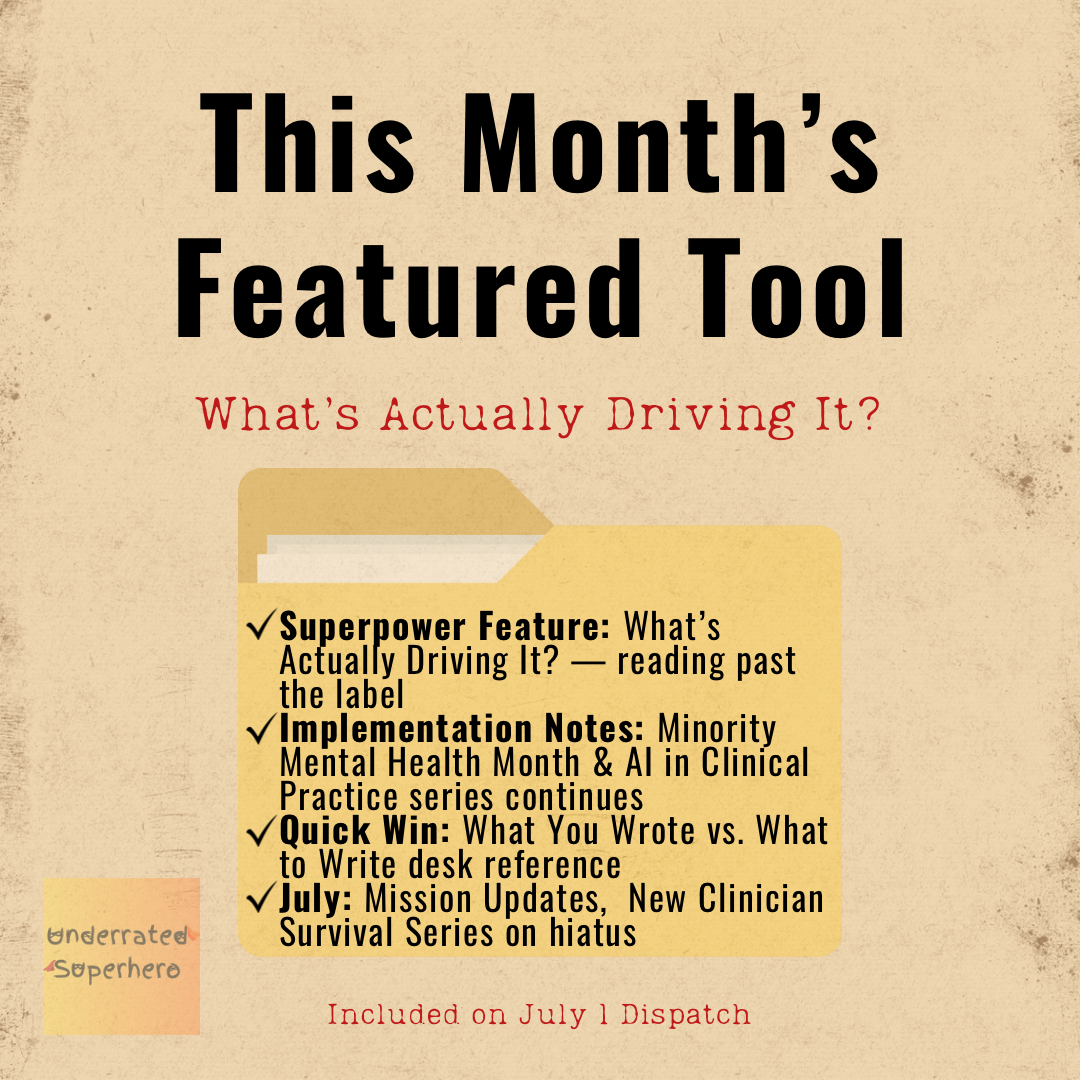
FEATURED HIGHLIGHT: What’s Actually Driving It?
This month’s feature is a tool built for exactly that moment: What’s Actually Driving It? — an interactive activity about the single most consequential habit in clinical work, the one nobody flags because everyone does it. We reach for the label. “Resistant.” “Noncompliant.” “Unmotivated.” One word, and the thinking stops. One word, and the client becomes the problem — and the next clinician inherits that read without ever questioning it.
The activity walks through eight real clinical moments and asks the harder question underneath each label: what’s actually driving this? Not as a quiz with a right answer — most of the time several things are true at once. The skill isn’t picking the correct driver. It’s learning to read past the easy word toward what’s really there, and to notice which read you reached for first, and why.
Free for all subscribers.
THE CLINICAL PROBLEM IT SOLVES
You know the moments. The mandated client who’s polite, agreeable, and tells you nothing — and you write “engaged” or you write “guarded,” and neither is quite right. The client who misses two appointments and you reach for “ambivalent” before you reach for the two-hour bus route and the childcare she doesn’t have. The man who says therapy doesn’t work for people like him, and your pen hovers between “hopeless” and “resistant,” and you don’t stop to ask whether he’s just told you something true about his life.
The label isn’t always wrong. That’s what makes it dangerous. “Resistant” sometimes is the most accurate word — but it’s also the word we reach for when we’re tired, when the session ran long, when we don’t have the bandwidth to look underneath. And once it’s in the chart, it stops being a hypothesis and becomes a fact about the person. It follows them. The next clinician reads “resistant” and walks in already braced.
This is where it stops being a documentation issue and becomes a justice issue. The cost of a lazy label isn’t evenly distributed. For a client moving through systems that have already misread them — by race, by criminal-legal involvement, by language, by culture — “minimally engaged” in a chart isn’t neutral. It confirms the system’s existing read. It can shape decisions about their liberty. The research bears this out: stigmatizing language in clinical notes lands disproportionately on marginalized clients, and diagnostic over-pathologizing is measurable, not theoretical.
So the activity isn’t about being nicer. It’s about being accurate — and noticing that accuracy costs more attention for some clients than others, and that the clients it costs the most for are the ones who can least afford for you to get it wrong.
THIS MONTH IS REALLY ABOUT THE LABEL
Most clinicians already know the principle. We’ve all sat through the training that says don’t write “noncompliant.” That’s not the gap. The gap is that knowing it hasn’t changed what happens at 4:45 on a Friday with three more notes to write.
Minority Mental Health Awareness Month is a useful frame because it lets us name something the field is quiet about: the label problem isn’t a vocabulary problem. It’s an attention problem, and attention is exactly what runs out under caseload pressure. When you’re depleted, you reach for the read that requires the least of you — and the least-effort read is almost always the one that makes the client the problem rather than the situation, the system, or the history.
For minority and justice-involved clients, that default read has a specific shape. Guardedness gets written as resistance. A rational distrust of providers — earned across generations of being misread by the same institutions now asking for trust — gets written as a personality defect. Help-seeking that runs through family or faith rather than a stranger gets written as avoidance. None of these are exotic clinical phenomena. They’re ordinary, and they’re documented across populations, and they’re the exact moments where the easy label does the most damage.
This month’s resources are about the work that happens between noticing the label and writing something better — the part most resources skip. Not “use kinder words.” The discipline of reading the driver before the label, holding accountability and context at the same time, and writing notes that serve the clinician, the court, and the client all at once.
Most of you catch this more often than you think. Some of you are catching it less than your clients need. This month is about closing both gaps.
Important July Updates
🟢 IT’S MINORITY MENTAL HEALTH AWARENESS MONTH
July is Minority Mental Health Awareness Month — and for most of the clinicians reading this, that’s not an awareness campaign, it’s the daily reality of the caseload. The clients most affected by stigma, misdiagnosis, and system mistrust are often the ones whose presentations get read fastest and labeled hardest. This month’s content reflects the work of slowing that reflex down.
⚖️ THE LABEL IS A CLINICAL DECISION
Every time you choose a word for a chart, you’re making a clinical decision that outlives the session. A good month to notice which clients you’ve been quick to label — and to ask yourself why those clients, and not others.
JULY MISSION UPDATES
Here’s everything happening this month:
- Featured Highlight (7/1) — What’s Actually Driving It?
- Featured Board (7/1) — BIPOC Mental Health Interactive Board
- New Clinician Series — One month hiatus, back in August
- Monthly Content Drop (7/15)
- AI In Clinical Practice (7/1, 7/15) – Post 2 and Post 3
- Minority Mental Health Awareness Month — All of July
BONUS SPECIAL: AI in Clinical Practice
The series continues.
Last month I started writing about something I’d been doing quietly for two years — using AI in clinical work, carefully, and learning where it helps and where it quietly goes wrong. It’s not anti-AI and it’s not a sales pitch. It’s the middle position, from someone actually doing the work. This month, two posts that go to the heart of it:
Recent Posts You May Have Missed:
Post 1 — “AI Can Draft It. Reading It Is Still Clinical Work” (6/15) – AI can generate a clinical scenario, a note, a treatment plan in seconds. But every draft it hands you arrives from somewhere — carrying assumptions about who the client is, what a family looks like, what recovery means. This first post starts where the whole series lives: the draft is the easy part. Reading it — catching what it assumed and deciding whether that serves the client in front of you — is the clinical work that doesn’t transfer to the machine.
Post 2 — “Capability Isn’t the Problem” (7/1) – The tools can draft almost anything now. That was never the question. The question is what happens when something fluent, confident, and plausible lands in front of a clinician who’s tired and behind — and whether reading it critically is a skill we’re keeping or quietly losing.
Coming in July:
Post 3 — “It’s Not Wrong, That’s the Problem” (7/15) The harder post. The danger isn’t AI getting things obviously wrong — you’d catch that. It’s AI getting things almost right, in clinical-sounding language, in a way that’s hard to argue with and subtly off. That’s the failure mode that slips into a note, a treatment plan, a chart — and the one no amount of capability fixes.

FEATURED BOARD: BIPOC Mental Health Interactive Board
For Minority Mental Health Awareness Month, the BIPOC Mental Health board sits right at the center of the work — built for clinicians serving clients across cultural difference, where the system’s default read so often lands hardest on the people it’s already failed.
It’s a collection of tools, frameworks, and resources for the clinical realities that don’t make it into the standard training: cultural mistrust that’s earned rather than pathological, help-seeking that looks different across communities, and the gap between what a presentation means in the textbook and what it means in the client’s actual context.
Perfect For:
- Clinicians serving predominantly BIPOC caseloads
- Mental health and SUD clinicians working across cultural and linguistic difference
- Justice-involved treatment settings, where the cost of a misread is highest
- Anyone who suspects the textbook read doesn’t fit the client in front of them — and wants to understand what they’re missing
Quick Win Tool of the Month
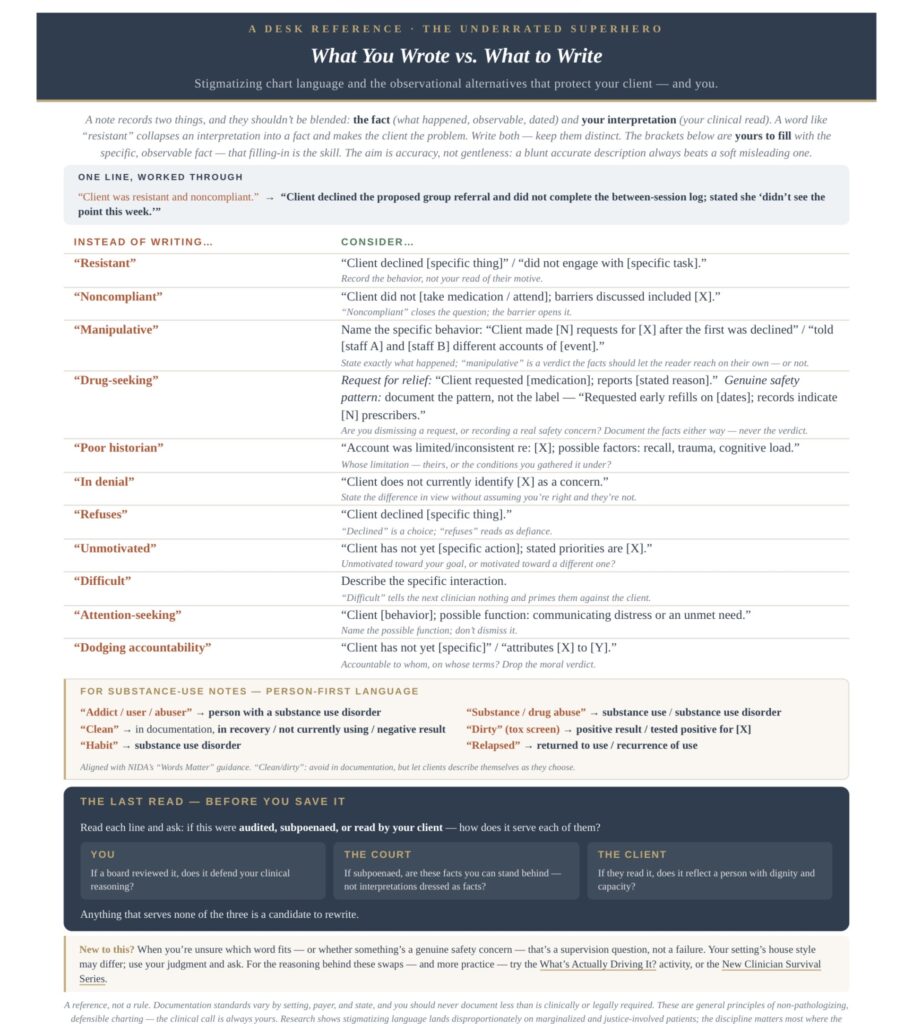
What You Wrote vs. What to Write
The companion desk reference to this month’s feature
This month’s Quick Win Tool turns the feature’s thinking into something you can use mid-note: a printable one-page desk reference pairing eleven of the most common stigmatizing chart phrases — resistant, noncompliant, manipulative, drug-seeking, poor historian — with observational alternatives that record what actually happened.
It also includes a substance-use section aligned with NIDA’s “Words Matter” guidance (addict, substance abuse, clean/dirty, relapsed — and the person-first language that replaces them), a worked before-and-after example, and a simple test for any line you’re unsure about: if this were audited, subpoenaed, or read by your client, how does it serve each of them?
This isn’t about softer words — it’s about accurate ones. A blunt, accurate description always beats a gentle, misleading one. The reference shows you the rewrite; your clinical judgment fills in the specifics.
Print it. Keep it where you write your notes.
Free for all subscribers
UNDERRATED TACTIC: Read the Driver Before the Label
Before you write “resistant,” ask one question: what would I be missing if I’m wrong?
It costs about four seconds, and it’s the whole discipline. Most of the time the answer is nothing — the label fits, write it. But sometimes the four seconds surface the bus route, the prior provider who burned them, the cultural meaning of what they just declined. And for the clients who can least afford a lazy read, those four seconds are the difference between a chart that follows them as a problem and one that follows them as a person.
Reading the driver first doesn’t lower the bar. The client stays capable, accountable, held to the work. Understanding what’s driving a behavior changes how you hold a boundary — it doesn’t dissolve it. The lens just decides whether your accountability lands as respect, or as one more rupture from one more system that decided who he was before it asked.
The label is the fastest thing to write and the hardest thing to take back. Slow down on the front end.
PAIRS PERFECTLY WITH THIS MONTH’S FEATURE AND QUICK WIN TOOL.
THIS MONTH’S RESOURCES-July Calendar Resources
Your home base for July — the month’s resources, awareness dates, and tools gathered in one place. Bookmark it and check back as the month fills in.


A Note on the New Clinician Survival Series
The New Clinician Survival Series is taking a one-month hiatus.
I’d rather tell you that plainly than publish a rushed post to keep a streak alive. The series exists for clinicians in some of the hardest stretches of early-career work, and those posts are worth doing right or not that week. It’s back in August.
The label is already in your charts. The question isn’t whether to use words for what you see — you have to. The question is whether you’re reaching for the read that’s accurate, or the one that’s fast.
The Underrated Superhero Resource Hub has ready-to-use tools, templates, and clinical resources built by someone who still sits across from clients every week. Use them.
— The Underrated Superhero
Prefer to download and read later?
