
Documentation for Court Mandated Clients
Part of the Justice-Involved Treatment Mastery Series
You’re staring at a blank progress note.
Your client just told you they used over the weekend. They’re engaged. They’re showing up. They’re actually doing the harm reduction work—reduced frequency, safer use, reaching out when things get hard.
But on paper? It’s going to look like nothing changed.
And you know who’s reading this note.
The Documentation Dilemma Nobody Talks About
Working with justice-involved clients means you’re always writing for two audiences. Maybe more, actually.
There’s the clinical record—what actually happened in session, the progress you’re seeing, the work the client is doing. And then there’s the court-facing reality—what probation needs to see, what a judge might read, what could show up in a violation hearing.

Federal guidelines say treatment plans should be collaboratively developed by the treatment provider, probation officer, and defendant. That sounds nice in theory. In practice, you’re often navigating competing priorities without much guidance on how to document the messy middle.
Most clinicians feel like they have to choose. Write for the court and sanitize the clinical work. Or write clinically honest notes and hope nobody weaponizes them.
I felt stuck in the middle for a long time. Especially with clients doing harm reduction work where the substance use continued but the risk was actually decreasing. How do you document that someone is making real progress when the UAs still come back positive? I’d hesitate. I didn’t want it to seem like no progress was being made when that wasn’t true.
The answer isn’t choosing one audience over the other. It’s learning to write for both at the same time. Which sounds simple but took me years to figure out.
What I Got Wrong Early On
When I started out, I wrote too much. Way too much.
I’d elaborate. Include details that weren’t actually required. Document things because they felt clinically relevant without thinking about who else might read them.
I didn’t understand that my notes could be subpoenaed. That a phrase I meant one way could be taken completely differently by a PO or a judge. The more I wrote, the more potential ammunition I was creating. I didn’t think about it like that at the time, but yeah. That’s what was happening.
The shift for me was templates.
Not because templates are lazy—because templates keep you from going off on a tangent. They force you to document what’s required and nothing more. They create consistency so you’re not writing differently depending on which PO is assigned or how you’re feeling that day or whatever.
I developed my templates, asked probation for feedback, and used them consistently. That last part matters.
Building Relationships With Probation
I learned early that my documentation doesn’t exist in a vacuum. Probably should’ve figured that out sooner.
Research on treating offenders under community supervision emphasizes that case management means linking clients with resources, tracking progress, AND reporting to supervising authorities. The relationship between clinician and PO matters for all of that to work.
I’ve written letters advocating for clients that got poor reactions from probation. Usually when I was pushing for something they’d already said no to, or requesting something that seemed excessive from their perspective.
They granted my requests. But they were irked. You could tell.
What I learned: reach out before the letter. Build the relationship so they don’t assume your client is manipulating you. So they don’t think you’re naive about who you’re working with. Because that’s what they’re going to assume otherwise, honestly.
When I created my documentation templates, I asked for a meeting with probation. I wanted all the POs to be okay with the format and confirm it met their needs. They weren’t super into it—they’re busy, and I don’t think clinicians do this very often. But they never had a problem with it after that.
That meeting took maybe thirty minutes. Saved me years of friction. Worth it.
Documenting Both Audiences at Once

Here’s what changed things for me: documenting both court compliance AND clinical progress in the same note.
Not one or the other. Both.
Client attended 4/4 sessions this week AND self-reported weekend substance use. Client tested positive for THC AND remained engaged in treatment, participating in safety planning. Client reduced alcohol use from daily to weekends only AND still has work to do.
Both things are true. Document both.
Courts care about attendance, testing, compliance. Give them the numbers and dates they need. But in the same note, document the actual clinical work—the harm reduction milestones, the skills the client is developing, the progress that doesn’t show up on a UA. Good clinical documentation captures the full picture using frameworks like SOAP and ASAM dimensions.
You’re not hiding information. You’re presenting the full picture. A client who tests positive but self-reported before the test, showed up for their session, engaged in safety planning, and identified their triggers is in a completely different clinical place than a client who tests positive and is MIA. Your notes should reflect that.
When Clients Show Up Under the Influence
It happens. Not often if you set expectations early, but it happens.
I had an agreement with clients: if you’re noticeably high, don’t come see me. I’ll have to send you to security. You know I can’t maintain confidentiality if it’s against the rules—especially in school settings where there’s mandatory reporting.
Most of the time, that agreement worked. They’d reschedule instead of putting both of us in a bad position.
But sometimes it happened anyway. And honestly? Those moments can be teachable if you handle them right. I know that sounds like therapist-speak but it’s true.
If a client showed up under the influence but was safe—not in danger, just impaired—the session got cut short. We’d briefly discuss the rules. This isn’t punishment, it’s just… what has to happen. I’d document that I ended the session early due to the client being under the influence per program regulations.
Then I’d document what we’re doing about it. Treatment plan adjustments. Additional measures. How they got home safely—because I’m not letting someone drive impaired, that’s a whole other situation.
The note doesn’t read like a violation report. It reads like a clinician managing a clinical situation.
One time a client “greened out” in group. That became an incident report. Different situation, different documentation. You have to know the difference.
What Probation Doesn’t Need to Know
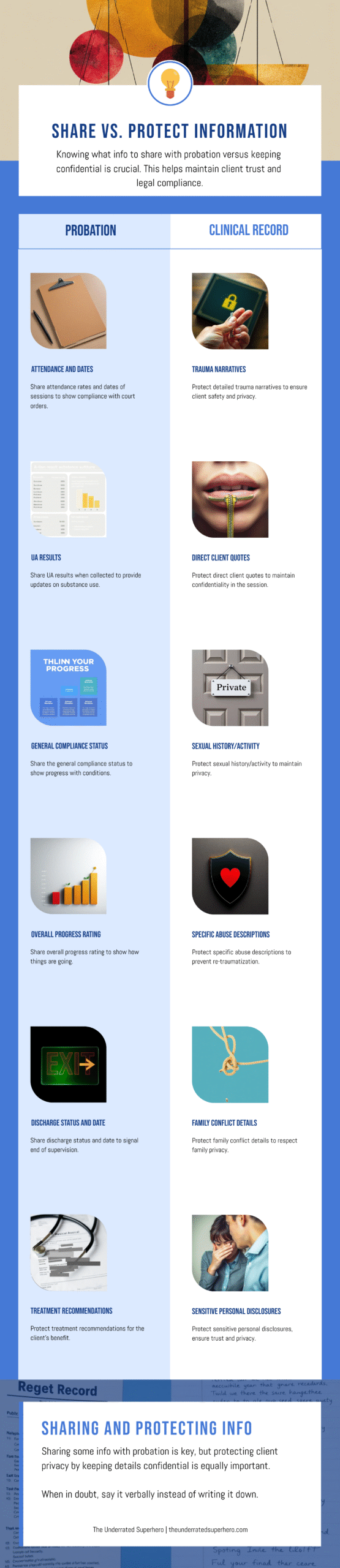
I didn’t provide treatment plans or assessments to probation unless specifically asked. They have lots of information already, and most of what’s in those documents isn’t necessary for their purposes.
Treatment plans might have direct quotes. Trauma histories. Sexual activity. Information that’s clinically relevant but none of probation’s business, frankly. (The Treatment Plan Guide for Justice Settings at the end of this article walks through how to write plans that work for both audiences from the start.)
Why Templates Matter
That’s why I had templates for what I sent them. Standardized, consistent, appropriate. If they had questions beyond what the template covered, they could call me. We’d talk—sometimes with the client present via phone. But I wasn’t handing over documents full of sensitive information just because.
(If you haven’t seen them yet, the Probation Communication Forms from Article 2 in this series—Admission, Monthly Progress Report, and Discharge Summary—are the templates I’m talking about.)
The Lapse Question
Here’s the line I walked: if a client discussed having a lapse the day before their UA, we’d talk about it. We’re working toward harm reduction. A violation could be detrimental to their treatment—could undo months of progress.
I’d decide whether probation needed to know.
If I was collecting a urine screening, clients knew that result was going to probation. So they needed to discuss relapses with me BEFORE giving a sample if they were going to test positive. That way we could talk about it, plan for it, document appropriately. Not hiding. Just being strategic about what goes where and when.
I don’t know if every clinician would agree with that approach. But it worked.
If you want a quick reference for where to draw these lines, the What to Share vs. What to Protect guide at the end of this article breaks it down—what goes in writing, what stays verbal, and sample language for when POs ask for more than necessary.
What New Clinicians Get Wrong
When I’ve supervised newer clinicians working with this population, same mistake keeps coming up: they provide too much information.
The bare minimum should be fine. You don’t need to write a novel. You don’t need to include every detail from the session. You don’t need to document things that aren’t required just because they happened.
Obviously, if probation hasn’t fully supported you yet, questions will arise. If new justice officials enter the picture, sometimes they have disagreements with harm reduction approaches. That can cause problems. I’ve seen it happen.
In those situations, advocacy matters most. But advocacy is easier when your documentation is clean, consistent, and doesn’t give anyone ammunition to use against your client.
Structuring Your Notes
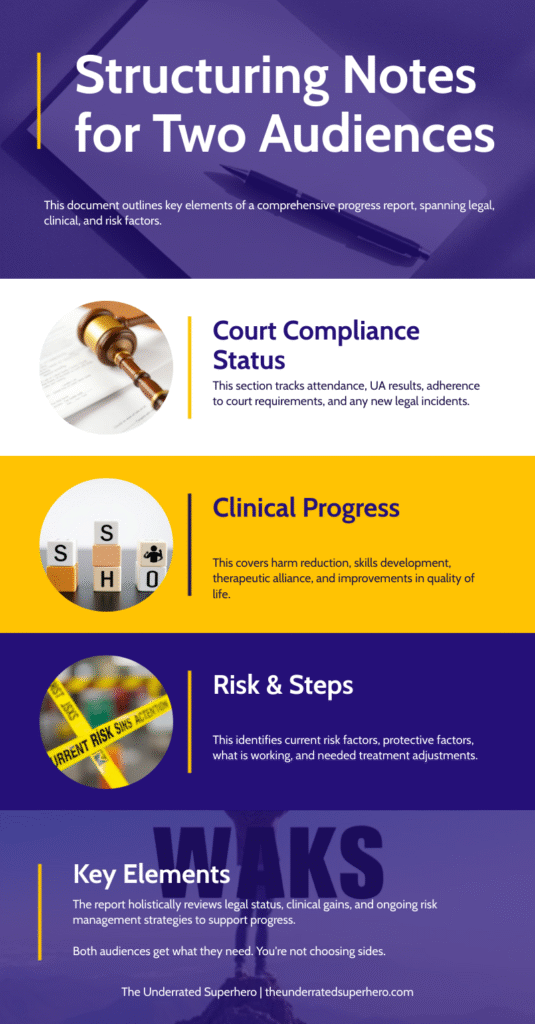
When I finally figured this out, I started structuring every note to hit both dimensions:
Court Compliance Status: Attendance with specific numbers. Drug testing results with dates. Court requirement adherence. Legal status and any new incidents.
Clinical Progress: Harm reduction milestones. Skills development. Therapeutic alliance. Quality of life improvements.
Risk and Next Steps: Current risk factors. Protective factors. What’s working. What we’re adjusting.
This structure gives courts what they need while documenting honest clinical practice. You’re not choosing between audiences.
The Progress Note Examples at the end of this article show what this looks like in practice—five different scenarios in DAP format, from harm reduction wins to sessions cut short.

The Bare Minimum Is Enough
Here’s what I wish someone had told me when I was starting out: you don’t have to over-document to be a good clinician.
With this population, over-documenting can actually hurt your clients.
Develop your templates. Build relationships with probation. Learn to write notes that satisfy both audiences without choosing sides.
Your clients are already navigating a system that’s stacked against them. Your documentation shouldn’t make that harder.
📁 Month 4 Resources: Log in or create a free account to download from the Justice-Involved Mastery Page
→ Treatment Plan Guide for Justice Settings — How to write treatment plans that work for courts AND clients. Includes SMART goal examples for ASAM dimensions 4, 5, 6, plus trauma, mental health, and family involvement goals.
→ Progress Note Examples – Court Compliant — Five DAP-format progress notes covering common scenarios: harm reduction progress, self-reported lapses, sessions cut short, missed appointments, and successful completion.
→ What to Share vs. What to Protect Quick Reference — A one-pager on documentation boundaries with probation. What goes in writing, what stays verbal, and sample language for when POs ask for more than necessary.
Next month: Motivational Interviewing for Mandated Clients
References
- Marlowe, D. B. (2003). Integrating substance abuse treatment and criminal justice supervision. Science & Practice Perspectives, 2(1), 4-14. https://pmc.ncbi.nlm.nih.gov/articles/PMC2851043/
- U.S. Courts. (2024). Substance abuse treatment, testing, and abstinence: Probation and supervised release conditions. https://www.uscourts.gov/about-federal-courts/probation-and-pretrial-services/post-conviction-supervision/
- U.S. Department of Health and Human Services. (2024). 42 CFR Part 2: Confidentiality of substance use disorder patient records final rule. https://www.hhs.gov/hipaa/for-professionals/regulatory-initiatives/fact-sheet-42-cfr-part-2-final-rule/
